
ASMT-10 Notice for GSTR-1 vs GSTR-3B Turnover Difference – Reply Format & Solution
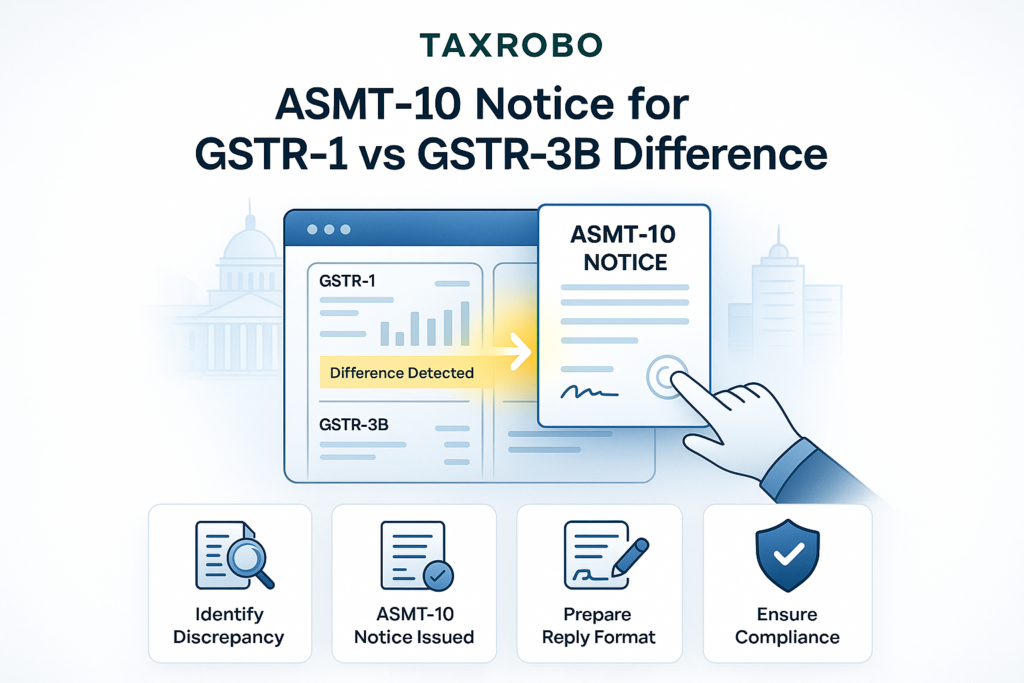
Received a notice from the GST department? Don’t panic. An ASMT-10 notice for a GSTR-1 GSTR-3B turnover difference is one of the most common communications taxpayers receive, often stemming from minor discrepancies that can be easily explained. This notice signifies that the tax authorities’ automated systems have detected a mismatch between the sales you declared in your GSTR-1 return and the sales on which you actually paid tax in your GSTR-3B return for a specific period. While it requires your immediate attention, it is not a demand for tax but rather a request for clarification. This comprehensive blog post will serve as your guide to understanding the notice, performing a thorough reconciliation, and drafting a proper reply using Form ASMT-11 to resolve the issue efficiently. Navigating GST compliance can be tricky, and knowing that professional help is available can simplify the process and ensure you meet all legal requirements without stress.
Understanding the Core of the Mismatch: GSTR-1 vs GSTR-3B
To effectively address a mismatch notice, it is crucial to first understand the distinct roles of Form GSTR-1 and Form GSTR-3B in the GST ecosystem. These two returns serve different purposes, and a clear comprehension of each is the foundation for accurate reconciliation. Any confusion between them is often the root cause of the discrepancies that trigger an ASMT-10 notice. One is a detailed statement of all your sales transactions, while the other is a consolidated summary used for paying your tax dues. The GST system cross-references the data between these two forms to ensure that the tax paid corresponds to the sales declared, and any deviation flags an alert for the tax officer to investigate further. For a detailed walkthrough, see our guide on how to file GSTR-1 & GSTR-3B correctly – Step-by-Step Guide 2025.
What is GSTR-1? Your Statement of Outward Supplies
Form GSTR-1 is a detailed return that a registered taxpayer must file, either monthly or quarterly, to declare all their outward supplies, commonly known as sales. This form captures invoice-level details for business-to-business (B2B) sales, including the recipient’s GSTIN, invoice number, date, value, and applicable tax rates. For business-to-consumer (B2C) sales, it requires a consolidated summary. Crucially, the information you provide in your GSTR-1 is used to populate the GSTR-2A and GSTR-2B of your recipients, allowing them to claim their rightful Input Tax Credit (ITC). Common GSTR-1 turnover issues in India arise from data entry errors, such as reporting an incorrect invoice value, making amendments in a later month without proper tracking, or incorrectly categorizing a supply. Since GSTR-1 is a statement of liability created, it forms the baseline for the tax department’s revenue expectations from your business.
What is GSTR-3B? Your Summary Return and Tax Payment
In contrast, Form GSTR-3B is a monthly self-declaration and a summary return. Its primary purpose is to provide a consolidated overview of your outward supplies, eligible Input Tax Credit, and the final tax liability for the month. Unlike the detailed GSTR-1, GSTR-3B presents summarized figures for sales and ITC. Most importantly, GSTR-3B is the form through which you discharge your GST liability by paying the net tax amount to the government. This is the “payment return.” The tax department compares the total taxable value declared in Table 3.1 of your GSTR-3B with the total taxable value reported across various tables in your GSTR-1. When the GSTR-1 value is higher than the GSTR-3B value, it signals to the department that you may have collected more tax from customers than you have paid to the government, triggering a scrutiny notice.
Top Reasons for a GSTR-1 GSTR-3B turnover difference
A mismatch between these two returns can occur for various legitimate reasons, and understanding them is the first step towards a successful reconciliation. These are not always cases of tax evasion but are often procedural or timing-related issues that can be clarified with proper documentation.
- Clerical Errors: The most frequent cause is simple human error. A data entry mistake, such as adding an extra zero or omitting one, transposing digits in the taxable value or tax amount in either GSTR-1 or GSTR-3B, can create a significant difference.
- Amendments in a Later Period: If you discover an error in an invoice from a previous month (e.g., August), you would correct it by issuing a debit/credit note or amending the invoice in a subsequent month’s GSTR-1 (e.g., September). However, you might forget to make the corresponding tax adjustment in the GSTR-3B of the original or subsequent month, leading to a mismatch.
- Supplies Reported in GSTR-1 but Missed in GSTR-3B: An invoice might be correctly uploaded in GSTR-1, but its value might be inadvertently missed while calculating the consolidated turnover for GSTR-3B tax payment, leading to a shortfall in tax paid.
- Timing Mismatches: An invoice issued on the last day of the month (e.g., 30th September) might be correctly reported in the GSTR-1 for September. However, due to accounting practices, it might be included in the turnover for tax payment in the next month’s GSTR-3B (October), creating a temporary mismatch for September.
- Incorrect Reporting: There can be confusion in classifying supplies. For example, a zero-rated supply might be correctly shown under Table 6A of GSTR-1 but mistakenly included in the taxable supplies table (Table 3.1a) of GSTR-3B, or vice-versa, distorting the comparison of taxable turnover.
A Deep Dive into the ASMT-10 Notice
Receiving a formal communication from the tax department can be intimidating, but understanding the nature and purpose of Form ASMT-10 can alleviate much of the anxiety. It is a procedural tool used by officers to ensure tax compliance through preliminary scrutiny rather than an immediate punitive measure. Knowing how to interpret the notice correctly is essential for formulating an appropriate and effective response that addresses the department’s concerns head-on. This notice is your opportunity to explain your case before any formal demand is created.
What Exactly is Form ASMT-10?
Form ASMT-10 is a scrutiny notice issued by a proper GST officer under Section 61 of the Central Goods and Services Tax (CGST) Act, 2017, read with Rule 99. The officer issues this notice when they find discrepancies in your GST returns during their preliminary review. It is crucial to understand that ASMT-10 is not a demand notice. Instead, it is a formal intimation that flags potential inconsistencies and provides you with an opportunity to explain them. The notice will clearly state the discrepancies observed, such as the GSTR-1 GSTR-3B turnover difference, and will ask you to either provide a satisfactory explanation or pay the differential tax along with any applicable interest and penalty. It is the first step in the scrutiny process, designed to encourage voluntary compliance before resorting to more stringent measures like a show-cause notice or an audit.
How to Read and Understand Your Notice
When you receive an ASMT-10, you must carefully analyze its contents to prepare a precise reply. A typical notice will be structured to provide all the necessary information for you to understand the officer’s query. Pay close attention to the following details:
- The Notice Reference Number (ARN): Every notice has a unique reference number. You must use this number in all future correspondence related to this matter, especially in your reply.
- The specific tax period(s): The notice will clearly mention the month(s) or quarter(s) for which the discrepancy has been identified. This helps you narrow down your reconciliation efforts to the relevant timeframe.
- The exact table or section of the discrepancy: The officer will typically include a table that details the
GSTR-1 vs GSTR-3B comparison India. This table will show the turnover as per GSTR-1, the turnover as per GSTR-3B, and the calculated difference that needs explanation. - The deadline for filing a reply: The notice will specify a date by which you must submit your response, usually within 15 to 30 days. It is vital to adhere to this deadline to avoid adverse action.
Your Action Plan: A Step-by-Step GSTR-3B Reconciliation Guide India
Once you have understood the notice, the next step is to prepare a data-backed response. This involves a meticulous reconciliation of your returns to pinpoint the exact cause of every discrepancy. Following a structured process will ensure that your reply is comprehensive, accurate, and convincing to the tax officer.
Step 1: Download Your Data from the GST Portal
The foundation of a good reconciliation is accurate data sourced directly from the government’s records. You must download all relevant returns from the official GST portal to ensure you are working with the same information as the tax officer.
- First, log in to the official GST Portal.
- Navigate through the dashboard using this path: Services > Returns > Returns Dashboard.
- Select the financial year and the specific return filing period(s) mentioned in your ASMT-10 notice.
- Download the detailed GSTR-1 data (in JSON or Excel format) and the summary GSTR-3B returns (in PDF) for all the relevant months.
Step 2: Compare and Reconcile Month by Month
With all the data at hand, you can begin the reconciliation process. Using a simple spreadsheet program like Microsoft Excel or Google Sheets is highly recommended for this task, as it allows you to organize and analyze the data effectively.
- Create a new spreadsheet and set up a comparison table with the following columns:
| Month | Taxable Value as per GSTR-1 | Taxable Value as per GSTR-3B | Difference (+/-) | Reason for Difference |
|---|---|---|---|---|
| Apr-23 | ₹1,50,000 | ₹1,50,000 | ₹0 | – |
| May-23 | ₹2,10,000 | ₹2,00,000 | ₹10,000 | To be identified |
| Jun-23 | ₹1,85,000 | ₹1,85,000 | ₹0 | – |
- Carefully populate this table by entering the taxable turnover values from the GSTR-1 and GSTR-3B returns you downloaded for each month mentioned in the notice. The “Difference” column will automatically highlight the months that require investigation.
Step 3: Identify the Root Cause of the Mismatch
The final and most critical step is to investigate the “Difference” column. For every month with a non-zero difference, you must dig into your accounting records, invoices, credit/debit notes, and e-way bills to find the exact reason for the discrepancy.
- Match the identified differences with the common reasons listed earlier in this article (clerical errors, timing differences, amendments, etc.).
- For example, if you find a difference of ₹10,000 in May, you might discover an invoice (No. 123) for ₹10,000 was reported in GSTR-1 for May but its tax was paid with the June GSTR-3B.
- Document the precise reason for every single mismatch in the “Reason for Difference” column of your spreadsheet. This sheet will become the primary supporting document for your official reply.
How to Draft the Perfect Reply: The ASMT-10 Notice Format for GSTR-1 India
A well-drafted reply is clear, factual, and supported by evidence. Your goal is to provide the tax officer with a logical explanation that fully addresses their queries and closes the loop on the scrutiny process. The official channel for this is Form ASMT-11.
Understanding Form ASMT-11: Your Official Reply
Form ASMT-11 is the prescribed format for furnishing a reply to a notice issued in Form ASMT-10. This reply must be filed online through the GST Portal. It is essential to file this form within the time limit mentioned in the notice to demonstrate your cooperation and to prevent the officer from proceeding with further action based on the information they have on hand. A timely and well-prepared ASMT-11 can often resolve the matter without any further escalation.
Structuring Your ASMT-11 Reply
Your reply in Form ASMT-11 should be structured logically to make it easy for the officer to understand your position. While filing online, you will have a text box to provide your explanation and an option to upload attachments.
- Introduction: Begin by formally acknowledging the receipt of the ASMT-10 notice. Clearly mention the Notice Reference Number and its date. For example: “With reference to the scrutiny notice issued vide ARN ASMT10-xxxxxxxxxxxxx dated DD/MM/YYYY, we are hereby submitting our point-wise reply and explanation for the discrepancies noted.”
- Reconciliation Summary: Attach the detailed month-wise reconciliation sheet you prepared in the previous step. This provides a clear overview of your findings and shows that you have done a thorough analysis.
- Point-wise Explanation: Address each discrepancy raised by the officer one by one. Your explanation will depend on whether you agree or disagree with the discrepancy.
- Scenario A: If you agree with the discrepancy: If your reconciliation reveals that you have indeed short-paid taxes, accept the difference. State that the differential tax liability, along with applicable interest, has been paid via Form DRC-03. You must provide the ARN (payment reference number) of the DRC-03 challan as proof of payment. For example: “We accept the discrepancy of ₹15,000 in taxable turnover for the month of July 2023. The resultant tax of ₹2,700 plus interest of ₹250 has been paid via Form DRC-03 vide ARN XXXXXXXXXXXXXX.”
- Scenario B: If you do not agree with the discrepancy: Provide a clear, detailed justification supported by facts and evidence. For example: “The difference of ₹50,000 in turnover for August 2023 is due to a credit note (No. CN-045) issued in the same month. This was correctly reported by reducing turnover in GSTR-1, and the same was netted off from the total turnover reported in Table 3.1(a) of GSTR-3B, as per GST rules. A copy of the credit note is attached for your reference.”
- Supporting Documents: Always attach relevant supporting documents to substantiate your claims. These can include:
- Your detailed reconciliation worksheet.
- Copies of specific invoices, credit notes, or debit notes.
- The payment challan for Form DRC-03, if applicable.
- Relevant extracts from your accounting records or bank statements.
What Happens After You File Your Reply?
After you have successfully filed your reply in Form ASMT-11, the tax officer will review your explanation and the attached documents. The outcome will depend on how satisfied they are with your response.
Scenario 1: The Officer is Satisfied
If your explanation is found to be satisfactory and all the discrepancies have been adequately explained or the short-paid tax has been duly paid, the proceedings are concluded. The officer will issue an order in Form ASMT-12, formally accepting your reply and informing you that the notice is being dropped. This is the ideal outcome and marks the closure of the scrutiny for that period.
Scenario 2: The Officer is Not Satisfied
If the officer finds your reply to be inadequate, unconvincing, or incorrect, they are not bound to accept it. In such a case, they may proceed with further action under the GST law. This could involve initiating proceedings under Section 73 (for non-fraud cases) or Section 74 (for fraud cases) by issuing a detailed show-cause notice (SCN). The SCN will demand why the tax, along with interest and penalty, should not be recovered from you. If you receive one, it’s important to understand how to respond to a GST Show Cause Notice: A Step-by-Step Guide. This underscores the critical importance of preparing a thorough, accurate, and well-documented reply in the first instance.
Conclusion: Proactive Reconciliation is Key
An ASMT-10 notice for a GSTR-1 GSTR-3B turnover difference is a common compliance check and should be treated with seriousness but not alarm. When handled correctly, it can be resolved smoothly. The key lies in a systematic approach: meticulously download and reconcile your data, identify the root cause of every mismatch, and draft a clear, factual reply in Form ASMT-11 with strong supporting documents. By being proactive and maintaining good records, you can address the department’s queries effectively and ensure your business remains compliant. This highlights the importance of accurate record-keeping to prevent GST demand notices. Regular monthly reconciliation between GSTR-1, GSTR-3B, and your books of accounts is the best practice to avoid such notices altogether.
Navigating GST notices can be complex, requiring a deep understanding of GST law and procedures. If you need expert assistance in reconciling your data and drafting a professional reply to the GST department, TaxRobo’s team of GST experts is here to help. Contact us today to ensure your business remains 100% compliant.
Frequently Asked Questions (FAQ)
1. What is the time limit to reply to an ASMT-10 notice?
The time limit to file a reply is always specified in the notice itself. Typically, a taxpayer is given 15 to 30 days from the date of receipt of the notice to submit their explanation in Form ASMT-11. It is crucial to adhere to this deadline to avoid any adverse actions.
2. What happens if I ignore an ASMT-10 notice?
Ignoring an ASMT-10 notice is highly inadvisable. If you fail to furnish a reply within the stipulated time, the tax officer may proceed with the assumption that you have accepted the discrepancies. They can then initiate action to recover the tax, interest, and penalty under Section 73 or 74 of the CGST Act by issuing a show-cause notice and a formal demand order.
3. What is Form DRC-03 and when should I use it?
Form DRC-03 is a voluntary tax payment challan. You should use this form to pay any tax, interest, or penalty that you find is payable during your reconciliation process after receiving the ASMT-10 notice. If you agree with a discrepancy raised by the officer and accept a short payment of tax, you must pay the amount using DRC-03 and mention its payment reference number (ARN) in your ASMT-11 reply.
4. Can I make corrections in my GSTR-1 or GSTR-3B for a past period?
No, you cannot revise any GST return once it has been filed. For any errors or omissions in a past GSTR-1, you can make corrections or report missed invoices through amendments in the GSTR-1 of a subsequent tax period. However, if a discrepancy related to tax payment in GSTR-3B is pointed out by an officer, the differential tax must be paid using Form DRC-03, not by adjusting it in a future GSTR-3B.