
A Complete Guide to Handling a GST Notice for RWA Maintenance Charges
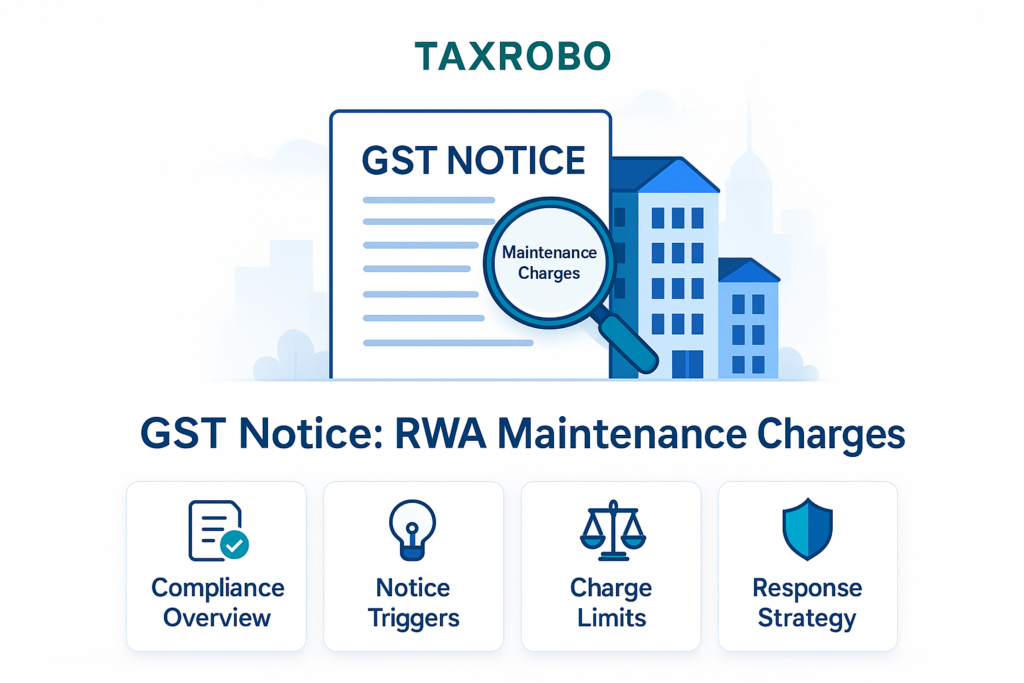
The RWA treasurer opens an official-looking envelope, only to find a notice from the GST department. It’s a situation causing stress and confusion for many Resident Welfare Associations (RWAs) and apartment associations across the country. Many RWAs are facing increased scrutiny regarding their financial collections, leading to uncertainty and the risk of significant penalties. The core of this issue often revolves around the maintenance charges limit issues India. Understanding the regulations is no longer optional; it’s a necessity for every committee member and resident. This guide is designed to demystify the rules for a GST notice RWA maintenance charges, explaining why your association falls under the GST net, clarifying the exemption limits that cause the most trouble, and providing a clear, step-by-step plan on how to respond to a notice effectively. Our goal is to empower you with the knowledge needed to navigate this complex area and ensure long-term apartment complex GST compliance India.
Understanding Why Your RWA Falls Under GST
Many RWA members are often surprised to learn that their non-profit, member-driven association is subject to Goods and Services Tax (GST). This classification stems from how the GST law defines a “taxable event.” The core principles are the concept of ‘supply of services’ and specific monetary thresholds that, once crossed, bring the RWA into the GST framework. It’s not about being a commercial entity; it’s about the nature of the transactions between the RWA and its members. Understanding these two pillars—the service definition and the financial limits—is the first step toward demystifying your GST obligations and preventing future compliance issues. Failing to grasp these fundamentals is often the primary reason RWAs receive notices from the tax authorities. For a general overview of the topic, you can read more about GST on Housing Societies.
The ‘Supply of Services’ Concept for Apartment Associations
Under the GST Act, the relationship between an RWA and its members is not merely a collective pooling of funds; it is legally defined as a business transaction. The RWA provides a bundle of services—such as common area lighting, security, lift maintenance, cleaning, and upkeep of shared amenities—to its members. In return, the members pay a regular maintenance fee. This exchange of services for a consideration (the maintenance fee) squarely fits the definition of a “supply of services.” Because of this, the RWA is treated as a service provider and its members as service recipients. This fundamental concept is what makes an RWA’s activities potentially taxable, moving it from a simple residents’ collective to an entity with formal tax obligations, provided it meets the necessary financial criteria.
The Two Key Thresholds for GST Applicability
For an RWA to be liable for GST, it must cross two distinct thresholds. The first and most critical is the Aggregate Turnover Threshold. An RWA is required to register for GST if its total annual collections from all sources combined exceed ₹20 lakh in a financial year (this limit is ₹10 lakh for special category states). This ‘aggregate turnover’ is comprehensive and includes not just monthly maintenance charges but also corpus fund contributions, sinking fund payments, charges for events, income from renting out community halls, and any other revenue. If your RWA’s total annual income is below this limit, you are not required to register for GST, regardless of the individual maintenance charges.
The second is the Maintenance Charge Exemption Threshold, which applies only after the RWA has crossed the ₹20 lakh turnover limit and is registered for GST. This secondary condition, which is a common source of confusion and leads to many GST notice for RWA apartment association India cases, dictates whether GST is levied on the individual member’s contribution. We will explore this specific rule in detail in the next section. For the most current threshold limits, it is always advisable to consult the official GST portal.
The Core Issue: Decoding the RWA Maintenance Charges Limits India
The heart of most GST-related issues for housing societies lies in the specific exemption limit for monthly maintenance contributions. While the ₹20 lakh turnover rule determines if an RWA needs to register for GST, the ₹7,500 rule determines how GST is applied to individual members’ payments once the RWA is registered. This nuance is frequently misunderstood, leading to incorrect calculations, underpayment of taxes, and ultimately, the issuance of a GST notice RWA maintenance charges. This rule is not a simple deduction; it’s a conditional exemption that, if breached, has significant consequences on the entire contribution amount. Clarifying this point is essential for any RWA committee aiming for accurate billing and full compliance.
The ₹7,500 Per Month Exemption Rule Explained
The Central Board of Indirect Taxes and Customs (CBIC) has clarified the exemption rule for RWAs. If the monthly maintenance charge collected per member (per residential unit) is up to ₹7,500, that amount is exempt from GST. However, the most critical part of this rule—and the most common misconception—is what happens when the charge exceeds this limit. If the maintenance charge for a member is more than ₹7,500 per month (e.g., ₹9,000), then GST at 18% is applicable on the entire amount, not just the portion exceeding ₹7,500. This “all or nothing” application is one of the most significant issues with maintenance charges limits India and a frequent cause for notices.
Here’s a clear breakdown:
| Monthly Maintenance Per Member | Is the Amount Above ₹7,500? | GST Applicable? | Taxable Amount for GST Calculation | Total Bill for Member |
|---|---|---|---|---|
| ₹7,000 | No | No | ₹0 | ₹7,000 |
| ₹7,500 | No | No | ₹0 | ₹7,500 |
| ₹9,000 | Yes | Yes | ₹9,000 (Entire Amount) | ₹10,620 (₹9000 + 18% GST) |
| ₹12,000 | Yes | Yes | ₹12,000 (Entire Amount) | ₹14,160 (₹12000 + 18% GST) |
As you can see, crossing the threshold by even a single rupee makes the entire contribution taxable.
What is Included in Maintenance Charges for GST Calculation?
To correctly apply the ₹7,500 limit, it’s vital to know what constitutes “maintenance charges.” Generally, any amount collected for the provision of common services and amenities is included. These typically cover:
- Common Area Expenses: Electricity for common areas, water charges for common purposes.
- Services: Security agency fees, housekeeping and cleaning services.
- Upkeep: Lift maintenance contracts, water pump operations, gardening.
- Administrative Costs: Society manager’s salary, accounting fees.
- Collective Funds: Contributions towards society events or general repair funds.
However, certain charges collected by the RWA on behalf of individual members, acting purely as an agent, may be excluded. For instance, municipal property tax or electricity bills for individual flats that are routed through the RWA are treated as reimbursements and are not part of the maintenance charge calculation, provided they are billed separately and shown distinctly in the invoice as “reimbursements.”
How to Respond to a GST Notice RWA Maintenance Charges
Receiving a formal notice from the GST department can be intimidating for any RWA management committee, which often comprises volunteers. However, a structured and timely response can resolve the issue efficiently. The key is to approach the situation methodically, backed by accurate financial data and a clear understanding of the GST regulations discussed earlier. Ignoring the notice is not an option, as it can lead to more severe consequences, including ex-parte orders and heavy penalties. For detailed instructions on drafting your reply, our guide on How to Respond to a GST Show Cause Notice: A Step-by-Step Guide is an essential resource. The following steps provide a roadmap for navigating the process and ensuring a proper RWA maintenance issues resolution in India.
Step 1: Don’t Panic – Read and Understand the Notice
The first and most important step is to avoid panic. Carefully read the entire notice, which is often a Show Cause Notice (SCN), and identify the key details. Look for the issuing authority, the unique notice number or SCN number, the financial period under review, and most importantly, the specific reason or allegation mentioned. The notice will clearly state why it has been issued—it could be for failure to obtain GST registration despite crossing the turnover threshold, incorrect application of the ₹7,500 exemption, non-payment or short payment of tax, or discrepancies between filed returns and bank records. Note the deadline for submission of your reply, as adhering to this timeline is critical. A thorough understanding of these details is the foundation for a successful resolution.
Step 3: Collate All Financial Records
Once you understand the scope of the notice, your next task is to gather all the necessary financial documents for the period in question. Your response must be supported by evidence, and having organized records is crucial. The essential documents you will need to collect include:
- Annual Financial Statements: The RWA’s Balance Sheets and Profit & Loss (or Income & Expenditure) accounts for the relevant financial years.
- Bank Statements: Complete bank statements for all accounts held by the RWA during that period.
- Member Ledgers: A detailed ledger showing month-wise collections from each member. This is vital for verifying the ₹7,500 exemption rule.
- Invoices and Receipts: Copies of all invoices or receipts issued to members for maintenance and other charges.
- Expense Vouchers: Records of major expenses on which Input Tax Credit (ITC) might be applicable, such as security agency bills or repair contracts.
Step 3: Reconcile Your Data Against GST Rules
With all the documents in hand, you must perform a thorough internal audit to verify the claims made in the notice. This reconciliation should be done on two levels. First, conduct a Turnover Check by calculating the RWA’s total aggregate turnover for each financial year mentioned in the notice. Add up all income sources—maintenance, corpus funds, event charges, etc.—and check if the total crossed the ₹20 lakh threshold. Second, perform an Exemption Check. If your turnover did cross the threshold, review your member-wise collection ledgers for each month. Identify every instance where a member’s monthly contribution exceeded ₹7,500. For all such cases, verify if GST at 18% was collected on the full amount and subsequently paid to the government. This detailed reconciliation will reveal any gaps in your compliance and form the factual basis of your reply.
Step 4: Draft a Factual and Professional Reply
Your formal reply to the GST notice must be professional, factual, and address every single point raised by the tax officer. It is best to structure it as a point-by-point rebuttal to the allegations in the SCN. Begin by acknowledging the notice and then systematically present your case, supported by the data you reconciled in the previous step. Attach all relevant documents like financial statements, reconciliation worksheets, and sample invoices as clearly labeled annexures. Be honest and transparent; if a mistake was made, acknowledge it and state your intention to rectify it by paying the due tax and interest. Drafting a legal response can be complex, and the RWA GST notice effects India can be serious if handled incorrectly. Connect with TaxRobo’s GST experts to ensure your reply is accurate, comprehensive, and protects your RWA’s interests.
Proactive Measures for Apartment Complex GST Compliance India
Handling a GST notice is a reactive process, but the best strategy for any RWA is to be proactive. Establishing robust financial practices and maintaining a clear understanding of tax obligations can prevent such notices from ever being issued. Good governance in an apartment complex is not just about clean common areas and functioning lifts; it also involves sound financial management and legal compliance. By implementing a few key measures, your RWA can build a strong compliance framework that minimizes tax risks, ensures transparency for members, and avoids unnecessary penalties and legal hassles down the line.
Maintain Meticulous Records
The foundation of good compliance is meticulous record-keeping. Your RWA’s accounting practices must be clear, transparent, and segregated. Instead of pooling all collections into a single account, maintain separate ledgers for different types of income, such as monthly maintenance charges, corpus or sinking fund contributions, and reimbursements for member-specific utilities. This segregation makes it significantly easier to calculate the aggregate turnover accurately and apply the ₹7,500 exemption rule correctly. Using reliable accounting software can automate this process, reduce human error, and ensure that all financial data is readily available for audits or in case of any query from the tax department.
Understand Input Tax Credit (ITC)
A significant benefit for RWAs registered under GST is the ability to claim Input Tax Credit (ITC), a topic covered extensively in our GST Input Tax Credit (ITC) Full Guide 2025 – Eligibility, Limits & Common Issues. This means your RWA can reduce its final GST liability by claiming credit for the GST it has paid on its own expenses (inputs). For example, if your RWA pays GST on bills from security agencies, housekeeping contractors, or for the purchase of capital goods like a new water pump or generator, this GST amount can be set off against the GST collected from members. This effectively lowers the tax burden. To claim ITC, you must have valid tax invoices for your expenses, and your suppliers must have filed their GST returns correctly. Understanding and properly utilizing ITC is a crucial aspect of managing your RWA’s finances efficiently under the GST regime.
Issue GST-Compliant Invoices
Once your RWA is registered for GST, it is mandatory to issue proper tax invoices to its members for the maintenance charges collected. These invoices must adhere to the format prescribed under the GST law. A GST-compliant invoice should clearly display details like the RWA’s GSTIN, the member’s name and address, the invoice number and date, the SAC (Services Accounting Code) for the services provided, and a clear breakdown of the taxable value, the GST rate (CGST and SGST), and the total amount due. Issuing proper invoices is not just a legal requirement; it also promotes transparency with your members and serves as a primary document for your financial records. This practice is a cornerstone of the apartment association GST notice guidelines.
Conclusion
Navigating the complexities of GST can be challenging for a Resident Welfare Association, but it is not an insurmountable task. The key to compliance lies in understanding the two fundamental thresholds: the ₹20 lakh annual turnover limit for mandatory registration and the ₹7,500 monthly maintenance contribution limit for exemption. A calm, data-backed, and timely response is the key to handling a GST notice RWA maintenance charges. However, the most effective approach is always proactive compliance rather than reactive clarification after receiving a notice. By maintaining clear records, issuing proper invoices, and understanding the nuances of GST and Input Tax Credit, your RWA can ensure smooth operations and financial peace of mind.
Don’t let GST notices disrupt your community’s harmony. From initial registration and monthly filings to expert handling of departmental notices, TaxRobo provides end-to-end GST solutions tailored for RWAs and apartment associations. Schedule a free consultation with our experts today!
Frequently Asked Questions (FAQs)
1. Is GST applicable on one-time payments like the sinking fund or corpus fund collected by the RWA?
Yes, absolutely. All contributions received by the RWA, whether they are recurring maintenance charges or one-time payments like a sinking fund, corpus fund, or repair fund, are included in the calculation of the “aggregate turnover.” If the RWA’s total turnover, including these one-time collections, exceeds the ₹20 lakh threshold in a financial year, it becomes liable for GST registration. Once registered, these contributions are also subject to GST.
2. Our RWA’s total turnover is less than ₹20 lakh, but a few members pay over ₹7,500/month. Do we need to register for GST?
No. The primary condition for GST registration is the aggregate turnover threshold. GST registration is mandatory only if the total annual turnover exceeds ₹20 lakh. If your RWA’s total annual collections from all sources are below this limit, you are not required to register for GST. In this scenario, the ₹7,500 per member exemption limit is irrelevant, as your RWA is outside the GST net entirely.
3. What are the penalties for not complying with apartment association GST notice guidelines?
Non-compliance can lead to significant financial penalties. The penalties can be severe and may include the full tax amount that was due from the date it was originally payable, interest calculated on the delayed tax payment (currently 18% per annum), and an additional penalty that can be as high as 100% of the tax amount itself. Prompt and correct action is crucial to minimize these liabilities.
4. Can our RWA claim Input Tax Credit (ITC) on capital goods like a new water pump or generator?
Yes. If the RWA is registered under GST, it is eligible to claim Input Tax Credit (ITC) on capital goods, such as a new generator set, water pump, or elevator, provided these goods are used for the purpose of providing services to its members. The claim is subject to standard ITC rules and conditions, such as possessing a valid tax invoice and the supplier having paid the tax to the government. This helps reduce the overall cost burden on the RWA.