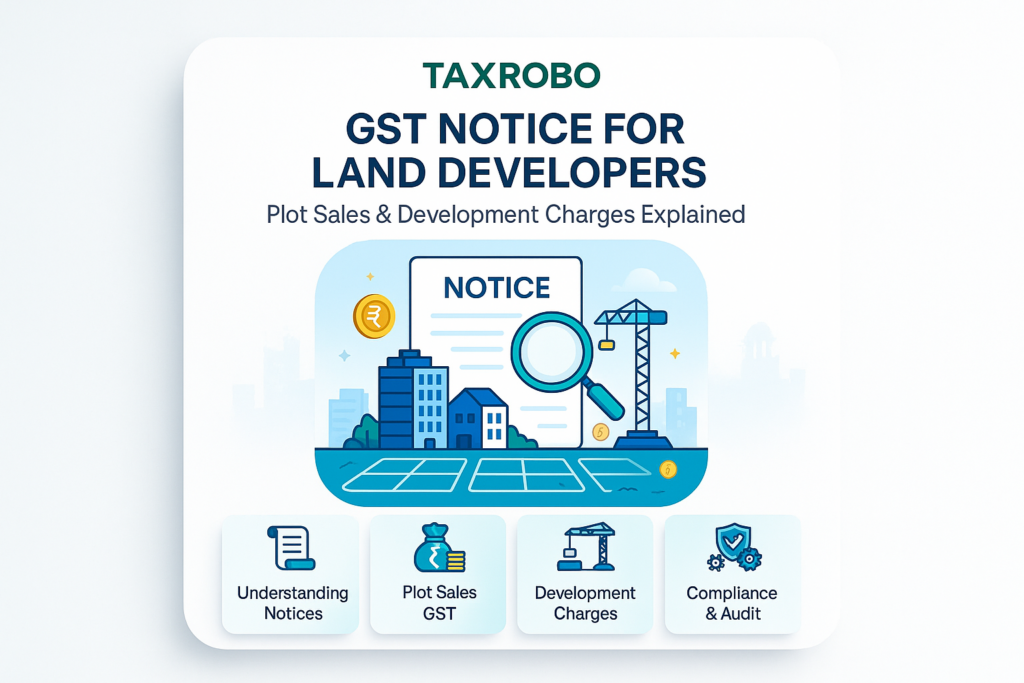

GST Notice for Land Developers – Plot Sales & Development Charges Explained
Are you developing and selling plots of land in India? While the profit potential is high, a single mistake in tax compliance can lead to a dreaded GST notice for land developers. This common issue stems from a widespread confusion surrounding the Goods and Services Tax (GST) and its application to real estate transactions. Many developers incorrectly assume that since the sale of land is exempt from GST, all related activities are also tax-free. This misunderstanding can lead to significant financial penalties and legal complications. This article will provide a clear breakdown of land development tax guidelines India, explaining exactly when GST is applicable, how it should be calculated on development charges, and what your action plan should be if you receive a notice from the tax authorities. This guide is designed to help you ensure complete plot sales GST compliance and navigate the complexities of real estate taxation with confidence.
Understanding the Core Rule: Is GST Applicable on the Sale of Land?
To effectively navigate understanding land GST regulations India, it’s crucial to start with the foundational rule. The core principle is straightforward: the sale of land, in its basic form, is not subject to GST. This is explicitly stated in Schedule III of the Central Goods and Services Tax (CGST) Act, 2017. This schedule lists activities or transactions which shall be treated neither as a supply of goods nor a supply of services. “Sale of land” and, subject to certain conditions, “sale of building” are included in this list.
Therefore, if you are simply selling a piece of undeveloped, raw land without any improvements, the transaction is completely outside the purview of GST. You are not required to charge or pay GST on the value of the land itself. However, this is where the simplicity ends and the complexity begins. The critical distinction that every developer must understand is that this exemption applies only to the sale of the land itself. It does not extend to any services rendered to develop that land, make it habitable, or increase its value before the sale. Any activity that enhances the land beyond its original state is likely a taxable service, which is the primary reason developers receive GST notices. For official reference, you can consult the CGST Act on the CBIC website.
GST on Land Development Charges India: The Taxable Component
The most common point of confusion for real estate developers revolves around the taxability of development activities. While the plot of land is exempt, the services provided to transform it into a developed plot are not. These services, collectively known as land development charges India, are fully taxable under GST. The government views these activities as a distinct supply of service, separate from the land sale, and this is where compliance becomes paramount for all GST for real estate developers India.
What Qualifies as “Land Development Charges”?
Land development involves a range of activities that make a plot of land suitable for construction and living. These are considered taxable services because the developer is providing value-added services to the buyer. Common examples include:
- Levelling and Demarcation: Preparing the land by levelling uneven surfaces and clearly marking the boundaries of each individual plot.
- Internal Infrastructure: Construction of essential access routes like internal roads, pathways, and culverts within the layout.
- Utilities and Services: Laying down fundamental utility lines such as drainage, sewerage systems, water pipelines, and electrical cabling.
- Common Amenities: Developing shared facilities that enhance the value and usability of the plotted development, such as parks, gardens, streetlights, overhead water tanks, and security infrastructure like boundary walls and gates.
Why are These Services Taxable?
From a GST perspective, all the activities listed above are classified as “construction services” or “works contracts.” When a developer undertakes this work, they are not merely selling land; they are providing a comprehensive service to the plot buyer. This service of developing the land is a taxable supply under GST law. The consideration (payment) received for these activities is therefore subject to GST, even if it’s collected as part of a consolidated sale price. The law sees two distinct transactions: an exempt sale of land and a taxable supply of development services. Failing to recognize and correctly tax this service component is a primary trigger for GST notices.
Current GST Rate and Calculation
The services related to land development currently attract a GST rate of 18%. To ensure compliance, developers must clearly bifurcate the total price into the cost of land and the cost of development services.
Here is a simple, clear example of how the calculation works:
- Cost of Undivided Share of Land: ₹15,00,000 (This portion is Exempt from GST)
- Development Charges: ₹3,00,000 (This portion is Taxable)
- GST Payable: 18% of ₹3,00,000 = ₹54,000
- Total Cost to Buyer: ₹15,00,000 (Land) + ₹3,00,000 (Development) + ₹54,000 (GST) = ₹18,54,000
This clear separation in invoicing and agreements is the cornerstone of transparent and compliant land transactions.
Received a GST Notice for Land Developers? Here’s Your Action Plan
Receiving a notice from the tax department can be unsettling, but a calm and structured approach is the best way forward. Understanding why you might have received a GST notice for land developers is the first step toward resolving it effectively.
Common Triggers for a GST Notice
Notices are not random; they are typically triggered by specific compliance gaps detected by the GST authorities. The most common reasons include:
- Failure to Register for GST: Many developers mistakenly believe they don’t need to register if they only sell land. However, if your annual turnover from taxable development services crosses the threshold of ₹20 lakhs (or ₹10 lakhs for special category states), GST registration becomes mandatory.
- Consolidated Pricing: Charging buyers a single, all-inclusive price for a developed plot without clearly separating the exempt land value and the taxable development charges. This is a major red flag for tax officers, who may then deem the entire amount taxable.
- Data Mismatches: Discrepancies between the turnover declared in your GSTR-1 (outward supplies) and GSTR-3B (summary return and tax payment) filings.
- Incorrect ITC Claims: Improperly claiming Input Tax Credit on goods or services that were not used for providing taxable development services.
How to Respond Effectively
If you find yourself with a notice, follow these steps methodically:
- Step 1: Analyze the Notice Thoroughly: Do not panic. Read the notice carefully to understand the exact reason it was issued. Note the deadline for response, the specific discrepancies pointed out by the tax officer, and the documents requested.
- Step 2: Collate Your Documents: Gather all relevant paperwork to build your case. This includes sale agreements (which hopefully show a clear bifurcation of costs), tax invoices issued for development charges, bank statements showing receipt of payments, and copies of your GST returns.
- Step 3: Prepare a Detailed Reply: Draft a formal, point-by-point reply addressing each query raised in the notice. Your response should be clear, concise, and supported by the documentary evidence you have collected. Explain your business model and the basis for your GST calculations.
- Step 4: Seek Professional Guidance: Navigating land taxation rules India and responding to departmental notices can be complex. It is highly advisable to consult a tax professional. An expert from TaxRobo’s Online CA Consultation Service can help you draft an accurate and legally sound response, represent you before the authorities, and ensure your interests are protected.
Best Practices for Proactive Plot Sales GST Compliance
The best way to handle a GST notice is to avoid receiving one in the first place. Adopting a proactive approach to plot sales GST compliance will save you time, money, and stress in the long run.
Structure Your Sale Agreements Correctly
Your sale agreement is the most critical legal document in the transaction. Ensure it is drafted with tax compliance in mind. The agreement must have two distinct and clearly defined parts:
- Part A: The value of the undivided share of land being sold. This section should explicitly state that this amount is for the sale of immovable property and is exempt from GST.
- Part B: The value of development services being provided. This section should detail the scope of development work and state that this amount is subject to GST at the applicable rate.
Maintain Meticulous Invoicing and Records
Proper documentation is your best defense. For every plot sold, issue a proper tax invoice for the development charges component. This invoice must show the GST amount separately and include your GSTIN. Maintain a clear ledger that distinguishes between receipts for land and receipts for development services. These clean records are invaluable during any departmental scrutiny or audit.
Understand Input Tax Credit (ITC)
One of the benefits of being a registered taxpayer is the ability to claim Input Tax Credit (ITC). As a developer providing taxable development services, you can claim ITC on the GST you pay for inputs. This includes GST paid on raw materials (like cement, steel, pipes), contractor services, professional fees, and capital goods (like construction machinery). Claiming legitimate ITC reduces your final GST cash outflow, making your business more efficient. Keep accurate records of all purchases to substantiate your ITC claims.
Conclusion
The landscape of real estate taxation in India can seem daunting, but the rules regarding GST on plotted developments are clear once understood. The key takeaway is simple: the sale of land is exempt, but development services are taxable at 18%. The non-negotiable pillars of compliance are clear documentation, proper bifurcation of costs in all agreements and invoices, and timely GST filings. By embracing these principles, you can operate your business smoothly and effectively. Proactive compliance is, without a doubt, the best defence against receiving a GST notice for land developers.
Feeling overwhelmed by the GST implications for plot sales? Don’t leave your business vulnerable to compliance risks. Partner with TaxRobo’s experts for end-to-end GST consultation, registration, and filing. Contact us today for a hassle-free experience!
Frequently Asked Questions (FAQs)
Q1. What is the GST registration threshold for a land developer?
A: GST registration is mandatory if your annual aggregate turnover from taxable services (i.e., development charges) exceeds ₹20 lakhs (₹10 lakhs for special category states). The value of the exempt land sale is not included when calculating this turnover threshold.
Q2. I sold a single plot from my family’s agricultural land. Do I owe GST?
A: If you sold a simple plot of land without providing any development services (like levelling, roads, drainage, etc.), the transaction is considered a “sale of land” and is exempt from GST. No GST is payable in this case.
Q3. Can I charge a single all-inclusive price for a developed plot?
A: This is highly inadvisable and a major compliance risk. If the value of land and development services is not clearly split, tax authorities have the right to treat the entire transaction as a composite supply where the principal supply is development. In such a scenario, they could levy GST on the total sale value, leading to significant tax liabilities, interest, and penalties.
Q4. Can I claim ITC on the machinery purchased for levelling the land?
A: Yes. If you are a registered taxpayer providing taxable land development services, you are eligible to claim Input Tax Credit (ITC) on the GST paid for capital goods (like earth-moving machinery) and input services (like architect or contractor fees) that are used exclusively for carrying out the taxable development work.