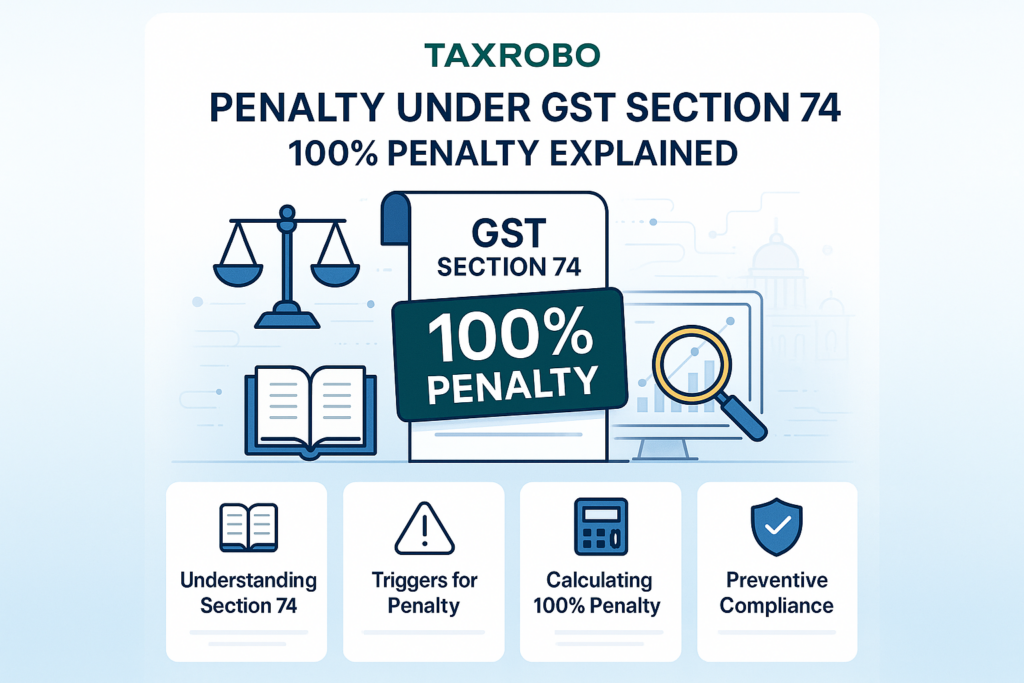

Penalty Under GST Section 74 – 100% Penalty Explained
Introduction: The GST Notice That Every Business Dreads
Imagine this: after a long day of managing operations, you open an email from the GST department. The subject line mentions a “Show Cause Notice,” and as you read through the technical jargon, words like “fraud,” “suppression of facts,” and a staggering penalty demand jump out at you. This is a scenario that sends a chill down the spine of even the most diligent business owner. While Goods and Services Tax (GST) compliance is a fundamental part of running a business in India, the law makes a sharp distinction between genuine human errors and deliberate attempts to evade tax. This is precisely where Section 74 of the CGST Act comes into play, a provision that deals with the most severe non-compliance. This article is your comprehensive guide to demystifying the stringent 100% penalty under GST Section 74, helping you understand what triggers it, its severe financial consequences, and most importantly, the strategies available to mitigate the damage. This deep dive into GST penalties explained India is essential reading for every entrepreneur and finance manager aiming to safeguard their business from crippling financial liabilities.
Understanding the Difference: GST Section 73 vs. Section 74
To truly grasp the gravity of a Section 74 notice, it is crucial to understand its counterpart, Section 73. The GST law deliberately separates cases based on the taxpayer’s intent. This distinction is the single most important factor that determines the amount of penalty levied and the course of legal proceedings. Knowing where your case falls can mean the difference between a manageable penalty and a devastating financial blow.
Section 73: For Non-Fraudulent Cases
Section 73 of the CGST Act is applied in situations where tax has been short-paid, not paid, erroneously refunded, or where Input Tax Credit (ITC) has been wrongly availed or utilized for reasons other than fraud, willful misstatement, or suppression of facts. Think of this as the provision for honest mistakes—a calculation error, a misunderstanding of a new notification, or an incorrect HSN code applied without any intention to deceive the government. Because the element of deliberate evasion is absent, the penalties are significantly more lenient. You can read a detailed guide on Understanding Section 73 of the CGST Act: Handling GST Demand Notices Without Fraud. The penalty under Section 73 is capped at 10% of the tax amount due or ₹10,000, whichever is higher. This section provides taxpayers with an opportunity to correct their errors without facing punitive measures meant for tax evaders.
Section 74: When Tax Evasion is Deliberate
This is where the gloves come off. The penalty under GST Section 74 India is specifically invoked when the tax authorities have reason to believe that tax evasion was intentional. This section is triggered by actions that demonstrate a clear intent to defraud the exchequer. The key ingredients for invoking Section 74 are:
- Fraud: This involves intentional deception to secure an unlawful financial gain. For example, creating fake invoices to claim ITC that you are not entitled to.
- Willful Misstatement: This means knowingly providing incorrect information or false statements in your GST returns or other documentation. An example would be deliberately declaring a lower sales value than what was actually collected.
- Suppression of Facts: This refers to the act of intentionally hiding or not disclosing material information that you are legally required to furnish to the tax authorities. A classic case is not reporting cash sales to lower your turnover and corresponding tax liability.
When the tax department invokes Section 74, they are alleging that you didn’t just make a mistake; you actively tried to cheat the system. Consequently, the burden of proof is high on the department, but if proven, the penalties are equally severe.
Decoding the 100% Penalty Under GST Section 74
Receiving a notice under this section is a serious matter, and understanding the full financial implications is the first step toward formulating a response. The term “100% penalty” is not a scare tactic; it is a literal and legally enforceable provision that can double your liability to the government overnight. For any business, especially small and medium-sized enterprises, such a penalty can have crippling financial consequences.
What “100% Penalty” Actually Means
The provision is straightforward and harsh: the penalty levied is equal to 100% of the tax amount that was evaded. This penalty is over and above the actual tax due and the interest applicable on the delayed payment. This is a critical point in understanding GST 100% penalty—you are not just paying what you owed; you are paying that amount again as a punishment.
Let’s use a simple example:
Suppose a business deliberately suppressed cash sales in its returns and, as a result, evaded paying GST amounting to ₹2,00,000. The GST officer investigates, proves the suppression, and issues an order under Section 74.
- Tax Due: ₹2,00,000
- Penalty Under Section 74: 100% of the tax due = ₹2,00,000
- Interest: Applicable interest (currently 18% per annum) on the tax amount from the due date until the date of payment.
The total immediate liability for the business (excluding interest) would be ₹4,00,000. This demonstrates how quickly the financial burden can double, severely impacting cash flow and business viability.
The Legal Process: From Notice to Order
The GST officer doesn’t just impose the penalty arbitrarily. There is a defined legal process that must be followed, which also provides the taxpayer with an opportunity to present their case.
- Show Cause Notice (SCN) in Form DRC-01: This is the formal beginning of the proceedings. The officer issues an SCN detailing the grounds for the proposed tax demand, the specific facts of the case, and the calculation of the tax, interest, and proposed 100% penalty. Learning How to Respond to a GST Show Cause Notice: A Step-by-Step Guide is crucial at this stage.
- Opportunity for Representation: After receiving the SCN, you are given a specific timeframe (usually 30 days) to file a reply. This is your chance to contest the allegations, submit documentary evidence, and present your legal arguments against the notice.
- Final Order in Form DRC-07: After considering your reply and providing a personal hearing if requested, the officer will issue a final order. If the officer is not convinced by your arguments, this order will confirm the demand for the tax, applicable interest, and the full penalty amount.
Is It Possible to Reduce the GST Section 74 Penalty?
While the prospect of a 100% penalty is daunting, the GST law provides a silver lining. The government’s primary objective is tax collection, not just punishment. Therefore, Section 74 includes built-in incentives for taxpayers to come clean and pay their dues early in the process. Acting swiftly upon receiving a notice can dramatically reduce the financial impacts of GST penalties in India.
Your Window of Opportunity: The Penalty Reduction Structure
The law offers a structured, time-based mechanism for penalty reduction. The earlier you pay the tax and interest, the lower the penalty you will have to bear. This structure provides clear windows of opportunity for businesses to cut their losses.
| Stage of Payment | Penalty Amount Payable |
|---|---|
| Voluntarily pay tax + interest before the Show Cause Notice (SCN) is issued. | 15% of the tax amount |
| Pay tax + interest within 30 days of the SCN being issued. | 25% of the tax amount |
| Pay tax + interest within 30 days of the final order being passed. | 50% of the tax amount |
| Payment made after 30 days of the final order. | 100% of the tax amount |
This table clearly shows that proactive and timely compliance, even after a lapse has been pointed out, can save you a significant amount of money. Waiting until the final order is passed doubles the penalty from 25% to 50%, and delaying further makes the full 100% penalty mandatory.
Why Professional Guidance is Non-Negotiable
Navigating a Section 74 proceeding is not a DIY task. The allegations are serious, the legal language is complex, and the stakes are incredibly high. Drafting a legally sound and factually robust reply to a Show Cause Notice requires deep expertise in GST law and precedents. A qualified tax professional can analyze the notice, gather the necessary evidence, build a strong defence, and argue your case effectively. More importantly, they can provide strategic advice on whether it’s better to fight the case or to utilize the penalty reduction options by paying the dues at the right time. Engaging an expert is an investment that can save you multiples of its cost in penalties.
Common Mistakes Leading to Section 74 Penalties for Businesses
Understanding the theory is one thing, but seeing how these provisions apply in the real world makes the risks more tangible. Here are some common scenarios where GST Section 74 penalties for businesses are often invoked.
Case Scenario 1: Willful ITC Mismatch
A manufacturing company, ABC Pvt. Ltd., is looking to reduce its GST outflow. They get in touch with a dubious operator who provides them with invoices for raw materials worth ₹10 lakhs (with ₹1.8 lakhs in GST) without actually supplying any goods. ABC Pvt. Ltd. uses these fake invoices to claim an Input Tax Credit of ₹1.8 lakhs in their GSTR-3B. During a data analytics-driven audit, the GST department discovers that the supplier is a shell entity that has not filed returns or paid any tax. Since ABC Pvt. Ltd. knowingly used fraudulent documents to evade tax, the department issues an SCN under Section 74 demanding the reversal of ITC (₹1.8 lakhs), interest, and a 100% penalty (₹1.8 lakhs). Such cases often lead to strict judicial action, and it is important to understand the High Court Ruling on Fake GST Invoices: What Businesses Should Learn.
Case Scenario 2: Suppression of Turnover
A popular restaurant, “Spicy Delights,” has a high volume of cash transactions. To lower their tax liability, the owner instructs the cashier not to issue printed bills for cash payments and maintains a separate, unofficial record of these sales. Consequently, they only report their digital and card-based sales in their GSTR-1 and GSTR-3B filings, suppressing nearly 40% of their actual turnover. The tax authorities conduct a surprise visit, seize the unofficial records, and find a massive discrepancy. This is a clear case of suppression of facts with willful intent to evade tax, leading to a demand under Section 74 for the tax on the suppressed turnover, plus interest and a 100% penalty.
Proactive Compliance Tips to Stay Safe
- Impeccable Bookkeeping: Maintain clean, accurate, and up-to-date books of accounts. Every transaction, big or small, must be recorded.
- Regular Reconciliation: Routinely reconcile your sales register with your GSTR-1 and GSTR-3B filings. Similarly, reconcile your purchase register with your GSTR-2A/2B to ensure you are only claiming legitimate ITC.
- Verify Your Suppliers: Before claiming ITC, ensure you have a valid tax invoice and verify your supplier’s compliance status on the GST portal. Never engage with suppliers who offer “bills only” without goods.
- Seek Expert Advice: If you are ever in doubt about the taxability of a transaction, the applicability of an exemption, or an ITC claim, do not guess. Consult a tax expert immediately.
Conclusion: Proactive Compliance is Your Best Defence
Section 74 of the CGST Act is one of the most stringent provisions in the law, designed to penalize deliberate tax evasion with severe financial consequences. The 100% penalty under GST Section 74 is not a distant threat but a harsh reality for businesses that engage in fraud, willful misstatement, or suppression of facts. As we have seen, the financial impact can be crippling, potentially doubling your liability overnight and putting your business’s survival at risk. However, the law also provides clear, time-sensitive pathways to significantly reduce this penalty. Timely payment and a proactive approach upon receiving a notice can make a world of difference. The ultimate defence, however, is not in mitigating penalties but in preventing them altogether through robust, honest, and transparent compliance practices.
Received a GST notice or worried about your compliance? Don’t leave it to chance. The experts at TaxRobo GST Service are here to help you navigate GST complexities, respond to notices, and ensure your business stays compliant. Contact us today for a consultation.
For official circulars and updates, you can always visit the CBIC website.
Frequently Asked Questions (FAQs)
1. What is the main difference between a penalty under Section 73 and Section 74?
Answer: The core difference is intent. Section 73 applies to bonafide mistakes where there is no fraud, willful misstatement, or suppression of facts. Its maximum penalty is 10% of the tax due. Section 74 is specifically for cases of deliberate tax evasion involving fraud or suppression, and it carries a heavy penalty of up to 100% of the tax amount.
2. Can the 100% penalty under Section 74 be completely waived?
Answer: No, once proceedings under Section 74 are initiated and the elements of fraud or suppression are established, a complete waiver of the penalty is not possible. However, the law provides a clear structure to reduce the penalty significantly—down to 15%, 25%, or 50%—depending on how early you pay the demanded tax and interest.
3. Apart from the penalty, are there other consequences under Section 74?
Answer: Yes. In addition to paying the outstanding tax, interest, and a hefty penalty, severe cases of fraud established under Section 74 can also trigger prosecution proceedings under Section 132 of the CGST Act. This can lead to more severe consequences, including imprisonment.
4. I just received a Show Cause Notice (SCN) under Section 74. What should I do first?
Answer: Do not ignore it or panic. The first step is to carefully read the notice to understand the specific allegations and the amount demanded. The second, and most critical, step is to immediately consult a tax professional. You have a limited time to file a reply, and a well-drafted, legally sound response is absolutely essential to defending your case and minimizing potential liabilities.