
GST Evasion Cases – How the Department Detects Fraud (DGGI Methods)
In a recent financial year, Indian tax authorities uncovered a staggering amount of GST evasion, running into thousands of crores. This isn’t just a headline; it’s a clear signal that the government is leveraging advanced technology and sophisticated strategies to clamp down on tax fraud. The primary agency leading this charge, the Directorate General of GST Intelligence (DGGI), employs a wide array of GST evasion detection methods that every business owner should understand. For many small businesses, non-compliance isn’t always a deliberate act of fraud but can stem from complex rules or simple oversight. However, the consequences remain severe regardless of intent. This blog will demystify the advanced techniques used by the DGGI to uncover fraud, explain the investigation process, and provide you with actionable steps to ensure your business remains fully compliant and protected.
Understanding GST Evasion: More Than Just a Mistake
Before diving into how fraud is detected, it’s crucial to understand what it is. GST evasion is the illegal and deliberate act of not paying or underpaying the Goods and Services Tax owed to the government. This is fundamentally different from a genuine error, such as a minor calculation mistake that is promptly corrected. The key differentiator is intent, or mens rea—the intention to deceive the tax authorities for financial gain. The department looks for patterns of behaviour that indicate a deliberate attempt to avoid tax liabilities.
Some of the most common methods used by fraudsters include:
- Issuing Fake Invoices: This is a rampant form of fraud where businesses create invoices for goods or services that were never actually supplied. The sole purpose is to allow the “buyer” to fraudulently claim Input Tax Credit (ITC), effectively stealing money from the exchequer. Understanding the nuances of Fake ITC Cases in GST – Latest Rules, Penalties & Defence Strategy is crucial for businesses.
- Under-reporting Sales or Revenue: A straightforward method where a business deliberately declares a lower turnover in its GSTR-1 and GSTR-3B filings than what it actually earned, thereby paying less GST.
- Misclassifying Goods or Services: Businesses may intentionally use the wrong HSN (Harmonized System of Nomenclature) code for their products or SAC (Services Accounting Code) for their services to fall into a lower tax slab (e.g., classifying an 18% item as a 5% item).
- Claiming Ineligible ITC: This involves claiming ITC on goods or services that are not used for business purposes, are on the blocked credit list (like food and beverages or motor vehicles for personal use), or are based on invoices from non-compliant suppliers.
The consequences for such actions are severe. They go far beyond just paying the evaded tax. Penalties can be as high as 100% of the tax amount evaded, plus hefty interest charges. For serious offenses, the GST fraud investigation process in India can lead to criminal prosecution, arrest, and imprisonment.
The DGGI: India’s GST Intelligence Apex Body
At the forefront of the battle against tax fraud is the Directorate General of GST Intelligence (DGGI). Think of the DGGI as the primary intelligence and investigation agency for all matters related to GST. It is the apex body responsible for identifying and dismantling complex, large-scale tax evasion schemes across the country. The DGGI’s role in GST evasion cases is critical; it functions as the central authority that gathers intelligence, conducts detailed investigations, and prosecutes offenders.
Unlike state-level GST authorities that have jurisdiction within their respective states, the DGGI has a pan-India mandate. This allows it to tackle sophisticated, multi-state fraud rings that exploit jurisdictional gaps. Its officers are empowered to conduct searches, seize documents, record statements, and make arrests, making it a formidable force in the tax ecosystem. For any business, understanding that such a high-powered agency is constantly monitoring the system underscores the importance of maintaining impeccable compliance records.
Advanced GST Evasion Detection Methods Used by the DGGI
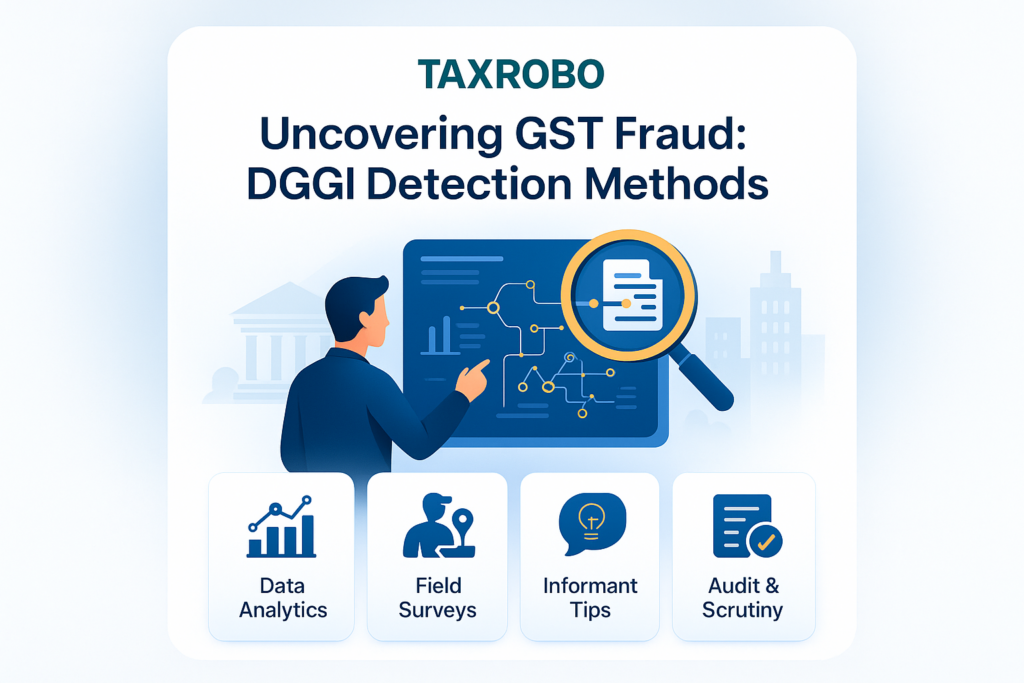
Gone are the days of manual audits and random checks being the primary tool. Today, the department relies on a technology-driven, data-first approach. Here’s an inside look at how DGGI detects GST evasion using cutting-edge tools and a multi-pronged strategy.
1. Data Analytics and Artificial Intelligence (AI)
The GST Network (GSTN) is a massive digital repository containing every B2B invoice, tax payment, and return filed by millions of businesses. The DGGI harnesses this big data with sophisticated AI and machine learning algorithms to identify suspicious patterns and red flags that would be impossible for a human to spot. These DGGI fraud detection techniques are highly effective.
Key analytical methods include:
- GSTR-1 vs. GSTR-3B Mismatch: The system automatically compares the total outward supplies you declare in your GSTR-1 (the detailed statement of all your sales) with the summarized turnover and tax paid in your GSTR-3B (the monthly summary return). Any significant discrepancy is an immediate red flag for under-reporting.
- GSTR-2A/2B vs. GSTR-3B ITC Analysis: This is one of the most powerful tools. The system cross-verifies the Input Tax Credit (ITC) you claim in your GSTR-3B against the data auto-populated in your GSTR-2B. GSTR-2B is generated from the GSTR-1 filings of all your suppliers. If you claim more ITC than what your suppliers have declared, the system flags your business for scrutiny.
- E-Way Bill & FASTag Data Correlation: For businesses involved in the movement of goods, this is a game-changer. The DGGI correlates the data from e-way bills (which document the consignment of goods) with the vehicle’s movement data captured by FASTag at toll plazas. If an e-way bill shows goods moving from Bengaluru to Chennai, but the truck’s FASTag data shows it never left a local warehouse, it’s a strong indicator of a fake transaction designed only to generate an invoice for fraudulent ITC.
2. Cross-Verification with Other Agencies
GST data is not viewed in isolation. The DGGI understands that a taxpayer’s financial footprint extends across multiple government databases. Therefore, it actively collaborates with other agencies to create a 360-degree profile of a taxpayer, making it incredibly difficult to hide illicit activities. This inter-agency cooperation is a cornerstone of GST fraud detection in India.
Information is sourced and compared from:
- Income Tax Department: The DGGI compares the annual turnover declared in your GST returns with the gross receipts or revenue shown in your Income Tax Return (ITR). A major mismatch suggests that income is being concealed on one of the platforms. You can find more information about income tax filings on the official Income Tax Department website.
- Banks and Financial Institutions: In an investigation, the DGGI has the power to scrutinize bank statements to trace the flow of money. If a business claims to have made a large purchase but there is no corresponding outflow from its bank account, it points towards a sham transaction.
- Registrar of Companies (ROC): Data from the ROC is used to identify shell companies or suspicious director networks often used to perpetrate invoice fraud.
- Customs Department: For businesses engaged in international trade, GST filings are matched with import/export data from the Customs department’s ICEGATE portal to verify the value and movement of goods.
3. Scrutiny of High-Risk Indicators
The DGGI’s AI-powered systems are programmed to flag businesses that exhibit high-risk characteristics. These red flags automatically place a business under a microscope for further investigation. Some of the key risk parameters include:
- Unusually High ITC Claims: A business claiming ITC that is abnormally high compared to its declared turnover or the average for its industry sector is flagged. For example, a service business with few physical inputs claiming massive ITC raises suspicion.
- Multiple GST Registrations on a Single PAN: Fraudsters often create numerous dummy companies using a single PAN card to complicate the transaction trail. The system looks for suspicious patterns of transactions between these related entities.
- “Missing Trader” Pattern: This involves newly registered businesses that show a very high turnover and pass on significant ITC in a very short period, only to vanish without paying any taxes. The system tracks the compliance history of new registrants very closely.
- Transactions with Non-Compliant Suppliers: If a significant portion of your ITC comes from suppliers who consistently fail to file their GSTR-1 or pay their taxes, your claims will be flagged. This is because the risk of fake ITC is highest when dealing with non-compliant vendors.
4. Human Intelligence and Whistleblowers
While technology is the primary weapon, traditional intelligence gathering remains a vital part of the DGGI’s operations. The agency maintains a robust network of informants across various industries who provide crucial on-the-ground information about fraudulent schemes. Furthermore, the government has instituted whistleblower reward schemes, which incentivize insiders, competitors, or the general public to report tax evasion. This combination of digital surveillance and human intelligence creates a comprehensive detection framework.
The GST Fraud Investigation Process in India
Once a potential case of tax evasion is flagged, a systematic investigation process is initiated. Understanding these steps can help a business owner appreciate the gravity of the situation and the importance of a proper response if they ever receive a notice.
Step 1: Scrutiny & Notice: The process usually begins with the department issuing a formal notice or summons (like Form GST ASMT-10) to the taxpayer. This notice will point out the discrepancies found and ask for clarification, along with supporting documents like invoices, ledgers, and bank statements.
Step 2: Search & Seizure: If the initial response is unsatisfactory or if there is strong evidence of large-scale fraud, the DGGI can exercise its power to conduct a search and seizure operation, commonly known as a “raid.” Officers can visit the business premises to inspect and seize records, documents, computers, and even goods.
Step 3: Statement Recording & Audit: During the investigation, DGGI officers are empowered to record sworn statements from the proprietors, directors, key employees, and even third parties like suppliers or customers to gather evidence. A detailed forensic audit of the company’s books of accounts is often conducted to quantify the exact amount of tax evaded.
Step 4: Show Cause Notice & Adjudication: After gathering all evidence, the department issues a detailed Show Cause Notice (SCN). This legal document outlines the charges, the evidence collected, and the proposed tax liability, interest, and penalty. The taxpayer is given an opportunity to present their case before an adjudicating authority, who then passes a final order determining the liability. Knowing How to Respond to a GST Show Cause Notice: A Step-by-Step Guide is a critical skill for any business owner.
How to Ensure GST Compliance: Fraud Prevention Techniques for GST India
The best way to avoid the stress and financial drain of a GST investigation is to build a rock-solid compliance framework from the ground up. Proactive measures are always better than reactive defenses. Here are some essential fraud prevention techniques for GST India that every business must implement.
- Maintain Impeccable Records: This is the golden rule of compliance. Ensure you maintain organized and accurate records of all sales invoices, purchase bills, expense receipts, bank statements, and e-way bills. Good bookkeeping is your first line of defense, underscoring The Importance of Accurate Record-Keeping to Prevent GST Demand Notices.
- Perform Regular Reconciliations: Don’t wait until the end of the financial year. On a monthly or at least quarterly basis, you must reconcile the data between your GSTR-1, GSTR-3B, and GSTR-2B. This simple habit can help you catch discrepancies early and correct them before they attract the department’s attention.
- Verify Your Vendors: Your ITC claims are only as legitimate as your suppliers. Before engaging in business with a new vendor, use the “Search Taxpayer” feature on the official GST Portal to check their GST registration status and filing history. Avoid dealing with suppliers who have a poor compliance record.
- File Returns Accurately and On Time: The most fundamental aspect of compliance is filing all your GST returns correctly and within the due dates. Delays or inaccuracies are often the first triggers for departmental scrutiny. For a detailed walkthrough, see our guide on How to File GST Returns Online: A Step-by-Step Guide of the GST Filing Process & Procedure.
- Seek Professional Help: GST law is complex and constantly evolving. Trying to manage it all on your own, especially as your business grows, can lead to costly errors. If you find compliance challenging or if you receive any notice from the department, the safest course of action is to consult a professional.
Conclusion
In today’s digital-first economy, the idea of hiding from the taxman is a myth. The government’s investment in technology has armed agencies like the DGGI with powerful GST evasion detection methods, including advanced data analytics, inter-agency data sharing, and AI-driven risk profiling. For honest business owners, this shouldn’t be a cause for fear, but a call for diligence. Proactive and meticulous compliance is no longer just a legal requirement; it’s a fundamental business strategy for sustainable growth. By maintaining clean records, performing regular reconciliations, and seeking expert guidance, you can ensure your business stays off the radar of tax authorities.
Don’t wait for a notice to land on your desk. Ensure your GST compliance is flawless with TaxRobo’s expert accounting and GST filing services. Contact us today for a consultation and protect your business from unnecessary risks.
Frequently Asked Questions about GST Evasion and Detection
1. What is the penalty for GST evasion in India?
The penalty for GST evasion is severe. It can be up to 100% of the tax amount that was evaded, in addition to the tax itself and any applicable interest. In cases of serious or willful fraud, the consequences can escalate to include the arrest of the persons involved and imprisonment for a term that may extend up to five years.
2. Can a genuine mistake in a GST return be considered fraud?
A genuine, unintentional error (like a typo or a minor miscalculation) is generally not treated as fraud, especially if it is rectified promptly by the taxpayer. The key legal difference is the absence of mens rea, or the intention to deceive. However, repeated “mistakes” that consistently benefit the taxpayer can be viewed with suspicion and may trigger a detailed scrutiny to determine if there is an underlying fraudulent intent.
3. How does the DGGI get information about my bank transactions?
Tax authorities like the DGGI are empowered by law (including the GST Act and the Prevention of Money Laundering Act) to request financial information from banks and other financial institutions as part of a formal investigation. This is done to verify transactions, trace the money trail, and confirm whether the financial dealings of a business align with what has been declared in its tax returns.
4. What is the first thing I should do if I receive a GST notice?
First, do not panic, but more importantly, do not ignore it. Read the notice carefully to understand exactly what information the department is seeking and the deadline for the response. The best course of action is to immediately consult with a qualified tax professional or a Chartered Accountant. They can help you interpret the notice, gather the required documents, and formulate a clear, accurate, and timely reply, which is crucial to resolving the issue efficiently.