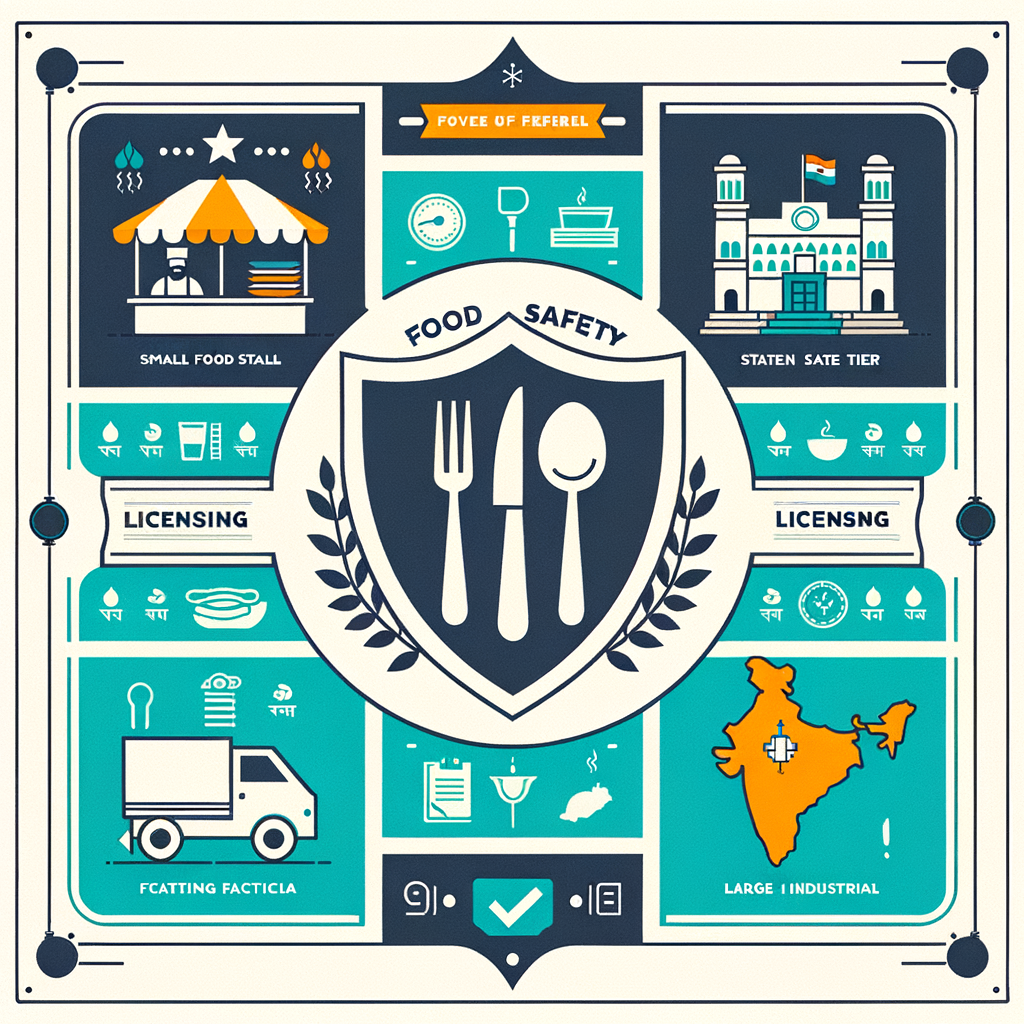

Types of FSSAI Licenses in India – Basic, State, and Central Explained
Planning to start a cloud kitchen, a small café, or even a large-scale food manufacturing unit in India? The first and most critical legal step is securing the right FSSAI license. This mandatory certification is the cornerstone of any food business, ensuring that your operations meet the country’s stringent safety and quality standards. As a Food Business Operator (FBO), navigating the various regulations can be daunting, but understanding the different types of FSSAI licenses in India is essential for legal compliance and building customer trust. The Food Safety and Standards Authority of India (FSSAI) is the primary governing body for food safety, and obtaining the correct license from them is not just a suggestion—it’s the law. This post will serve as a definitive guide to the different FSSAI license categories, helping you make an informed and compliant choice for your business venture.
What is an FSSAI License and Why is it Crucial for Your Business?
The Food Safety and Standards Authority of India (FSSAI) is an autonomous body established under the Ministry of Health & Family Welfare, Government of India. Its primary role is to regulate and supervise food safety across the country. The authority operates under the Food Safety and Standards Act, 2006 (FSS Act), which consolidates various laws and orders related to food safety into a single, comprehensive statute. This act makes it mandatory for every FBO—from a street food vendor to a multinational food importer—to obtain an FSSAI license or registration certificate. This 14-digit number must be printed on food packages and displayed prominently on the business premises, acting as a direct signal to consumers that the food is safe to consume and has been prepared under hygienic conditions. It is a powerful tool for standardizing food quality, eliminating adulteration, and ensuring public health.
Key Benefits of FSSAI Licenses in India
Securing an FSSAI license is far more than a simple legal obligation; it is a strategic business asset that offers numerous advantages. The most significant benefits of FSSAI licenses in India directly contribute to a business’s growth, credibility, and long-term success in a competitive market.
- Legal Compliance: The most immediate benefit is avoiding the severe consequences of non-compliance. Operating without a valid license can lead to heavy penalties, including substantial fines and even imprisonment. A license ensures you are running your business legally and protects you from potential legal complications, allowing you to focus on growth and operations.
- Building Customer Trust: In today’s health-conscious world, consumers are increasingly aware of food safety. The FSSAI logo on your product or menu is a universally recognized mark of quality, safety, and hygiene. It assures customers that your business adheres to government-mandated standards, which instantly builds trust and encourages them to choose your products over non-certified competitors.
- Brand Credibility: A valid FSSAI license significantly enhances your brand’s image and reputation. It positions your business as responsible, reliable, and committed to customer well-being. This credibility is invaluable for creating a loyal customer base and fostering positive word-of-mouth marketing, which is crucial for sustainable growth.
- Business Expansion: An FSSAI license is often a non-negotiable prerequisite for scaling your business. If you plan to partner with large retailers, get listed on popular food delivery platforms like Zomato and Swiggy, or participate in government tenders, you will need to present your FSSAI certificate. It is also a key document that banks and investors look for when you seek funding or business loans, as it demonstrates legal compliance and operational legitimacy.
Decoding the Three Types of FSSAI Licenses in India
The FSSAI has structured its licensing framework into three distinct categories to cater to the diverse scale and nature of food businesses operating in the country. The specific license you need is determined by three main factors: your business’s annual turnover, its production or handling capacity, and the scope of its operations (local, state-level, or national/international). Choosing the wrong license can lead to legal issues, while understanding the criteria for each ensures you apply for the correct one from the start. Let’s break down the three types of FSSAI licenses in India.
FSSAI Basic Registration Explained
The FSSAI Basic Registration is the entry-level certification designed for small food business operators. This includes petty retailers, itinerant vendors, hawkers, small-scale manufacturers, cottage industries, food stalls, and any FBO whose operations are limited in scale. It is intended to bring the vast unorganized food sector under the ambit of basic safety and hygiene regulations without imposing a heavy compliance burden. If you are just starting with a home-based bakery, a small tea shop, or a food cart, this is likely the registration you will need. The process is relatively simple and is designed to be accessible for businesses with minimal resources.
- Who is it for? Petty food business operators, including small-scale manufacturers, storage units with a capacity of less than 10 MT, transporters with up to 1 vehicle, retailers, street food vendors, and food stalls.
- Eligibility Criteria: The primary criterion is annual turnover. This registration is for businesses with an annual turnover of up to ₹12 Lakhs.
- Issuing Authority: The registration is granted by the respective State Government.
- Form: The application for Basic Registration is filed using Form A.
FSSAI State License Details
The FSSAI State License is for mid-sized food businesses whose operations are confined to a single state. This category covers a broad range of FBOs, such as restaurants, hotels (3-star and above, or up to 5-star), medium-sized manufacturers and processors, larger storage facilities, and transporters with a fleet of vehicles. If your business has outgrown the ₹12 Lakhs turnover limit but does not exceed ₹20 Crores, the State License is the mandatory requirement. The compliance requirements for a State License are more stringent than for Basic Registration, often involving a more detailed application process and potential site inspections to verify adherence to food safety management systems.
- Who is it for? Mid-sized businesses, including manufacturers, processors, storage facilities, transporters, distributors, restaurants, hotels, and retailers.
- Eligibility Criteria: This license is required for businesses with an annual turnover between ₹12 Lakhs and ₹20 Crores.
- Issuing Authority: The license is issued by the State Government.
- Form: The application for a State License is filed using Form B.
FSSAI Central License Overview
An FSSAI Central License overview reveals that this is the highest level of certification, reserved for large-scale food businesses with extensive operations. This license is mandatory for businesses that operate in multiple states, engage in import/export activities, or supply to Central Government agencies. This category includes large manufacturers, 100% export-oriented units (EOUs), food importers, and operators working within the premises of airports, seaports, and railways. The Central License is issued directly by the FSSAI headquarters in New Delhi and involves the most rigorous scrutiny and compliance standards, including the implementation of a comprehensive Food Safety Management System (FSMS) plan.
- Who is it for? Large-scale businesses, importers, 100% export-oriented units, large manufacturers, FBOs operating in Central Government agency premises (e.g., airports, seaports), and businesses with units in multiple states.
- Eligibility Criteria: This license is for businesses with an annual turnover exceeding ₹20 Crores.
- Issuing Authority: The license is granted by the Central Government (FSSAI).
- Form: The application for a Central License is also filed using Form B.
A Quick Comparison: Choosing the Right FSSAI License
To simplify the decision-making process, here is a clear comparison table that highlights the key differences between the three license types at a glance. Use this to quickly identify which category your food business falls into.
| Parameter | Basic Registration | State License | Central License |
|---|---|---|---|
| Annual Turnover | Up to ₹12 Lakhs | > ₹12 Lakhs to ₹20 Crores | > ₹20 Crores |
| Scale of Business | Petty/Small FBOs | Mid-sized FBOs | Large FBOs, Importers/Exporters |
| Issuing Authority | State Government | State Government | Central Government |
| Application Form | Form A | Form B | Form B |
The FSSAI Licensing Process in India: A Step-by-Step Guide
The FSSAI licensing process India has been streamlined through a unified online portal, making it more accessible for business owners. However, it requires careful attention to detail to ensure a smooth and successful application. Here is a simplified step-by-step guide to the general process.
Step 1: Determine Your Eligibility
Before starting the application, the first and most crucial step is to accurately assess your business. Evaluate your projected annual turnover, the nature of your food activities (manufacturing, trading, storage, etc.), and your production capacity. Use this information to determine whether you need a Basic Registration, a State License, or a Central License. This initial assessment will define the entire application path, including the required forms and documents.
Step 2: Prepare the Necessary Documents
Documentation is a critical part of the FSSAI application. The requirements for FSSAI licenses vary significantly based on the license type. For Basic Registration, the list is minimal, but for State and Central licenses, it is quite extensive. Gather all required documents in the specified digital format. This includes identity proofs, address proofs, layout plans, FSMS plans, water test reports, and NOCs. Having all documents ready beforehand will prevent delays.
Step 3: Complete the Online Application
The application must be filed online through the official FSSAI portal, which is the FoSCoS (Food Safety Compliance System). Create an account, select the appropriate license category, and fill out the application form (Form A or Form B) with accurate information. Upload the prepared documents and pay the requisite government fee online. Double-check all details before submission, as errors can lead to rejection.
Step 4: Application Scrutiny and Inspection
Once submitted, your application will be reviewed by an FSSAI officer. The authorities will scrutinize the form and the attached documents for completeness and accuracy. For State and Central license applications, a Food Safety Officer may conduct a physical inspection of your business premises to verify that it complies with the required hygiene and safety standards outlined in the FSS Act, 2006.
Step 5: Issuance of FSSAI License
If your application is complete and the inspection (if applicable) is satisfactory, the FSSAI authority will approve your application and issue the FSSAI license or registration certificate. The typical timeline can range from 7 days for a Basic Registration to up to 60 days for State or Central licenses. Once issued, you must display the certificate at your place of business.
Common Requirements for FSSAI Licenses
The documentation required for an FSSAI license depends entirely on the type of license you are applying for. Here is a general list of commonly required documents for each category.
Documents for FSSAI Basic Registration
- Photo of the Food Business Operator
- Government-issued Identity Proof (Aadhaar Card, PAN Card, Voter ID, etc.)
- Proof of Business Address (Electricity bill, rental agreement, etc.)
- A complete list of food products you intend to deal in
Documents for FSSAI State & Central License
This list is more extensive and requires greater preparation:
- Proof of Business Premises (Rental agreement, sale deed, etc.)
- List of Directors/Partners/Proprietor with complete address and contact details, along with their ID and Address Proof
- A comprehensive Food Safety Management System (FSMS) plan
- Blueprint or layout plan of the processing unit showing dimensions and allocation of areas
- List and details of machinery and equipment installed at the facility
- List of food categories desired to be manufactured or handled
- Water analysis report from a recognized or public health laboratory confirming potability
- No Objection Certificate (NOC) from the municipality or local body
- For Central License specifically: Import Export Code (IEC) issued by the DGFT for importers/exporters, and a source of milk or raw materials for manufacturing units.
Conclusion
Navigating the landscape of food business regulations in India begins with one crucial step: securing the right license. Understanding the three types of FSSAI licenses in India—Basic, State, and Central—is fundamental to ensuring your business operates legally and ethically. Each license is tailored to a specific business scale and turnover, from a small home kitchen to a large-scale import house. Having the correct FSSAI license is not just a legal formality; it is a mark of quality, a tool for building consumer trust, and a cornerstone for any successful and trustworthy food business in the long run. It opens doors for expansion, partnerships, and ultimately, a stronger brand reputation.
The FSSAI licensing process India can seem complex with its detailed documentation and specific requirements. Don’t let paperwork slow down your business dream. Contact the experts at TaxRobo today, and let us handle your FSSAI registration smoothly and efficiently!
Frequently Asked Questions (FAQs)
FAQ 1: What is the validity of an FSSAI license and when should I renew it?
An FSSAI license is valid for a period of 1 to 5 years, as chosen by the FBO at the time of application. It is crucial to renew the license at least 30 days before its expiry date to avoid late fees and penalties. Operating on an expired license is equivalent to operating without one.
FAQ 2: Is an FSSAI license required for a home-based kitchen or cloud kitchen?
Yes, absolutely. Any business involved in the preparation and sale of food, regardless of its location, must have an FSSAI license. Home-based kitchens and cloud kitchens are legally required to be registered. Depending on the annual turnover, this would either be a Basic Registration (up to ₹12 Lakhs) or a State License (above ₹12 Lakhs).
FAQ 3: Can I upgrade my FSSAI license from Basic to State?
Yes. License modification or upgrade is a common requirement as a business grows. If your annual turnover crosses the ₹12 Lakhs threshold, you must apply to upgrade your Basic Registration to a State License to remain compliant with the law.
FAQ 4: What are the penalties for not having the required FSSAI license?
Operating a food business without a valid FSSAI license is a serious offense under the FSS Act, 2006. The penalties can be severe, including imprisonment for a term that may extend to six months and a fine of up to ₹10 Lakhs, depending on the nature of the offense.