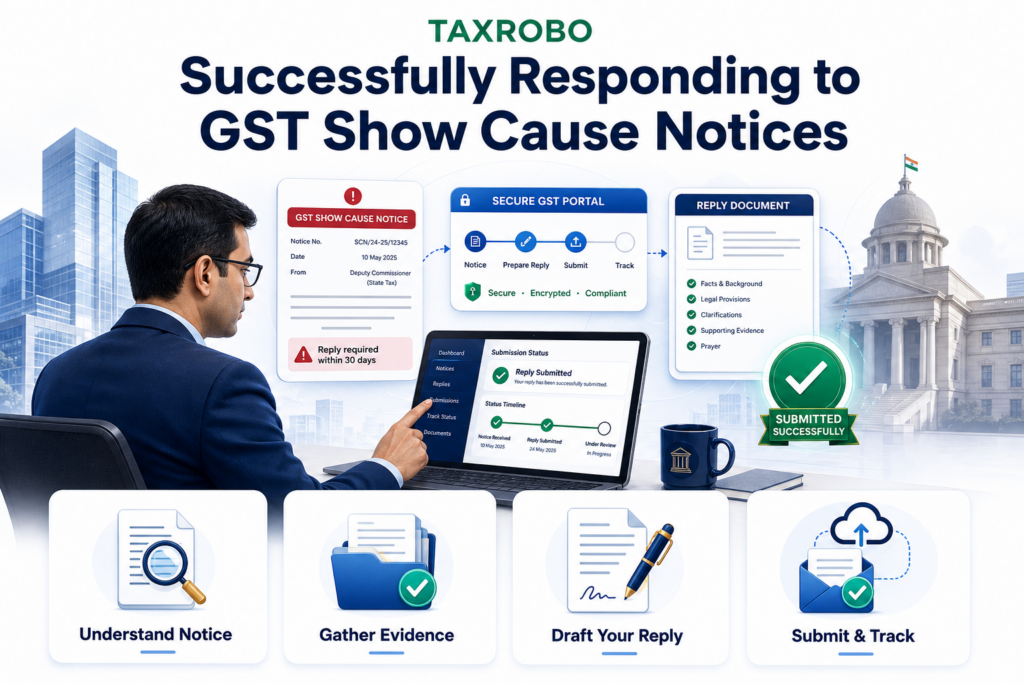

How to Reply to a GST Show Cause Notice Successfully
Receiving a formal notice from the GST department can be a daunting experience for any business owner. The official language and the threat of penalties can cause immediate stress. However, it’s important to understand that this is a standard procedure and not a final verdict on your business’s compliance. This comprehensive guide is designed to demystify the process and explain how to respond to a show cause notice effectively. We will break down what a GST Show Cause Notice (SCN) is, why you might receive one, and provide a step-by-step process for drafting a successful reply to a show cause notice. A timely and well-drafted reply is your crucial first line of defense to present your case, clarify any misunderstandings with the tax authorities, and avoid potential penalties or further legal complications. Ignoring such a notice is never an option and can lead to severe consequences for your business.
First, What Exactly is a GST Show Cause Notice?
A GST Show Cause Notice, often abbreviated as SCN, is an official communication from the tax authorities. In simple terms, it’s a formal document that asks a taxpayer to “show cause” or explain why a certain legal action should not be taken against them. This action could be the levying of unpaid tax, interest on that tax, or a penalty for a specific non-compliance. The primary purpose of an SCN is rooted in the principles of natural justice, specifically ‘audi alteram partem’ (let the other side be heard). It ensures that you, the taxpayer, are given a fair opportunity to present your side of the story and provide evidence before any adverse decision is made by the department. The notice is typically issued in Form GST DRC-01, which will meticulously detail the alleged discrepancies, the specific provisions of the GST law that have been contravened, and the grounds on which the proposed action is based. It serves as the foundation for the entire adjudication process. To learn more about the legal basis, read about The Significance of ‘Show Cause Notices’ in GST: Legal Framework and Compliance.
Top 4 Reasons You Might Receive a GST Show Cause Notice
Understanding the common triggers for an SCN can help you maintain better compliance and proactively avoid them. Generally, these notices are issued when the department’s automated systems or an audit flags a potential discrepancy in your tax filings. Here are the top four reasons a business might receive a GST Show Cause Notice.
1. Mismatch in GST Returns
This is one of the most frequent reasons for the issuance of an SCN. The GSTN system cross-verifies data across different returns, and any inconsistencies are quickly flagged.
- GSTR-1 vs. GSTR-3B Mismatch: A significant discrepancy between the total outward supplies you declared in your GSTR-1 (statement of sales) and the summary figures of sales and tax liability you reported in your GSTR-3B (monthly summary return) will trigger a notice. This suggests you may have under-reported your tax liability. For a detailed response strategy to this specific issue, refer to our guide on GST Notice for GSTR-1 vs GSTR-3B Mismatch – Reply Format & Reconciliation.
- GSTR-2B vs. GSTR-3B Mismatch: This mismatch occurs when the Input Tax Credit (ITC) you claimed in your GSTR-3B is higher than the ITC available in your auto-populated GSTR-2B (statement of inward supplies). Since GSTR-2B is generated based on your suppliers’ GSTR-1 filings, this mismatch indicates you might have claimed credit for which your supplier has not paid tax or filed their return.
2. Excessive Input Tax Credit (ITC) Claims
The rules surrounding Input Tax Credit are strict, and any deviation can lead to a notice. Claiming more ITC than you are eligible for is a major red flag for tax authorities.
- Claiming ITC on goods or services that fall under “blocked credits” as per Section 17(5) of the CGST Act is a common error. A detailed understanding of Blocked Credits Under Section 17(5): What ITC Cannot Be Claimed? is essential. This includes expenses on food and beverages, motor vehicles for personal use, club memberships, and construction of immovable property.
- Another critical error is claiming ITC without fulfilling the mandatory conditions, such as not possessing a valid tax invoice or debit note, or claiming credit for goods or services you have not yet received.
3. Non-Filing or Delayed Filing of Returns
Consistent non-compliance with filing deadlines is viewed seriously by the GST department. If a business repeatedly fails to file its mandatory GST returns, such as GSTR-1 and GSTR-3B, for several consecutive tax periods, the system will automatically flag the GSTIN. This is considered a significant violation as it disrupts the entire tax chain and indicates potential tax evasion. The department will issue an SCN to demand the filing of pending returns and propose penalties for the delay.
4. Incorrect Tax Payment
Errors in tax calculation or payment can also lead to an SCN demanding the differential amount along with interest. These errors often arise from a few common mistakes.
- Incorrect Classification: Applying the wrong HSN (Harmonized System of Nomenclature) code to your goods or SAC (Services Accounting Code) to your services can lead to you applying an incorrect tax rate.
- Wrong Tax Rate: You might mistakenly charge a lower tax rate (e.g., 12% instead of the applicable 18%), resulting in an underpayment of tax.
- Valuation Errors: Incorrectly valuing the goods or services supplied, for instance, by not including includible costs like packing and freight charges in the transaction value, can lead to a short payment of GST.
Received a Notice? Here Are Your Immediate Action Steps
The moment you see an SCN in your email or on the GST portal, it’s natural to feel a sense of alarm. However, a structured and calm approach is your best ally. Follow these immediate steps to handle the situation professionally.
Step 1: Don’t Panic and Verify the Notice
First and foremost, do not panic. An SCN is a query from the department, not a final confirmation of guilt or a demand for payment. It’s an opportunity for you to clarify your position. Before you do anything else, you must verify the authenticity of the notice. In today’s digital age, fake notices are a real threat.
- Actionable Tip: Every genuine notice issued by the GST department will have a unique Document Identification Number (DIN). You can and should immediately verify this DIN on the official GST portal. This simple check confirms that the notice is legitimate and has been issued by a proper officer.
Step 2: Read the Notice Carefully
Once you’ve verified the notice, read it thoroughly from start to finish. Do not just skim it. You need to understand every detail of the allegations being made against your business. Pay close attention to key details such as the specific discrepancy pointed out, the tax period(s) in question, the exact amount of tax, interest, and penalty being proposed, and, most importantly, the deadline for submitting your reply to the show cause notice. Missing this deadline can have serious repercussions, so mark it on your calendar immediately.
Step 3: Gather All Supporting Documents
A strong reply is built on strong evidence. Before you even start writing, you must gather all the relevant paperwork that can substantiate your claims and counter the allegations made in the SCN. This is a crucial step that will form the backbone of your defense. Your document checklist should include:
- Tax invoices for both sales and purchases related to the period in question.
- E-way bills, delivery challans, and transportation receipts.
- Bank statements to prove payments for inward supplies.
- Copies of all GST returns filed (GSTR-1, GSTR-3B, GSTR-9).
- Your internal ITC ledgers and detailed reconciliation statements that show how you calculated your figures.
How to Draft a Successful Reply to a Show Cause Notice in India
Drafting a response is the most critical part of the process. Your goal is to create a clear, logical, and legally sound document that effectively communicates your position to the tax officer. A haphazard or incomplete reply will only weaken your case. Here are some crucial reply to show cause notice tips India.
Understanding the show cause notice reply format India
Your reply should be drafted as a formal letter and must maintain a professional tone throughout. It needs to be well-structured to ensure the adjudicating officer can easily understand your arguments and follow your line of reasoning. An effective show cause notice reply format India typically includes the following key components:
- Header: Your company’s legal name, registered address, and GSTIN should be at the top.
- Addressee: Clearly mention the designation and office address of the officer who issued the SCN.
- Reference: This is vital. Clearly state the SCN number and the date it was issued. This helps in correctly mapping your reply to the notice in the department’s records.
- Facts of the Case: Begin with a brief and objective summary of the situation as you understand it, without adding any arguments at this stage.
- Point-wise Rebuttal: This is the heart of your reply. Address every single allegation made in the SCN one by one. Use the same numbering or lettering as in the notice to make it easy for the officer to cross-reference. For each point, state whether you agree or disagree, and then provide your detailed explanation and legal reasoning.
- Legal Arguments: Don’t just state facts; back them up with law. Refer to relevant sections of the CGST/SGST Act, specific rules, departmental circulars, notifications, or even relevant case laws to support your arguments.
- Prayer: Conclude your reply with a formal “prayer” or request. This is where you respectfully ask the officer to consider your submissions, drop the proceedings initiated by the SCN, and refrain from imposing any tax, interest, or penalty.
Responding to Show Cause Notice Guidelines: Essential Tips
Following a few best practices can significantly increase the effectiveness of your reply. These guidelines are crucial for crafting a successful reply to a show cause notice in India.
- Be Timely: The deadline mentioned in the SCN is not a suggestion; it’s a strict legal requirement. Always submit your reply within the stipulated time. If you genuinely need more time to gather documents or prepare a detailed response, you must submit a formal written request for an extension well before the original deadline expires.
- Acknowledge and Respond Point-by-Point: Never submit a vague or generic reply. A detailed, point-wise response demonstrates that you have taken the notice seriously and have carefully considered each allegation. This structured approach makes your reply more credible and easier for the officer to adjudicate.
- Back Claims with Evidence: Words are not enough. Every claim you make in your rebuttal must be supported by documentary evidence. Attach clear, legible copies of all the supporting documents you gathered earlier. It is good practice to label them neatly (e.g., “Annexure-A,” “Annexure-B”) and refer to these annexures directly in your reply (e.g., “…as evidenced by the tax invoice no. 123 dated 01/01/2023, a copy of which is attached as Annexure-A.”).
- Accept Mistakes Gracefully: If, after reviewing the notice, you find that there was a genuine error on your part, it is often best to accept it. Explain the reason for the error (e.g., a clerical mistake, a misunderstanding of a provision). If you have already taken corrective action, such as paying the short-paid tax and interest via Form DRC-03, provide proof of this payment. Admitting a genuine mistake and showing proactive correction can often lead the officer to take a more lenient view, potentially waiving or reducing the proposed penalty.
Submitting Your Reply and What to Expect Next
Once your reply is drafted and all documents are in order, the next step is to formally submit it to the department and prepare for the subsequent adjudication process.
Filing Your Reply on the GST Portal
In the digital era of GST, the reply to the show cause notice must be submitted electronically through the official GST Portal. The designated form for this purpose is Form GST DRC-06. You will need to log into your GST account, navigate to the “Notices” section, find the relevant SCN, and use the option to file your reply. All your supporting documents should be scanned, compiled into a single PDF file (or multiple files if necessary), and uploaded as attachments along with your written submission in Form DRC-06.
The Adjudication Process
After you have successfully filed your reply, the adjudication process begins. This process is a formal legal proceeding to decide the case.
- Review: The GST officer who issued the notice (the “adjudicating authority”) will carefully review your detailed reply and all the documentary evidence you have submitted.
- Personal Hearing: The law mandates that you be given an opportunity for a personal hearing. You will receive a notice fixing a date and time for this hearing. It is highly recommended that you or your authorized representative (like a tax consultant or lawyer) attend this hearing. It provides a valuable opportunity to explain your case in person, clarify any doubts the officer may have, and present your arguments directly.
- Final Order: After considering your written reply, the evidence, and the arguments made during the personal hearing, the officer will pass a final legal order, known as the “Order-in-Original.” This order will either drop the proceedings if the officer is satisfied with your explanation or confirm the demand for tax, interest, and penalty if your arguments are not accepted.
If the Order is Not in Your Favour
If the Order-in-Original is passed against you and confirms the demand, you do not have to lose hope. The GST law provides a clear appellate mechanism. You have the right to file an appeal against the order before the first GST Appellate Authority. This appeal must be filed within the prescribed time limit, which is typically three months from the date of communication of the order.
Conclusion: Your Checklist for an Effective Reply to a Show Cause Notice
Navigating a GST Show Cause Notice can be complex, but with a methodical approach, it is manageable. A well-prepared and legally sound reply to a show cause notice is your most powerful tool to resolve discrepancies, demonstrate your commitment to compliance, and protect your business from unnecessary financial strain and legal complications. Remember that the goal is to present a clear, factual, and legally supported case to the tax authorities.
Here is a final summary of the key takeaways:
- Act promptly: Never ignore a notice. Verify its authenticity and note the deadline immediately.
- Understand and analyze: Read the notice carefully to fully grasp the allegations and the financial implications.
- Gather all evidence: Collect every relevant document that can support your case before you begin writing.
- Draft a structured reply: Use the proper show cause notice reply format India, addressing each point of the notice separately and logically.
- Support your arguments: Back up every claim with corresponding documentary proof and references to the GST law.
Feeling overwhelmed by a GST notice? Let TaxRobo’s team of experts handle it for you. We specialize in drafting legally sound and effective replies to ensure the best possible outcome for your business. Contact us today for professional assistance!
Frequently Asked Questions (FAQs)
1. What is the time limit to reply to a GST Show Cause Notice?
Typically, the GST law provides a taxpayer with 30 days from the date of receipt of the notice to file a reply. However, this period can sometimes vary, so it is crucial to always check the specific deadline mentioned in the SCN itself. If you require more time to gather evidence or seek professional advice, you can submit a formal written application to the issuing officer requesting an extension, stating the valid reasons for the delay.
2. What happens if I ignore a GST Show Cause Notice?
Ignoring an SCN is a serious and costly mistake. If you fail to respond by the deadline, the GST officer is empowered to pass an “ex-parte” order. This means they will make a final decision based solely on the information and evidence available to them, without considering your side of the story. This almost invariably results in the confirmation of the full tax demand, interest, and the maximum applicable penalty proposed in the notice.
3. Do I need a tax professional to draft the reply?
The need for a professional depends on the complexity of the case. For very minor issues or simple clerical errors where the tax amount is negligible, you might be able to handle the reply yourself by providing a clear explanation and supporting documents. However, for complex cases involving significant tax amounts, intricate legal interpretations, or multiple discrepancies, engaging a chartered accountant or tax lawyer is highly recommended. Their expertise in law and procedure can be invaluable in crafting a successful reply to a show cause notice in India and representing you during the personal hearing.
4. Can I pay the tax demanded in the notice to close the matter?
Yes, absolutely. The GST framework encourages voluntary compliance. If you review the notice and agree with the discrepancy pointed out by the department, you can pay the demanded tax, applicable interest, and a substantially reduced penalty amount using Form GST DRC-03. This can be done even before the SCN is formally issued (if you discover the error yourself) or after receiving the notice. Once the payment is made, you must inform the tax officer. If the officer is satisfied that the dues have been paid correctly, they can conclude the proceedings, often without imposing a hefty penalty.