
Starting a D2C Brand? Here’s Every Registration You Need Before Your First Sale
The Direct-to-Consumer (D2C) market in India is booming, projected to be worth a staggering $100 billion by 2025. We see success stories everywhere, from Mamaearth to Lenskart, brands that have bypassed traditional retail to connect directly with their customers. This excitement makes D2C brand registration one of the first crucial steps for any aspiring entrepreneur. While you might be eager to launch your product, the maze of legal and compliance requirements can be daunting. Skipping these initial steps while starting a D2C business in India can lead to hefty penalties, operational roadblocks, and legal disputes down the line.
This comprehensive guide is your step-by-step checklist. We’ll walk you through all the D2C business setup requirements in India, ensuring your brand is built on a solid, legally compliant foundation. Let’s get started.
Step 1: Choosing and Registering Your Business Entity
The first crucial step in your legal registration for D2C brands in India is deciding on the right business structure. This foundational choice will define your personal liability, how you are taxed, your ability to raise funds, and the compliance you need to follow. Each structure has its own set of advantages and disadvantages, especially for a growing D2C business. For a detailed breakdown, our guide on Comparing Business Structures: Private Limited, LLP, OPC & More is a great resource.
Sole Proprietorship
- What it is: This is the simplest business structure, where the business is owned and run by one individual. Legally, there is no distinction between the owner and the business itself.
- Pros for D2C:
- Easy to Start: It requires minimal paperwork and is the quickest to set up.
- Minimal Compliance: Fewer regulatory filings and compliance burdens compared to companies.
- Full Control: You are the sole decision-maker.
- Cons for D2C:
- Unlimited Liability: This is the biggest drawback. If the business incurs debt or losses, your personal assets (like your home or car) can be used to settle them.
- Difficult to Raise Funds: Investors and banks are hesitant to fund proprietorships due to their unstructured nature and unlimited liability.
- Registration Process: There is no formal registration for a proprietorship itself. However, you will likely need other registrations like GST, a Shop and Establishment license, and an MSME registration to operate. You will use your personal PAN for all business transactions.
One Person Company (OPC)
- What it is: An OPC is a hybrid structure that gives a single founder the benefit of a private limited company. It is a separate legal entity from its owner, but with only one member.
- Pros for D2C:
- Limited Liability: Your personal assets are protected from business debts.
- Separate Legal Entity: The business has its own identity, enhancing credibility with vendors and customers.
- Easier Funding: It’s easier to secure loans and attract initial funding compared to a proprietorship.
- Cons for D2C:
- More Compliance: You must comply with parts of the Companies Act, including appointing a nominee and filing annual returns.
- Turnover Restrictions: If an OPC’s revenue exceeds ₹2 crore, it must be converted into a Private Limited Company.
- Registration Process: An OPC is registered with the Ministry of Corporate Affairs (MCA). The process involves obtaining a Digital Signature Certificate (DSC) and a Director Identification Number (DIN). TaxRobo can help you navigate this with our OPC Registration service.
Limited Liability Partnership (LLP)
- What it is: An LLP is a corporate structure that combines the flexibility of a traditional partnership with the advantage of limited liability, similar to a company. It requires a minimum of two partners.
- Pros for D2C:
- Limited Liability: Partners are not personally liable for the business’s debts.
- Flexible Management: The business is managed based on the LLP agreement, offering more flexibility than a company structure.
- Lower Compliance: Compliance requirements are fewer and less complex than those for a private limited company.
- Cons for D2C:
- Funding Challenges: Raising equity funding from Venture Capitalists (VCs) or angel investors is difficult, as they cannot hold shares in an LLP.
- Public Disclosure: LLPs are required to file their annual financial statements, making them publicly accessible.
- Registration Process: LLPs are also registered with the MCA. The process is similar to incorporating a company and involves filing specific forms and the LLP agreement. Let our experts handle it for you through our LLP Registration service.
Private Limited Company (Pvt. Ltd.)
- What it is: This is the most popular and scalable legal structure for startups and growing businesses in India. It is a separate legal entity, owned by shareholders and managed by directors.
- Pros for D2C:
- Separate Legal Entity & Limited Liability: Offers complete protection for the personal assets of its owners (shareholders).
- Easy to Raise Funds: This is the preferred structure for VCs and angel investors, making it ideal if you plan to seek external funding.
- Enhances Brand Credibility: A ‘Pvt. Ltd.’ suffix adds a layer of trust and professionalism to your brand.
- Cons for D2C:
- Higher Compliance: It has the most stringent compliance requirements, including board meetings, statutory audits, and various MCA filings.
- More Complex to Set Up: The incorporation process is more detailed and time-consuming.
- Registration Process: Incorporation is done through the official MCA website and involves applying for Director Identification Numbers (DIN), Digital Signature Certificates (DSC), and reserving the company name. For a hassle-free experience, consider TaxRobo’s expert Private Limited Company Registration service.
| Feature | Sole Proprietorship | OPC | LLP | Private Limited Company |
|---|---|---|---|---|
| Liability | Unlimited | Limited | Limited | Limited |
| Legal Status | Not a separate entity | Separate legal entity | Separate legal entity | Separate legal entity |
| Fundraising | Very Difficult | Moderate | Difficult (Equity) | Easy |
| Compliance | Minimal | Moderate | Moderate | High |
| Best For | Testing an idea | Solo founders wanting liability protection | Service businesses or co-founders | Startups planning to scale and raise funds |
Step 2: Securing Essential Tax Registrations for Your D2C Brand
Once your business entity is chosen, the next critical phase of your D2C brand registration involves obtaining the necessary tax IDs to operate legally and manage your finances correctly. These are non-negotiable for any business operating in India.
Permanent Account Number (PAN)
- What it is: PAN is a unique 10-digit alphanumeric code assigned to all tax-paying entities in India by the Income Tax Department.
- Why it’s essential: For any business entity like an OPC, LLP, or Private Limited Company, a separate business PAN is mandatory. It is required to open a business bank account, file income tax returns, and apply for GST registration. For a proprietorship, the owner’s personal PAN is used for the business.
- How to get it: You can apply for a PAN card for your business through the NSDL or UTIITSL portals, which are authorized by the Income Tax Department website.
Tax Deduction and Collection Account Number (TAN)
- What it is: TAN is another 10-digit alphanumeric number required for all entities responsible for deducting or collecting tax at source (TDS/TCS).
- When you need it: You will need a TAN if you are going to pay salaries to employees, make payments to contractors or professionals, or pay rent for your office or warehouse exceeding certain thresholds. It is wise to obtain a TAN early on as your business grows and these transactions become common.
Goods and Services Tax (GST) Registration
- Why it’s non-negotiable for D2C: This is arguably the most critical tax registration for any online business, and understanding the specific GST for E-commerce Businesses: Key Considerations is crucial. According to GST law, any business selling goods through an e-commerce platform must register for GST from the very first sale. The standard turnover thresholds (₹20 lakhs or ₹40 lakhs) do not apply to e-commerce sellers. This is a key
D2C brand compliance requirement in Indiathat cannot be ignored. - Breakdown of GST:
- CGST, SGST, IGST: GST is a destination-based tax. For sales within the same state (intra-state), CGST (Central GST) and SGST (State GST) are levied. For sales to a customer in another state (inter-state), IGST (Integrated GST) is levied. As a D2C brand, you will be selling to customers across India, making IGST compliance crucial.
- HSN Codes: The Harmonized System of Nomenclature (HSN) is a system for classifying goods. You must correctly identify the HSN code for each of your products to apply the correct GST rate (e.g., 5%, 12%, 18%, 28%).
- Registration Process: You can register for GST online through the official GST Portal. The process requires your PAN, business registration documents, and proof of address. To ensure accurate filing and avoid penalties, explore TaxRobo’s GST Registration and Filing services.
Step 3: Acquiring Key Operational Licenses and Registrations
Beyond business and tax registrations, certain operational licenses are among the essential registrations for D2C brands in India. These licenses depend on your specific industry, product category, and the location of your operations.
MSME / Udyam Registration
- What it is: Udyam Registration is a government certification that recognizes your business as a Micro, Small, or Medium Enterprise (MSME).
- Benefits for D2C: This free-of-cost registration unlocks numerous government benefits, including access to collateral-free bank loans, subsidies on patents and trademarks, preference in government tenders, and protection against delayed payments from buyers. It is highly recommended for every new D2C brand.
- How to register: The process is simple and can be done online through the official Udyam Registration portal.
Shop and Establishment Act License
- What it is: This is a state-specific license that governs the working conditions of employees in any commercial establishment.
- Why you need it: It regulates aspects like working hours, weekly holidays, wages, and health and safety norms. Most banks also require this license as a proof of business address when opening a current account. The rules and application process vary from state to state.
Industry-Specific Licenses (Conditional)
Your D2C brand may require additional licenses based on the products you sell. Operating without these can lead to severe legal consequences.
- FSSAI License: This is mandatory for any D2C brand that manufactures, processes, stores, or sells food products, health supplements, or beverages.
- Drug License: This is required if your D2C brand sells cosmetics, pharmaceuticals, or ayurvedic products. The regulations for cosmetics are particularly strict.
- Import Export Code (IEC): You will need an IEC if you plan to source raw materials or finished products from other countries or sell your products to international customers. It is a 10-digit code required for all import/export activities.
Step 4: Protecting Your Brand with Intellectual Property (IP) Registration
For a D2C brand, your brand identity—your name, logo, packaging, and content—is your most valuable asset. Protecting these assets through Intellectual Property (IP) registration is a crucial, though often overlooked, part of how to register a D2C brand in India.
Trademark Registration
- What it is: A trademark provides legal protection for your brand name, logo, slogan, or a combination of these. To fully understand its importance, it’s vital to Secure Your Brand’s Future Trademark Your Brand – Registration, Benefits & The Cost of Neglect. It distinguishes your goods from those of your competitors.
- Why it’s critical for D2C:
- Prevents Imitation: It gives you the exclusive right to use your brand name and logo, preventing competitors from creating confusion in the market with a similar name.
- Builds Brand Value: A registered trademark is a valuable intangible asset that builds trust and credibility with customers.
- Marketplace Requirement: Major e-commerce platforms like Amazon and Flipkart often require a trademark registration (or at least an application number) for their brand registry programs, which offer enhanced protection against counterfeiters.
- Understanding ™ vs. ®: You can start using the ™ symbol as soon as you file your trademark application to indicate your claim of ownership. The ® symbol can only be used after your trademark has been officially registered.
- How to register: You can file a trademark application with the Controller General of Patents, Designs and Trade Marks through the official IP India website. The process can be complex, and expert guidance is recommended. Check out TaxRobo’s Trademark Registration service for professional assistance.
Copyright Registration
- What it is: Copyright protects original works of authorship. For a D2C brand, this includes your website content, product photographs, blog posts, video content, and even the unique artistic design on your packaging.
- Why it matters: While copyright exists automatically upon creation, registering it provides a public record of your ownership. This strengthens your legal position significantly if you need to take action against someone who has copied your creative content without permission.
Conclusion
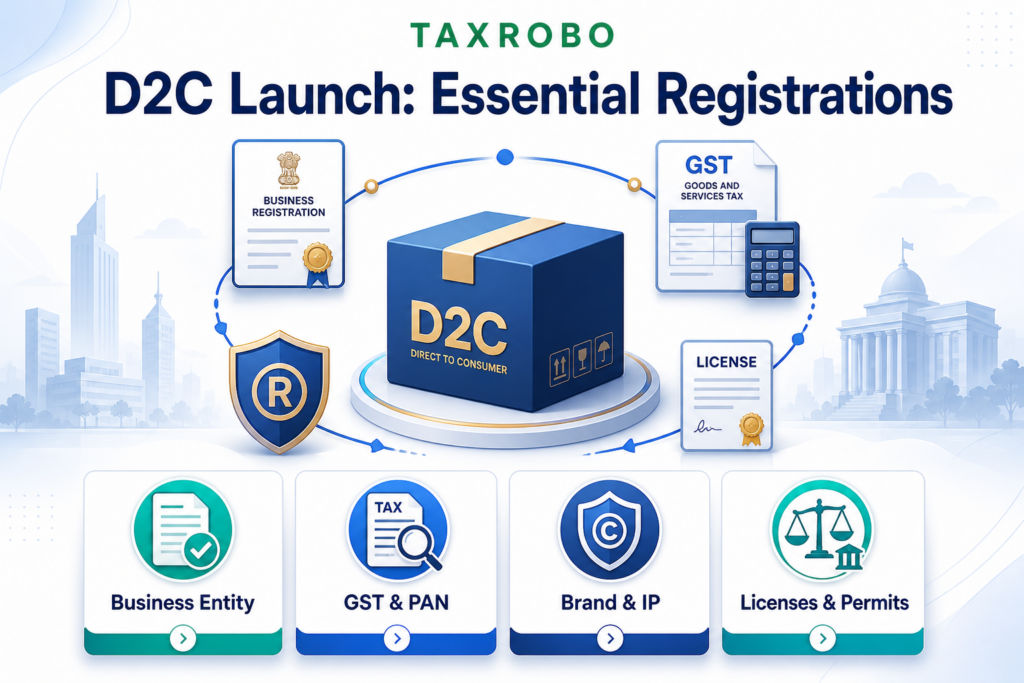
Building a successful D2C brand is a marathon, not a sprint. While the journey from idea to first sale is thrilling, laying a strong legal foundation is what ensures longevity and scalability. By systematically completing these four key steps—choosing your Business Entity, securing Tax Registrations, acquiring Operational Licenses, and protecting your Intellectual Property—you can avoid future legal headaches and financial penalties.
Navigating the D2C brand registration landscape can be complex. At TaxRobo, we help entrepreneurs like you handle all the legal formalities, from company incorporation to GST and trademark filing, so you can focus on building your brand. Contact us today for a free consultation!
Frequently Asked Questions (FAQs)
1. Do I need GST registration if my D2C brand’s turnover is less than ₹40 lakhs?
Answer: Yes. For businesses selling goods online (e-commerce), GST registration is mandatory from day one, regardless of your annual turnover. The turnover threshold exemption does not apply to e-commerce sellers making inter-state supplies.
2. Which business structure is best for a new D2C brand that plans to raise funding?
Answer: A Private Limited Company is the most preferred structure for startups seeking external funding from angel investors or venture capitalists. It offers limited liability, a clear shareholding structure for distributing equity, and is perceived as more credible and stable by investors.
3. How long does the entire D2C brand registration process take in India?
Answer: The timeline can vary. Company registration (LLP or Pvt. Ltd.) can take 10-15 business days. GST registration typically takes about 7-10 business days. Trademark registration is a longer process that can take several months to a year for final approval, but you can start using the ™ symbol as soon as you file the application. A realistic timeline to get all basic registrations in place to start selling is around 3-4 weeks.
4. Can I start selling my D2C products before I have all the licenses?
Answer: It is highly discouraged and illegal in most cases. Selling goods online without a GST number is a direct violation of tax laws. Similarly, selling products like food, supplements, or cosmetics without the mandatory FSSAI or Drug License can lead to severe penalties, product seizures, and even imprisonment. It’s crucial to complete all essential registrations for D2C brands in India before making your first sale to ensure full compliance.