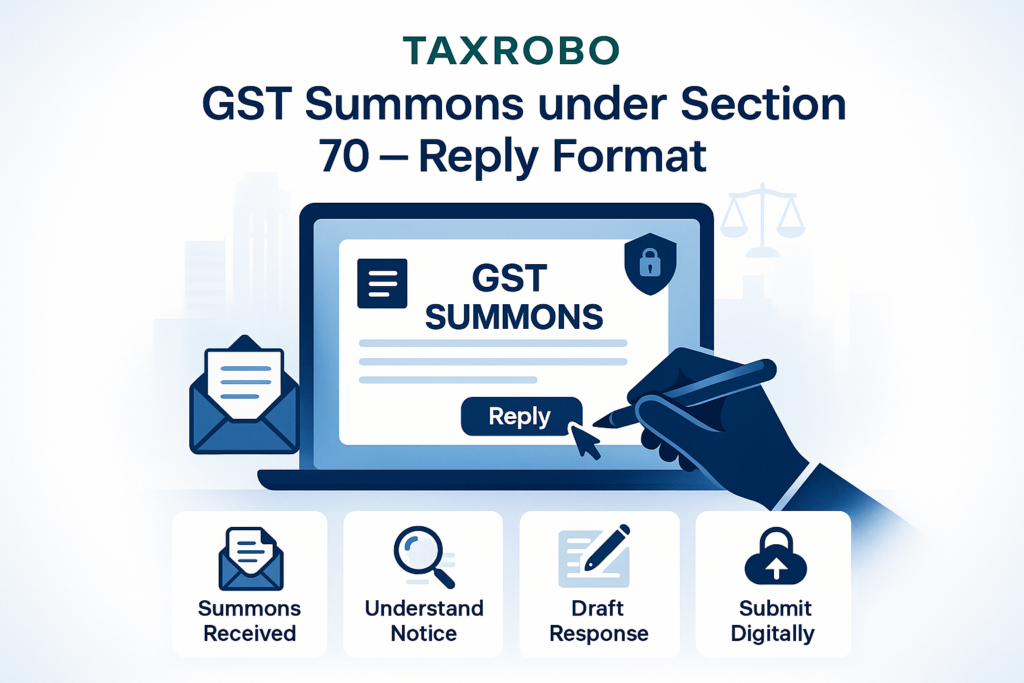

GST Summons under Section 70 – A Detailed Reply Format and Guide
Receiving a formal notice from a government authority can be unnerving for any business owner or individual. A summons from the GST department, in particular, requires immediate and careful attention. This legal notice is not something to be taken lightly, and your response can significantly impact the outcome of the inquiry. This guide provides a clear and actionable GST summons reply format, helping you understand the process and draft a professional response. A summons under Section 70 of the CGST Act is a legal instrument used by tax authorities to gather evidence or information for an ongoing investigation. Responding correctly and on time is crucial to avoid substantial legal penalties and ensure your business maintains its standing in GST compliance in India. We will cover everything from the initial steps you should take to a detailed template for handling GST summons in India.
What is a GST Summons under Section 70?
Understanding the nature of the summons is the first step towards formulating a proper response. It is not merely a request for information; it is a legal directive carrying significant weight. Misunderstanding its implications can lead to serious legal and financial repercussions for your business.
The Legal Framework: Understanding Section 70 of the CGST Act
Section 70 of the Central Goods and Services Tax (CGST) Act, 2017, grants authorized GST officers the power to summon any person whose attendance they consider necessary for an inquiry. This is one of the key Powers of GST Officers During Investigation (Section 67, 70, 74 Explained). These powers are similar to those vested in a civil court under the Code of Civil Procedure, 1908. The primary functions of a summons under this section are to compel a person to give evidence under oath or to produce specific documents and other materials relevant to the investigation. A critical aspect to note is that any proceedings conducted under this section are deemed to be “judicial proceedings” within the meaning of Section 193 and Section 228 of the Indian Penal Code. This legal status means that providing false evidence or causing an interruption during the proceedings can lead to criminal prosecution. For a broader understanding of the legal landscape, you can explore the fundamentals of the CGST Act.
For precise legal text, you can refer to the official CGST Act, Section 70 page on the CBIC website.
Who Can Receive a GST Summons?
A common misconception is that a GST summons is only issued to taxpayers who are directly suspected of tax evasion. However, the scope of Section 70 is much wider. The GST department can summon any individual they believe possesses information pertinent to their inquiry. This can include a wide range of individuals associated with a business or its transactions.
Summons can be issued to:
- Directors, partners, or key managerial personnel (KMP) of a company or LLP.
- Employees of the business, such as accountants, finance managers, or warehouse supervisors who have direct knowledge of the transactions under scrutiny.
- Third-party vendors, suppliers, customers, or transporters who have engaged in business with the taxpayer under investigation.
- Any other individual, even if not directly associated with the business, who the officer believes may hold relevant information, documents, or records.
Common Reasons for Receiving Section 70 GST Notices in India
GST authorities issue summons based on specific triggers that raise red flags during their data analysis or departmental audits. Understanding these reasons can provide context and help you prepare a more focused response. Some of the most common triggers include:
- Significant Mismatches in GST Returns: Discrepancies between data reported in GSTR-1 (outward supplies), GSTR-3B (summary return), and GSTR-2A/2B (auto-populated inward supplies) often lead to scrutiny and require a clear understanding of How to Resolve ITC Mismatch Issues – GSTR-2A/2B vs 3B Guide.
- Suspicion of Fake Invoicing: The department may issue a summons if they suspect the business is involved in issuing or receiving invoices without the actual supply of goods or services, a practice used to fraudulently claim Input Tax Credit (ITC).
- Wrongful Availment of Input Tax Credit (ITC): Claiming ITC on ineligible items, based on invalid documents, or in excess of what is legally permissible is a major cause for investigation.
- Investigations into a Business Associate: You might receive a summons if a supplier you deal with is under investigation. The department may need your records to corroborate information or trace the flow of transactions.
- Non-compliance Found During Audits: Discrepancies or non-compliance issues identified during a departmental audit or scrutiny of your records can escalate into a formal inquiry requiring a summons.
Your Immediate Action Plan After Receiving a GST Summons
Panic is a natural reaction, but it is counterproductive. A structured and calm approach is essential. The moments after receiving the summons are crucial for laying the groundwork for a successful resolution.
Step 1: Verify the Authenticity of the Summons
Before you take any other action, you must confirm that the summons is genuine. In an era of sophisticated fraud, verifying official documents is a non-negotiable first step to protect yourself.
- Check for a Document Identification Number (DIN): As per a CBIC circular, any communication from the GST department, including a summons, must have a computer-generated DIN. You can verify this DIN on the CBIC portal.
- Look for an Official Seal and Signature: The document must be duly signed by the issuing GST officer and should ideally bear an official seal.
- Review the Clarity of Details: Ensure that your name, address, GSTIN, and the specified date, time, and location for the appearance are clearly and correctly mentioned. Any ambiguity should be a red flag.
Step 2: Read and Understand the Requirements Carefully
Once you have verified the summons, read it multiple times to fully comprehend what is being asked of you. A thorough analysis will help you and your consultant prepare effectively.
Answer these key questions:
- Are you being summoned as a primary party to the investigation or as a third-party witness?
- What specific documents, records, or books of accounts are you required to produce? The summons should list these items clearly.
- Is the inquiry related to a specific financial year, a particular set of transactions, or a specific supplier/customer?
Understanding these specifics is vital for gathering the correct information and preparing a relevant response, fully adhering to the GST summons guidelines India.
Step 3: Seek Professional Guidance
This is arguably the most critical step. While you may understand your business operations, navigating the legal intricacies of a GST summons requires expert knowledge. We strongly recommend consulting a qualified tax professional, Chartered Accountant (CA), or lawyer immediately.
An expert can:
- Help you interpret the legal language and implications of the summons.
- Assist in gathering and organizing the required documents in the correct format.
- Draft a legally sound and professional reply.
- Advise you on your rights and obligations during the proceedings.
- Accompany you to the GST office to provide support and handle legal arguments.
Knowing how to reply GST summons India is a specialized skill. Professional guidance ensures you don’t make any procedural errors or inadvertent admissions that could harm your case.
TaxRobo’s team of GST experts is here to help you navigate complex notices. Contact us for professional assistance.
The Official GST Summons Reply Format: A Step-by-Step Template
A written reply often precedes your personal appearance, or it may be required to request an adjournment. A well-structured letter creates a professional first impression and serves as an official record of your compliance.
Essential Components of a Professional GST Summons Reply
Your reply should be formal, precise, and directly address the points mentioned in the summons. Follow this structure for a comprehensive legal format for GST summons reply.
- Your Letterhead: If you are a business entity, use your official letterhead. It should include your registered name, address, contact details, and GSTIN.
- Date: Mention the date on which you are drafting and sending the reply.
- Recipient’s Details: Address the letter to the specific officer who signed the summons. Include their full designation and the address of the GST office.
- Reference Number: This is crucial for tracking. Clearly state the Summons Number and Date as mentioned in the document you received.
- Subject Line: The subject should be clear and concise. For example: “Reply to Summons issued under Section 70 of the CGST Act, 2017 vide reference no. [Summons Number]”.
- Body of the Reply:
- Paragraph 1 (Acknowledgement): Begin by formally acknowledging the receipt of the summons. Mention the date you received it.
- Paragraph 2 (Confirmation of Attendance / Request for Adjournment): State your intention to comply. Confirm that you will attend the proceedings on the specified date and time. If you are genuinely unable to attend, this is where you must request an adjournment. Provide a valid reason (e.g., pre-scheduled critical engagement, medical emergency) and suggest alternative dates for your appearance.
- Paragraph 3 (Document Submission): List all the documents and information you are providing as requested in the summons. Specify whether the documents are attached with the reply letter or if you will be producing them in person.
- Closing: Use a professional closing such as “Yours faithfully,” or “Sincerely,”.
- Signature: Sign the letter, and type your full name and designation below your signature. Also include your contact number.
Sample Indian GST Summons Response Template
Here is a ready-to-use Indian GST summons response template that you can adapt based on your specific situation.
[Your Company/Individual Name]
[Your Address]
[Your GSTIN]
Date: [DD/MM/YYYY]
To,
The [Designation of the Officer],
[Address of the GST Office],
[City, Pincode].
Ref: Summons No. [Enter Summons Number] dated [Enter Summons Date]
Subject: Reply to Summons issued under Section 70 of the CGST Act, 2017
Respected Sir/Madam,
1. This is with reference to the summons issued to [Mr./Ms./M/s Your Name] under the reference number cited above, which was duly received by us on [Date of Receipt].
2. We hereby acknowledge the receipt of the said summons, which directs an appearance on [Date Mentioned in Summons] at [Time Mentioned in Summons]. We confirm our presence at your office on the scheduled date and time to cooperate with the ongoing inquiry.
(OR – Use this paragraph for an Adjournment Request)
We regret to inform you that due to a prior and unavoidable business commitment/personal medical emergency, we are unable to attend the proceedings on the specified date. We kindly request you to grant us an adjournment and provide a new date for the appearance, preferably after [Suggest a Date]. We have attached supporting documents regarding this matter for your kind perusal. We sincerely apologize for any inconvenience caused.
3. As requested in the summons, we have prepared the following documents and information. These will be produced in person during our appearance for your verification:
a. [List Document 1 as mentioned in the summons]
b. [List Document 2 as mentioned in the summons]
c. [List Document 3 as mentioned in the summons]
d. [Continue listing all requested documents]
We assure you of our fullest cooperation in this matter and are committed to providing any further information required for the inquiry.
Thanking you.
Yours faithfully,
(Signature)
[Your Name]
[Your Designation]
[Contact Number]
Do’s and Don’ts When Responding to a Summons
Your conduct throughout the process is as important as the documents you provide. Adhering to best practices can help ensure a smoother proceeding.
Best Practices (The Do’s)
- Do Respond Promptly: Never ignore a summons. Acknowledge it in writing immediately and confirm your attendance or request an adjournment.
- Do Be Truthful: Remember, you are giving evidence under oath. Any statements you make are recorded and are admissible as evidence in court. Providing false information is a serious offense.
- Do Carry Originals and Copies: Always take the original documents for verification by the officer and a set of self-attested photocopies for submission.
- Do Maintain Composure: Be respectful and cooperative during the proceedings. A calm and composed demeanor is always beneficial. Answer questions factually and to the point.
Common Mistakes to Avoid (The Don’ts)
- Don’t Delay or Ignore: Failure to comply with a summons can lead to a penalty of up to ₹25,000 under Section 122 of the CGST Act. It can also lead to prosecution under Sections 174 (Non-attendance in obedience to an order from public servant) and 175 (Omission to produce document to public servant) of the Indian Penal Code.
- Don’t Provide Vague or False Information: Inaccurate or misleading statements can be considered perjury, leading to severe legal consequences.
- Don’t Argue with the Officer: The proceeding is an inquiry, not a debate. Present your facts and documents clearly. Let your tax consultant handle legal interpretations and arguments.
- Don’t Go Unprepared: Thoroughly review all your documents, facts, and figures before the appearance. Being well-prepared demonstrates your seriousness and cooperation.
Conclusion
A GST summons under Section 70 is a serious legal matter, but it is entirely manageable with the right approach. The key lies in a timely, structured, truthful, and professionally-guided response. Understanding the correct GST summons reply format is your first and most critical step towards resolving the inquiry efficiently and demonstrating your commitment to compliance. Proactive GST compliance in India and seeking expert help at the outset can protect your business from unnecessary legal complications and financial strain. A well-drafted reply and a prepared appearance can make all the difference in navigating this challenging process successfully. Since a summons can be a precursor to further action, it’s also wise to understand How to Respond to a GST Show Cause Notice: A Step-by-Step Guide for comprehensive preparedness.
If you have received a summons or need assistance with any Section 70 notices reply guide, TaxRobo’s experts are ready to assist you. Contact us for a consultation to ensure your reply is perfect and your rights are protected.
Frequently Asked Questions (FAQs)
Q1. What is the penalty for not complying with a GST summons under Section 70?
A: Failure to appear or produce documents can attract a penalty of up to ₹25,000 under the CGST Act. Furthermore, it can be treated as an offence under Sections 174 and 175 of the Indian Penal Code, leading to potential prosecution in a court of law.
Q2. Can I send my accountant or authorized representative on my behalf?
A: The summons is typically issued to a specific person, and that individual is legally required to appear in person. Unless the summons explicitly permits representation, you cannot send someone else on your behalf. However, you are strongly advised to have an authorized representative (like a CA or lawyer) accompany you to provide legal and procedural assistance during the proceedings.
Q3. Do I have to answer every question asked by the GST officer?
A: You are legally bound to state the truth and answer questions relevant to the inquiry. Refusing to answer can be seen as non-cooperation. However, you are protected against self-incrimination under Article 20(3) of the Constitution of India, which means you cannot be compelled to be a witness against yourself. It’s best to have a legal consultant guide you on how to respond to sensitive questions.
Q4. How long does a proceeding under a GST summons typically last?
A: The duration varies greatly depending on the complexity of the case, the volume of documents involved, and the information being sought. A single proceeding could last a few hours. However, if the investigation is extensive, it may require multiple appearances spread over several weeks or even months.