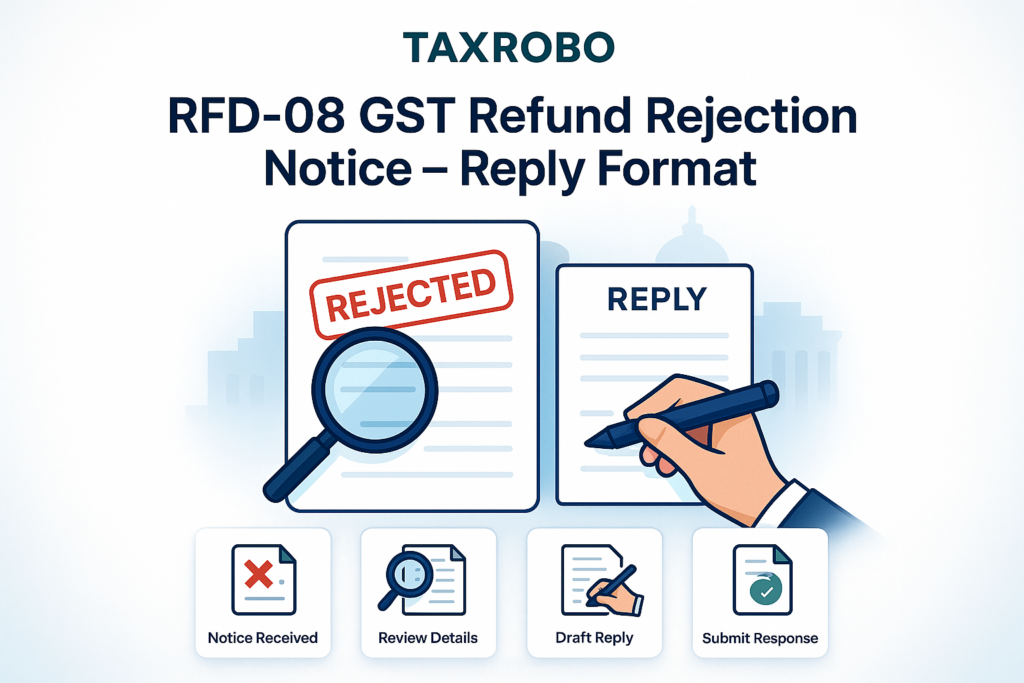

RFD-08 GST Refund Rejection Notice – Reply Format
Receiving a notice from the GST department can be a stressful experience for any business owner. One such communication that can cause immediate concern is Form GST RFD-08. If you have received this notice, it means there is a potential issue with your refund claim that needs your urgent attention. This post will break down exactly what a GST refund rejection notice (Form RFD-08) is, the common reasons for receiving one, and how to respond effectively. We will provide a clear, step-by-step guide and a practical RFD-08 reply format India to help you protect your business interests and secure the refund you are rightfully owed.
What is Form GST RFD-08? Understanding the GST Refund Rejection Notice
Form GST RFD-08 is officially titled a “Notice for rejection of application for refund.” However, it is crucial to understand that this is not a final rejection order. Instead, it should be viewed as a show-cause notice. A GST officer issues this notice when they find discrepancies or deficiencies in your refund application and want you to explain why your claim should not be rejected. It provides you with a critical opportunity to present your case, submit clarifications, and provide supporting documents to validate your claim. This notice is a standard and vital part of the GST refund notice procedure India, designed to ensure that only legitimate claims are processed while giving taxpayers a fair chance to address any issues identified by the department. Understanding its purpose is the first step in formulating a successful response and avoiding unnecessary financial strain on your business.
Common Reasons for Receiving an RFD-08 Notice
A tax officer can issue a Form GST RFD-08 for various reasons, most of which stem from inconsistencies in documentation or non-compliance with GST laws. Being aware of these common pitfalls can help you not only in replying to a notice but also in filing error-free refund applications in the future.
- Invoice Mismatch: This is one of the most frequent reasons. Discrepancies between the details reported in your GSTR-1, the summary figures in your GSTR-3B, and the physical or digital invoices you submitted with your refund application will almost certainly trigger a notice.
- ITC Claim Errors: The officer may find issues with your Input Tax Credit (ITC) claims. This could include claiming ITC on goods or services that are ineligible, claiming ITC that doesn’t appear in your GSTR-2A/2B, or simple calculation errors in the amount of ITC being claimed as a refund.
- Export Documentation Issues: For export-related refunds (with or without payment of tax), incomplete or incorrect documentation is a major red flag. This includes missing shipping bills, incorrect details on the bill of lading, absence of Bank Realisation Certificates (BRCs) or Foreign Inward Remittance Certificates (FIRCs) to prove receipt of export proceeds.
- Violation of GST Rules: Your refund claim may be flagged for non-compliance with specific conditions mentioned in the
GST refund application guidelines India. For example, you might not have filed all your GST returns for the relevant period, which is a prerequisite for claiming a refund. - Incorrect HSN/SAC Codes: Using the wrong Harmonized System of Nomenclature (HSN) codes for goods or Services Accounting Codes (SAC) for services can lead to classification disputes and cause the officer to question the validity of the tax rates applied and the subsequent refund amount.
Key Components to Check in Your RFD-08 Notice
To draft an effective reply, you must first understand the notice itself. Carefully examine every section of the Form GST RFD-08 you have received. Pay close attention to the following components:
- ARN (Application Reference Number): This unique number identifies your specific refund application. You will need it for all future correspondence and for filing your reply on the GST Portal.
- Date of Issue: This is a critical piece of information. Your deadline to reply is calculated from this date, and missing the deadline can lead to the automatic rejection of your refund claim.
- Grounds for Rejection: This is the most important section of the notice. The officer will list the specific deficiencies, discrepancies, or reasons why they believe your refund claim is inadmissible. These points form the basis of your reply.
- Officer’s Remarks: In addition to the structured grounds for rejection, this section may contain further comments, questions, or specific instructions from the tax officer. Read these remarks carefully as they often provide deeper insight into the officer’s concerns.
The Correct Procedure for Your GST Refund Notice Reply
Replying to a Form GST RFD-08 is a formal process that must be completed on the GST Portal. A timely, systematic, and well-documented response is your best strategy for getting your refund claim approved. Panicking or providing a hasty, incomplete reply can jeopardize your claim. Instead, follow a structured procedure to address all the concerns raised by the tax officer comprehensively. This ensures that you present a strong, evidence-backed case that is easy for the officer to review and accept, thereby expediting the resolution and minimizing the chances of a complete rejection of your application.
Step 1: Carefully Analyze the Notice
The first and most important step is to remain calm and carefully read the entire RFD-08 notice. Do not skim through it. Go through the “Grounds for Rejection” section point by point. Create a checklist of every single deficiency or query raised by the officer. For each point, refer back to the original refund application and documents you submitted. This mapping exercise will help you understand precisely what information the officer is missing or what discrepancy they have identified. This detailed analysis forms the foundation of your reply and ensures you don’t miss addressing any of the officer’s concerns.
Step 2: Gather All Supporting Documents
Once you have a clear list of the issues, your next step is to gather all the necessary documentary evidence to counter each point. Create a dedicated digital folder for your reply and save clear, legible scans of all relevant documents. A strong paper trail is your best defense. This checklist should include:
- Copies of the specific tax invoices that are in question.
- Screenshots or downloaded copies of your GSTR-1 and GSTR-3B filings for the relevant tax periods.
- Supporting logistical documents like e-way bills, shipping bills, bills of lading, or any other export-related paperwork.
- Proof of payment or receipt, such as bank statements, Bank Realisation Certificates (BRCs), or Foreign Inward Remittance Certificates (FIRCs).
- A detailed written clarification letter on your company letterhead that explains your position on each query in simple terms.
Step 3: Draft Your Reply in Form GST RFD-09
The official GST refund rejection notice reply must be filed online through the GST Portal. The designated form for this purpose is Form GST RFD-09, which is titled “Reply to Show Cause Notice.” You cannot reply via email or physical letter; the submission must be made through the portal to be considered valid. To do this, you will need to log in to the official GST Portal, navigate to the “Replies to Notices” section, and locate the RFD-08 notice by its reference number. This is where you will fill in your clarifications and upload the supporting documents you gathered in the previous step.
A Practical GST Refund Rejection Format for Your Reply (Form RFD-09)
Structuring your reply within Form GST RFD-09 in a clear and logical manner is crucial. A well-organized response makes it easy for the tax officer to understand your arguments and verify your documents, significantly increasing the chances of a favorable outcome. The key is to address each of the officer’s points directly and provide a corresponding piece of evidence. This systematic approach demonstrates professionalism and leaves no room for ambiguity. Adopting a clear GST refund rejection format shows that you have carefully considered the notice and are providing a thorough and justified response.
Section 1: Basic Information
This is the straightforward part of the form. You will need to ensure that all the preliminary details are filled in accurately. This information is automatically populated in most cases but should always be double-checked.
- GSTIN: Your Goods and Services Tax Identification Number.
- Legal Name: The name of your business as registered on the GST portal.
- ARN: The Application Reference Number of the refund claim, as mentioned in the RFD-08 notice.
Section 2: Point-by-Point Rebuttal
This is the core of your reply where you build your case. Do not write a single, long paragraph. Instead, structure your response to mirror the queries in the RFD-08 notice. Address each deficiency individually and systematically for maximum clarity.
Here is a sample GST refund rejection format you can adapt:
Deficiency 1 as per RFD-08: “Mismatch in taxable value for Invoice No. INV-456 dated 15/02/2023. Value as per GSTR-1 is Rs. 50,000, but the invoice copy submitted shows Rs. 45,000.”
Our Reply/Clarification: “We respectfully clarify that the value of Rs. 50,000 declared in GSTR-1 is correct. The initial invoice for Rs. 45,000 was for the primary service, and a supplementary debit note (DN-012) for Rs. 5,000 was issued on 18/02/2023 for additional charges. Both documents have been considered for the GSTR-1 filing. We have attached a copy of the original invoice, the debit note, and a reconciliation statement for your reference.”
Supporting Document Attached: Invoice_INV-456.pdf, Debit_Note_DN-012.pdf, Reconciliation_Statement.xlsx
Deficiency 2 as per RFD-08: “Shipping Bill No. 9876543 has not been provided for the export claim.”
Our Reply/Clarification: “We apologize for the omission. The Shipping Bill No. 9876543 dated 25/02/2023 is attached herewith for your verification. All details in the shipping bill match the details provided in our refund application.”
Supporting Document Attached: Shipping_Bill_9876543.pdf
Pro Tip: Always maintain a polite and professional tone. Stick to the facts and avoid making emotional or accusatory statements.
Section 3: Attaching Documents and Verification
After drafting your point-by-point rebuttal, the GST portal will provide an option to upload your supporting documents. Ensure that each file is named clearly (e.g., Invoice_123.pdf, BRC_March_2023.pdf) so the officer can easily identify them. Once all clarifications are entered and documents are uploaded, the final step is to submit the reply. This must be done using a Digital Signature Certificate (DSC) for companies and LLPs, or an Electronic Verification Code (EVC) for other taxpayers. This final verification authenticates your submission.
What Happens After You Submit? The GST Refund Rejection Appeal Process
Once you have successfully filed your reply in Form GST RFD-09, the officer will review your submission. The timeline for their decision can vary, but your part in the show-cause process is complete. There are a few possible outcomes that you should be prepared for, each communicated through a formal order. Understanding these potential next steps is important, as the journey might not end with your reply. It’s crucial to know what to expect and how to proceed, especially if the decision is not in your favor, which may require initiating the formal GST refund rejection appeal process.
Outcome 1: Refund is Approved (Form GST RFD-06)
This is the ideal outcome. If the tax officer is satisfied with the explanations and documentary evidence you have provided, they will accept your clarifications. They will then pass a final refund sanction order in Form GST RFD-06. This order will detail the amount of the refund that has been approved. Following this order, the refund amount will be credited to your registered bank account, and the process is successfully concluded.
Outcome 2: Refund is Rejected (Form GST RFD-06)
If the officer is not convinced by your reply or finds that the documents are still insufficient to validate your claim, they will proceed with the rejection. A rejection order will also be issued in Form GST RFD-06. Crucially, this order must clearly state the final, detailed reasons for the rejection of all or part of your refund claim. This document is extremely important because the reasons cited within it will form the basis of any future appeal you decide to file.
The Next Step: Filing an Appeal
Receiving a rejection order in RFD-06 does not mean you have reached a dead end. The GST framework provides a structured grievance redressal mechanism. Your next course of action is to file a formal appeal with the designated Appellate Authority. This officially begins the GST refund rejection appeal process. The appeal must be filed within the prescribed time limit from the date of receiving the rejection order. This process is more formal and legalistic than the reply stage and involves filing specific forms (like Form APL-01) and potentially presenting your case in a hearing. Given the complexities, it is highly recommended to seek professional guidance from experts like TaxRobo to navigate the appeal process effectively.
Conclusion
Facing a GST refund rejection notice in Form RFD-08 can seem daunting, but it is a structured and manageable process if approached correctly. The key to success lies in a timely and meticulous response. By understanding the deficiencies cited by the officer, gathering strong documentary evidence, and preparing a detailed, point-by-point GST refund rejection notice reply in Form RFD-09, you can significantly improve your chances of getting your claim approved. A calm, organized, and evidence-based approach is always the best strategy.
Don’t let procedural complexities and paperwork jeopardize your business’s vital cash flow. If you need assistance in drafting a professional reply to a GST notice or require expert guidance to navigate the refund or appeal process, contact the experts at TaxRobo today. We ensure your case is presented accurately, professionally, and effectively, safeguarding your financial interests.
Frequently Asked Questions (FAQs)
1. What is the time limit to reply to a GST RFD-08 notice?
You must file your reply in Form GST RFD-09 on the GST Portal within 15 days from the date you receive the RFD-08 notice. It is extremely important to adhere to this timeline. If you fail to reply within this period, the tax officer may reject your refund application outright based on the information available on record.
2. What are the most common mistakes to avoid in a GST refund rejection notice reply?
The most common mistakes include:
- Vague or Incomplete Answers: Not addressing each point raised by the officer directly.
- Missing Documents: Failing to attach all necessary supporting evidence for your claims.
- Missing the Deadline: Not submitting the RFD-09 reply within the stipulated 15 days.
- Incorrect Format: Providing a generic, paragraph-style reply instead of a structured, point-by-point rebuttal.
3. Can I file a new refund application if my claim is rejected?
No. Once a refund application for a specific period or transaction is formally rejected via an order in Form GST RFD-06, you cannot file a new application for the same claim. Your only available course of action is to challenge the rejection order by entering the GST refund rejection appeal process and taking the matter to a higher authority.
4. Where can I find the best RFD-08 reply format in India?
The best format is a systematic, point-by-point rebuttal drafted within Form GST RFD-09. The sample template provided in this blog post serves as an excellent practical guideline for structuring your clarifications and linking them to evidence. For complex cases involving multiple legal interpretations or significant amounts, it is highly advisable to consult a tax professional. They can help you draft a customized and legally sound reply that maximizes your chances of success.