
GST Investigation Notice – Reply Format & Practical Guide
Receiving an official notice from the GST department can be a stressful experience for any business owner. The sight of a formal envelope with a government seal often triggers anxiety and confusion, leaving you to wonder what you did wrong and what the consequences might be. This article is designed to demystify the entire process and serve as your trusted guide. We will provide a clear, actionable framework for preparing a proper GST investigation notice response, ensuring you can handle the situation with confidence and precision. Understanding the steps involved in replying to a GST investigation notice in India is the first step toward resolving the issue efficiently and protecting your business from unnecessary complications.
Understanding Why You Received a GST Investigation Notice
Before diving into the process of drafting a reply, it’s essential to understand why the GST department might send you a notice in the first place. A common misconception is that a notice is an outright accusation of fraud or tax evasion. While that can be the case in serious situations, most notices are simply requests for information, clarification, or the rectification of discrepancies found during automated data analysis. The GST Network (GSTN) is a powerful system that cross-references data from various returns and sources, and any mismatch can trigger an alert. Therefore, a notice is a formal mechanism for the tax authorities to communicate these flagged issues to you and give you an opportunity to explain. This proactive approach helps in maintaining transparency and is a core part of understanding GST investigation procedures in India, which ultimately aims to ensure that the correct amount of tax is paid to the government.
Common Triggers for a GST Investigation Notice
GST authorities issue notices for several reasons, most of which stem from data mismatches or non-compliance. Being aware of these common triggers can help you maintain better records and reduce the chances of receiving a notice.
- Mismatch in Returns: This is one of the most frequent reasons. Discrepancies between the sales declared in GSTR-1 and the tax paid in GSTR-3B, or a mismatch between your claimed Input Tax Credit (ITC) in GSTR-3B and the details available in your GSTR-2A/2B, are major red flags.
- Input Tax Credit (ITC) Issues: Claiming excessive ITC compared to your business’s scale, claiming ITC on items that are ineligible (blocked credits), or claiming ITC from suppliers whose GST registration has been cancelled can lead to a notice.
- E-way Bill Discrepancies: A significant difference between the value of goods transported as per your e-way bills and the turnover declared in your GSTR-3B can indicate suppressed sales.
- Delayed Filing of Returns: Consistently failing to file your GSTR-1 and GSTR-3B on time can lead to scrutiny, as it suggests potential financial distress or an attempt to delay tax payments.
- Suspicious Transactions: The GST department often receives intelligence from other government bodies like the Income Tax Department or the Directorate of Revenue Intelligence. If these agencies report suspicious activities or high-value transactions that don’t align with your GST filings, an investigation can be initiated.
- Non-compliance: This includes fundamental lapses such as failing to obtain GST registration even when your turnover exceeds the prescribed threshold, or not paying the correct tax under the reverse charge mechanism (RCM). Ensuring proper registration is the first step; our Ultimate Guide to GST Registration for Small Businesses can help.
First Steps After Receiving the Notice: A Practical Checklist
The moment you receive a GST notice, it’s crucial to act methodically rather than panic. Your initial actions can set the tone for the entire process. This section of our GST investigation practical guide in India provides a checklist of immediate steps you should take to ensure you are well-prepared to handle the inquiry. A calm, organized approach will help you understand the issue clearly and prepare a response that is both effective and timely, minimizing the risk of adverse consequences.
1. Verify the Notice’s Authenticity
In today’s digital age, fake notices can be circulated to defraud taxpayers. The first and most critical step is to verify the legitimacy of the notice you have received. The Central Board of Indirect Taxes and Customs (CBIC) has mandated that every communication from the GST department must have a computer-generated Document Identification Number (DIN). You can easily verify this DIN on the official government portal.
- Go to the official CBIC website or the GST Portal.
- Find the “Verify DIN” or a similar option.
- Enter the DIN mentioned on your notice.
- If the DIN is valid, the portal will display details about the notice, confirming its authenticity. An invalid DIN means the notice is not genuine, and you should not respond to it without further clarification from the department.
2. Read the Notice Carefully and Identify the Issue
Once you have confirmed the notice is authentic, read it thoroughly several times. Do not just skim it. The notice will contain specific details about the perceived discrepancy or the reason for the investigation. Pay close attention to the following:
- The Specific Allegation: What is the exact issue? Is it a mismatch in ITC, a difference in turnover, or something else?
- The Legal Section Cited: The notice will mention the section of the CGST Act under which it has been issued (e.g., Section 61 for scrutiny of returns, Section 73 for non-fraud cases, or Section 74 for fraud cases). The section cited indicates the seriousness of the matter. For non-fraud cases, see our guide on Understanding Section 73 of the CGST Act: Handling GST Demand Notices Without Fraud.
- Requested Documents: The notice will list the specific documents and information you need to provide, such as invoices, ledgers, bank statements, or reconciliation statements.
3. Note the Deadline for Your Response
This is a non-negotiable step. Every GST notice will specify a deadline by which you must submit your reply. This is usually 15 or 30 days from the date of issuance. Missing this deadline can have serious consequences, including the officer passing an ex-parte order (a decision made without hearing your side) and imposing penalties. Mark the date on your calendar, set reminders, and start preparing your response well in advance. If you believe you cannot meet the deadline for a valid reason, you can formally request an extension from the issuing officer.
How to Draft an Effective GST Investigation Notice Response
Drafting a reply to a GST notice is a formal process that requires precision, clarity, and factual accuracy. Your GST investigation notice response is your official statement to the tax authorities and serves as the primary document they will use to evaluate your case. The goal is to provide a comprehensive explanation that addresses every query raised in the notice, supported by concrete evidence. A vague, incomplete, or emotional response can complicate matters further. The reply should be structured professionally, address each point logically, and leave no room for ambiguity, demonstrating your commitment to compliance.
Key Components of a Strong Reply
A well-structured reply makes it easier for the GST officer to understand your position. Ensure your response includes these essential components.
- Acknowledgement: Begin by formally acknowledging the receipt of the notice. Mention the notice’s reference number (SCN/Notice Number) and the date it was issued. This establishes a clear reference for all future correspondence.
- Factual Submission: This is the core of your reply. Address each allegation or query raised in the notice one by one, in the same order they appear. Provide a clear, point-by-point rebuttal or explanation. Use simple language and stick to the facts. If there was a genuine error on your part, admit it and explain the circumstances.
- Supporting Documents: Every claim you make in your reply must be backed by documentary evidence. Clearly list all the documents you are enclosing as annexures. This could include tax invoices, credit/debit notes, ledger copies, bank statements, GSTR reconciliation statements, or any other relevant records that substantiate your claims.
- Legal Basis (if applicable): If your case involves a matter of legal interpretation, support your stance by citing relevant sections of the GST Act, related rules, circulars, or even judgments from courts or tribunals. This adds significant weight to your argument.
- Conclusion & Prayer: Conclude your reply with a summary of your position. Politely request the officer to consider your submissions and the provided evidence, and to drop the proceedings initiated by the notice.
GST Investigation Notice Response Format India: A Structural Outline
While the exact content will vary, the structure should remain professional. You can use your company letterhead for the reply. Here is a basic template to follow for the GST investigation notice response format in India:
[Your Company’s Letterhead]
GSTIN: [Your GSTIN]
Address: [Your Registered Address]Date: [Date of Reply]
To,
[Designation of the Issuing Officer]
[Address of the GST Department Office]Subject: Reply to Show Cause Notice / Intimation dated [Date of Notice] with Reference No. [Reference Number]
Respected Sir/Madam,
Para 1: Acknowledgement
We are in receipt of the Show Cause Notice/Intimation dated [Date of Notice] with Reference No. [Reference Number], issued under Section [e.g., 73(1)] of the CGST Act, 2017. We have carefully perused the contents of the said notice and are submitting our point-wise reply as under.Para 2: Point-wise Reply
1. Allegation 1: [State the allegation from the notice].
Our Submission: [Provide your detailed explanation with facts and figures]. We are enclosing [mention supporting document, e.g., a reconciliation statement] as Annexure-A to support our submission.
2. Allegation 2: [State the next allegation].
Our Submission: [Provide your detailed explanation]. Please refer to Annexure-B for the relevant [e.g., tax invoices].(Continue this for all allegations)
Para 3: Conclusion & Prayer
In light of the facts, submissions, and supporting documents provided above, it is clear that [summarize your position, e.g., the discrepancy was due to a clerical error which has since been rectified]. We humbly request your good office to consider our reply and drop the proceedings initiated via the aforementioned notice. We assure you of our full cooperation in this matter.Attachments:
1. Annexure-A: [Name of Document]
2. Annexure-B: [Name of Document]Thanking you,
Yours sincerely,
For [Your Company Name],
[Signature]
[Name of Authorized Signatory]
[Designation]
Do’s and Don’ts When Replying
| Do’s | Don’ts |
|---|---|
| ✅ Be Truthful: Always provide accurate information. | ❌ Ignore the Notice: This leads to penalties and ex-parte orders. |
| ✅ Be Prompt: Respond well before the deadline. | ❌ Provide Vague Answers: Be specific and address each point. |
| ✅ Keep Copies: Maintain a record of the notice and your reply. | ❌ Submit False Documents: This is a serious offense with severe penalties. |
| ✅ Be Respectful: Use a formal and polite tone in your reply. | ❌ Miss the Deadline: Request an extension if you cannot reply in time. |
When to Seek Professional Help
While you can handle simple notices for minor discrepancies internally, some situations are complex and carry significant financial and legal risks. In such cases, trying to manage the response on your own can be counterproductive. Knowing when to call in an expert is a crucial part of a sound business strategy. A tax professional, such as a Chartered Accountant or a tax lawyer, brings in-depth knowledge of GST laws, procedural expertise, and experience in dealing with tax authorities, which can be invaluable in navigating a serious investigation.
You should strongly consider seeking professional assistance in the following scenarios:
- The notice involves a large tax demand: If the potential tax liability mentioned in the notice is substantial, the stakes are too high to risk a poorly drafted reply.
- It alleges fraud or willful misstatement: A notice issued under Section 74 of the CGST Act is extremely serious, as it implies intent to evade tax. You can learn more about Section 74 of the CGST Act: Dealing with GST Demand Notices Involving Fraud. These cases involve heavy penalties and potential prosecution, requiring expert legal defense from the very beginning.
- You are unsure about the legal interpretation: If the notice raises complex legal questions or refers to provisions of the law that you do not fully understand, a professional can provide the necessary clarity and craft a legally sound argument.
- The case requires representation: If the notice requires you to appear in person before a GST officer, having a professional represent you can make a significant difference. They know how to present the case effectively and handle queries from the authorities.
Navigating GST law can be complex. The experts at TaxRobo specialize in handling GST matters and can help you draft a precise and legally sound reply. Contact us today for a consultation.
Conclusion
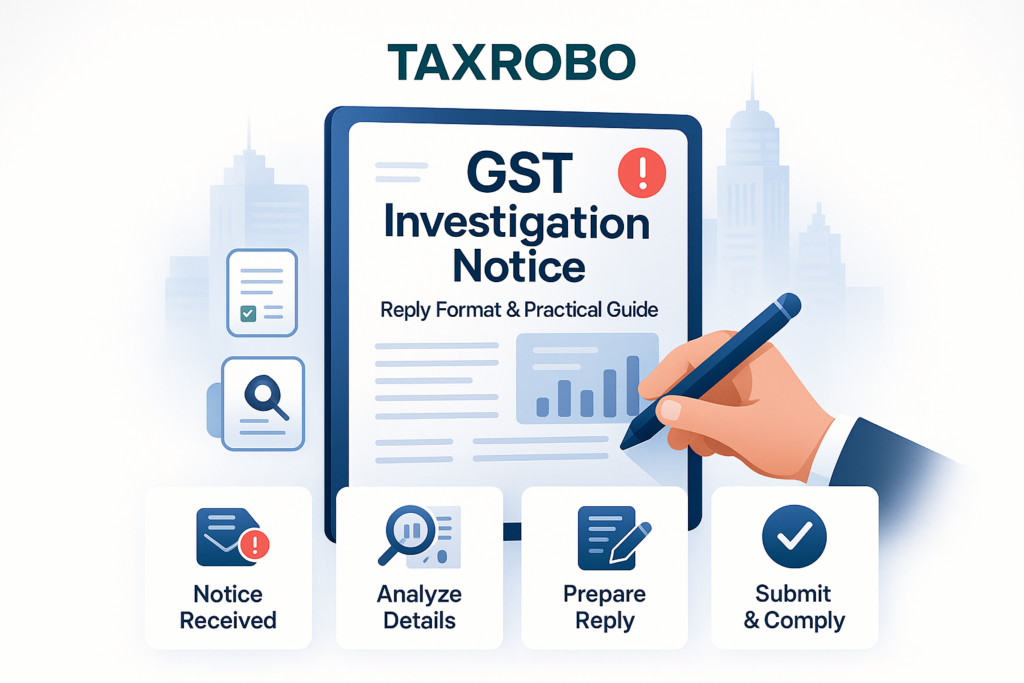
Facing a GST investigation notice doesn’t have to be a crisis. By following a structured approach—Verify, Understand, Collate Documents, and Draft a Factual Reply—you can address the department’s queries effectively and professionally. The key is to be proactive, transparent, and meticulous in your preparation. A timely and well-drafted GST investigation notice response is not just a procedural formality; it is a critical tool for resolving disputes, preventing penalties, and demonstrating your commitment to compliance. This process is a fundamental part of any robust GST compliance guide for businesses in India. Don’t let a GST notice disrupt your business. Stay compliant and seek expert guidance when needed. TaxRobo is here to support you every step of the way.
Frequently Asked Questions (FAQ)
1. What happens if I ignore a GST investigation notice?
Ignoring a GST notice is a serious mistake. The GST officer has the authority to proceed with an ex-parte order, which is a decision made based on the information available to them, without considering your side of the story. This can lead to the confirmation of the proposed tax demand, imposition of heavy penalties, and initiation of recovery proceedings, which may include the attachment of your business bank accounts.
2. Can I request an extension for replying to the notice?
Yes, in most genuine cases, you can request an extension. You must submit a formal written request to the issuing officer before the original deadline expires. In your request, you should clearly state the valid reasons for needing more time, such as the complexity of the data required or the unavailability of key personnel. The decision to grant an extension is at the discretion of the GST officer.
3. What is the difference between scrutiny (ASMT-10) and an investigation notice?
A scrutiny notice, typically issued in Form ASMT-10, is a preliminary, system-driven check of your returns to identify and communicate minor discrepancies. It’s an opportunity for you to explain the mismatch. An investigation notice is more serious and is issued when there is a specific reason or intelligence to believe that tax has been evaded. Investigations are more in-depth and can involve summons for personal appearance, detailed examination of books, and inspection of business premises.
4. Do I need a Chartered Accountant (CA) or a lawyer to handle a GST notice?
While it is not legally mandatory to hire a professional for every notice, it is highly recommended, especially for complex cases. For a simple scrutiny notice (ASMT-10), you might be able to reply on your own. However, for notices involving significant tax demands, allegations of fraud (Section 74), or complex legal questions, engaging a CA or a tax lawyer is crucial to ensure your response is accurate, legally sound, and effectively protects your interests.