
How to Draft an E-Way Bill Notice Response: Reply Format & Guide 2023
Receiving a formal notice from the GST department can be stressful for any business owner. One of the most common automated notices businesses receive today is for a mismatch between the turnover declared in GSTR-1/GSTR-3B returns and the data captured from the E-Way Bill system. This scrutiny, often initiated via Form ASMT-10, can seem daunting, but with a systematic approach, it can be handled effectively. This guide provides a clear, step-by-step process and a professional E-Way Bill notice response format to help you address this issue confidently and efficiently. A timely and well-documented reply is not just about resolving a specific query; it is a critical component of maintaining good GST compliance in India and preventing potential penalties or further legal complications.
Understanding Why You Received a GST Notice for E-Way Bill Mismatch
Before drafting a reply, it’s essential to understand the underlying mechanics of the E-Way Bill system and the common reasons that trigger these discrepancy notices. The GST Network (GSTN) has become increasingly sophisticated, using data analytics to compare various filings. A mismatch between the value of goods you’ve moved (as per E-Way Bills) and the sales you’ve declared (as per GST returns) is a significant red flag for the tax authorities, prompting them to seek clarification. Understanding the root cause of this difference is the first and most crucial step in preparing an accurate and convincing response that will satisfy the department’s query.
A Quick Refresher: What is a GST E-Way Bill?
To understand the complete E-Way Bill: Meaning, Rules, & Online Generation, it’s essential to know it is an electronic document that must be generated on the common portal before the commencement of the movement of goods. Its primary purpose is to track the movement of goods and check tax evasion. It is mandatory for any registered person who causes the movement of goods of a consignment value exceeding ₹50,000. This document contains crucial details, including the names and GSTINs of the supplier and recipient, the place of delivery, invoice details, the value of goods, and transporter information. The GSTN automatically captures this data and uses advanced algorithms to reconcile it with the turnover figures you report in your monthly or quarterly GSTR-1 and GSTR-3B returns. When the system detects a significant variance, it flags the GSTIN for scrutiny, leading to the issuance of a notice. You can access all related services on the official E-Way Bill Portal.
Common Reasons for GST Turnover Differences in India
The discrepancy between your E-Way Bill data and your GSTR-1 turnover is not always a case of tax evasion. More often than not, it arises from legitimate business scenarios and procedural differences. Identifying the specific cause applicable to your business is key to drafting a precise reply. Here are some of the most common reasons for GST turnover differences in India:
- Non-Supply Transactions: Many E-Way Bills are generated for the movement of goods that do not result in a taxable sale within that period. This includes sending goods to a job worker, transferring stock between your own branches in different states (using a delivery challan), or sending goods for exhibition or on an approval basis. These values appear in the E-Way Bill system but are not part of your taxable turnover in GSTR-1.
- Cancelled Transactions: A common operational issue is when an E-Way Bill is generated for a dispatch, but the customer cancels the order before delivery. While a credit note is issued to nullify the sale in your books, the corresponding E-Way Bill may not have been cancelled within the stipulated 24-hour window.
- Timing Mismatch: This frequently occurs at the end of a financial month or quarter. An E-Way Bill might be generated on the last day of the month (e.g., 30th March) as the goods leave the factory, but the tax invoice is dated the next day (e.g., 1st April). In this case, the turnover is correctly reported in the GSTR-1 of the subsequent month (April), creating a temporary mismatch for the month of March.
- Clerical and Typographical Errors: Simple human errors can also be a cause. An incorrect value might be entered while generating the E-Way Bill, or a typographical error could occur while filing the GSTR-1 return. For instance, an extra zero in the E-Way Bill value can create a substantial, albeit artificial, discrepancy. Learning How to Correct Errors in Your GST Returns is crucial for preventing such notices.
- B2C (Business to Consumer) Supplies: In GSTR-1, businesses are required to report B2C sales in a consolidated, state-wise summary. However, if E-Way Bills were generated for individual B2C movements (for instance, high-value goods sent to individual customers), it becomes difficult for the system to automatically reconcile the consolidated GSTR-1 figure with multiple individual E-Way Bills.
A Step-by-Step Guide to Preparing Your E-Way Bill Notice Response
Once you understand the potential reasons for the mismatch, you can follow a structured process to analyze the notice, reconcile your data, and prepare a comprehensive reply. A methodical approach ensures that no detail is overlooked and that your response is supported by solid evidence. This process transforms a potentially stressful situation into a manageable compliance task.
Step 1: Analyze the GST Notice Carefully
The first rule upon receiving any departmental notice is not to panic. The notice, typically in Form GST ASMT-10, is a preliminary communication asking for an explanation, not a confirmed demand. Read it carefully and make a note of the following crucial details, which will guide your internal review process. Adhering to these GST notice guidelines India is the first step toward a successful resolution.
- The Specific Tax Period(s): Identify the exact months or quarters for which the discrepancy has been raised.
- The Discrepancy Amount: Note the precise value of the difference between E-Way Bill turnover and GSTR-1 turnover as calculated by the department.
- The Deadline for Reply: This is the most critical piece of information. Ensure you know the exact date by which you must submit your response to avoid any adverse action.
Step 2: Conduct a Detailed Internal Reconciliation
Your reply will only be as strong as the data supporting it. Proper Maintenance of Books of Accounts: Section 128 Explained is the foundation for this reconciliation. The next step is to conduct a thorough internal audit to pinpoint the exact reasons for the discrepancy mentioned in the notice. This reconciliation is the backbone of your response.
- Gather Your Data: Download the E-Way Bill generation report (specifically “Report EWBs by me”) from the E-Way Bill portal for the entire period mentioned in the notice. Simultaneously, download your detailed GSTR-1 data from the GST portal for the same period.
- Compare with Books of Accounts: The most crucial comparison is against your primary source of truth: your company’s sales register or accounting software. This will help you validate the figures reported in your returns.
- Create a Reconciliation Statement: Prepare a detailed statement, preferably in an Excel sheet. This sheet should have columns for EWB Number, EWB Date, Taxable Value as per EWB, corresponding Invoice Number, Invoice Date, Taxable Value as per GSTR-1, the calculated difference for that entry, and a final column for “Reason for Difference.” This statement will form the primary annexure to your formal reply.
Step 3: Gather All Supporting Documents
An explanation without documentary proof holds little weight with tax authorities. Once you have identified the reasons for the mismatch in your reconciliation statement, you must gather all the necessary evidence to substantiate your claims. A well-organized set of documents makes it easier for the officer to understand and accept your explanation.
- A copy of the GST notice (ASMT-10) you received.
- The detailed month-wise reconciliation statement you prepared in Step 2.
- Copies of relevant tax invoices for transactions that correctly match.
- Copies of delivery challans for movements like job work or branch transfers.
- Copies of credit notes issued for cancelled orders or sales returns.
- Proof of E-Way Bill cancellation, if applicable.
- Any other relevant documents, such as transporter receipts or e-mails confirming order cancellation, that can support your case.
The Perfect Reply Format for a GST Notice on E-Way Bill Discrepancy
After completing your analysis and gathering the evidence, the final step is to draft a formal and professional reply. Using a clear and structured reply format for a GST notice ensures that your points are communicated effectively and leaves a positive impression on the assessing officer. Your response should be factual, polite, and directly address the queries raised in the notice, making it easy for the officer to process and close the inquiry. A well-drafted E-Way Bill notice response format is your best tool for a swift resolution.
Structure of the Formal Reply Letter
Your reply should be drafted on your company’s official letterhead and submitted online through the GST portal. The structure should be logical and easy to follow.
- Header: Your company’s letterhead with your business Name, Address, and GSTIN clearly mentioned at the top.
- Date & Notice Reference: State the current date and, most importantly, the specific Notice Reference Number (DIN/Reference No.) and date from the notice you received.
- Addressee: Address the reply to the correct authority, for example, “To, The Proper Officer, [Jurisdiction/Ward mentioned in the notice]”.
- Subject Line: The subject should be clear and concise. For example: “Reply to Show Cause Notice regarding mismatch between E-Way Bill data and turnover declared in GSTR-1 for the period [mention the specific period, e.g., F.Y. 2022-23]”.
- Introduction: Begin by acknowledging the receipt of the notice. A simple introductory line would be: “This is with reference to the notice dated [XX/XX/XXXX] with DIN [XXXXXXXX] requiring us to explain the discrepancy in turnover as per E-Way Bills generated and turnover declared in Form GSTR-1 for the aforementioned period.”
- Point-wise Explanation: This is the most critical section of your reply. Do not write a long, generic paragraph. Instead, refer to your reconciliation statement and provide a point-wise clarification for the major reasons behind the difference.
- Conclusion & Prayer: Conclude the letter by summarizing your position. Reiterate that the discrepancy is due to legitimate business, timing, or procedural reasons and not due to any suppression of turnover. Politely request the officer to review your submission and the attached documents and to drop the proceedings initiated by the notice.
- Signature & Attachments: The letter must be signed by the authorized signatory (e.g., Director, Partner, Proprietor). Below the signature, clearly list all the documents you are attaching as enclosures (e.g., “Enclosures: 1. Reconciliation Statement (Annexure-A), 2. Copies of relevant delivery challans (Annexure-B)…”).
Sample Snippet for the Reply Body
To give you a practical idea, here is a template you can adapt for the main body of your reply.
“With reference to the above, we have conducted a detailed reconciliation of our E-Way Bill data with our GSTR-1 returns and books of accounts. The reasons for the alleged discrepancy of ₹[Amount] are explained as follows:
- Mismatch due to Non-Supply Transactions (Job Work): A total of ₹[Amount] relates to E-Way Bills generated for the movement of goods for job work purposes, which does not constitute a taxable supply. A list of relevant delivery challans is attached as Annexure-A.
- Mismatch due to Timing Difference: A turnover of ₹[Amount] pertains to an E-Way Bill generated on 31st March 2023, for which the tax invoice was raised on 1st April 2023. This has been correctly declared in the GSTR-1 for April 2023. The invoice copy is attached as Annexure-B.
In light of the above facts and supporting documents, we humbly request your good office to consider our submission and drop the proceedings initiated by the said notice.”
Conclusion
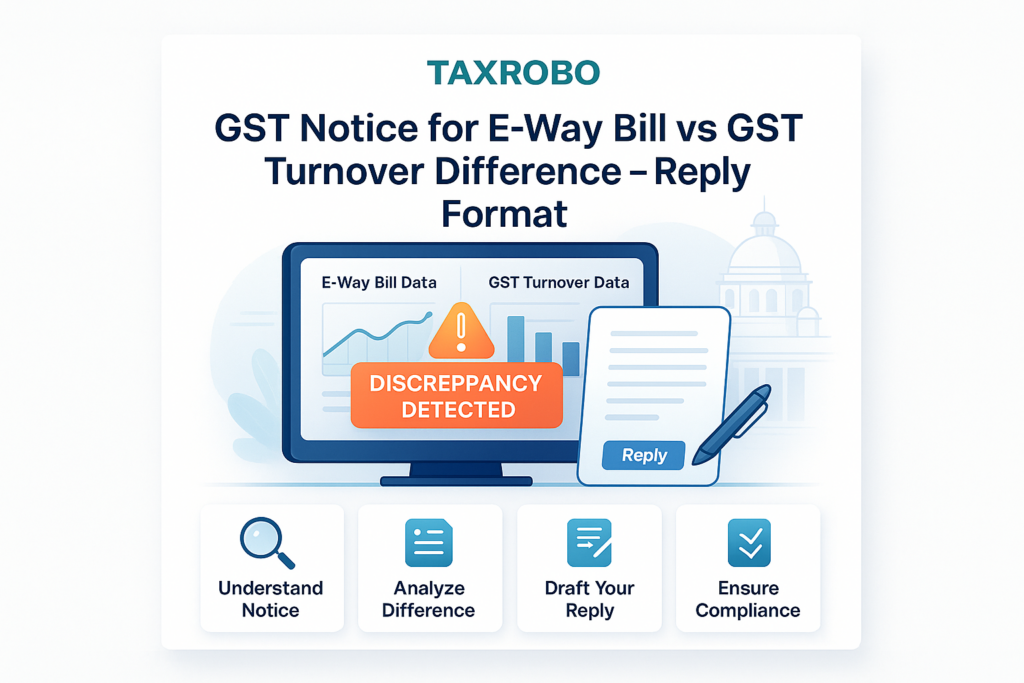
Facing a GST notice can be unsettling, but it is a standard part of the compliance process. By following a clear four-step process—Analyze the notice, Reconcile your data, Document your claims, and Reply formally—you can address the department’s queries effectively. A proactive and well-documented E-Way Bill notice response is the best way to demonstrate transparency, prove the legitimacy of your transactions, and ensure robust GST compliance in India. Ignoring such notices is never an option, as it can lead to assumptions of guilt, resulting in unnecessary penalties and legal hassles.
Navigating GST notices can be complex. If you need expert assistance in reconciling data and drafting a professional reply, TaxRobo’s team of GST experts is here to help. Contact us today to ensure your business remains compliant.
Frequently Asked Questions (FAQ)
Q1: What is the deadline to reply to a GST notice like ASMT-10?
A: The taxpayer is usually given 15 to 30 days from the date of the notice to file a reply. The exact deadline will be mentioned in the notice itself. It is crucial to adhere to this timeline to avoid any negative consequences.
Q2: What happens if I ignore a GST notice for an E-Way Bill mismatch?
A: Ignoring the notice can lead the GST officer to confirm the demand based on the data they have. This could result in the issuance of a formal demand order (Form DRC-07) for the differential tax, along with applicable interest and penalties, assuming you have under-reported your sales.
Q3: Can I file the reply online on the GST portal?
A: Yes, the reply to Form GST ASMT-10 must be filed online on the GST Portal using Form GST ASMT-11. All your supporting documents, including the reconciliation statement and copies of invoices/challans, should be scanned and uploaded as attachments along with the form.
Q4: Do I need a professional to draft my E-Way Bill notice response?
A: While it is not mandatory for very simple and minor discrepancies, engaging a tax professional is highly recommended for significant mismatches or complex cases. A professional can ensure the reconciliation is accurate, the reply is drafted in the correct legal and formal tone, and all nuances are addressed, significantly minimizing the risk of an adverse order from the department.