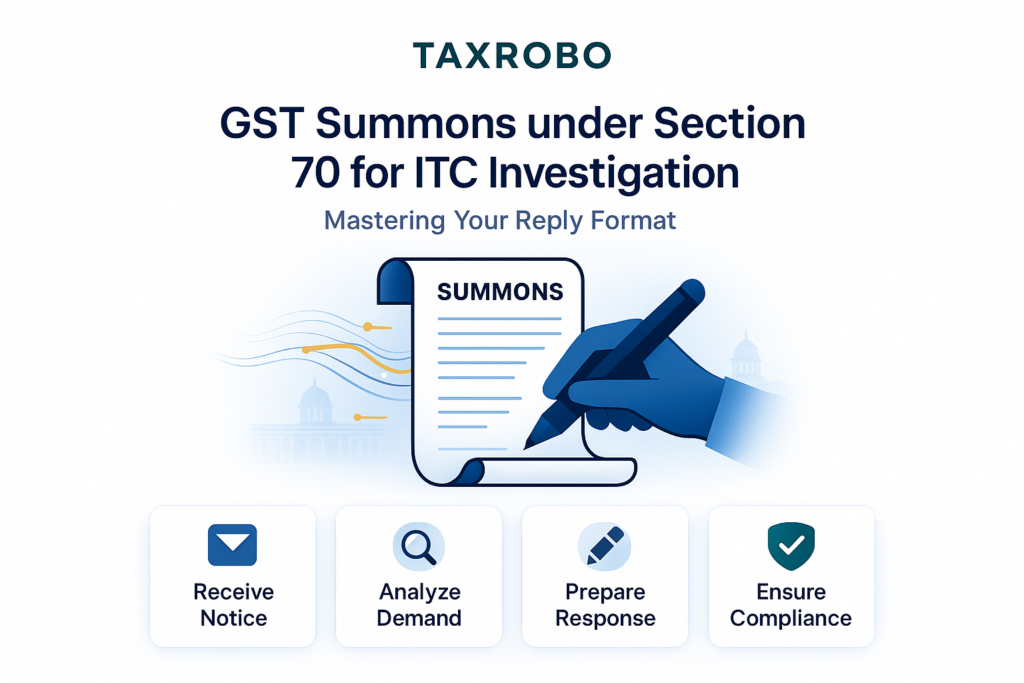

GST Summons under Section 70 for ITC Investigation – Reply Format
Receiving a legal document like a GST summons can be alarming for any business owner. This formal notice, issued by tax authorities, demands your presence or the submission of documents, and it’s a situation that requires immediate and careful attention. When the summons is under Section 70 of the CGST Act and concerns an Input Tax Credit (ITC) investigation, the stakes are even higher. Understanding how to respond correctly is crucial for your business’s compliance and legal safety. This comprehensive GST summons reply format and GST ITC investigation guide India is designed to walk you through the process, helping you draft a professional and effective response to protect your interests.
What is a GST Summons under Section 70?
Understanding the Legal Mandate
Section 70 of the Central Goods and Services Tax (CGST) Act, 2017, is a powerful tool in the hands of GST authorities. It’s one of several provisions outlining the Powers of GST Officers During Investigation (Section 67, 70, 74 Explained). In simple terms, this section gives a duly authorized GST officer the power to summon or call upon any person whose attendance is considered necessary for an ongoing inquiry. The purpose of such a summons is twofold: either to give evidence under oath or to produce specific documents or any other relevant items for examination. Think of it as a formal, legally binding request for information. Non-compliance is not an option and can lead to significant penalties and legal repercussions. Therefore, preparing a proper Section 70 GST summons reply is the first step towards resolving the inquiry efficiently.
Why You Might Receive a Summons for an ITC Investigation
An investigation into Input Tax Credit (ITC) is one of the most common reasons for the issuance of a GST summons. The GST department is highly vigilant about fraudulent ITC claims, which can lead to substantial revenue loss for the government. A summons related to ITC suggests that the authorities have reasons to believe there are discrepancies in your claims.
Here are some common triggers that might lead to a summons as part of a GST ITC investigation guide India:
- Mismatch in Returns: Significant discrepancies between the ITC claimed in your GSTR-3B and the details of inward supplies appearing in your GSTR-2A or GSTR-2B. Understanding the Impact of GSTR-2A and GSTR-3B Mismatches on ITC Claims is crucial for all businesses.
- Suspicion of Fake Invoices: The department may suspect that you have claimed ITC based on invoices from suppliers who are non-existent, non-compliant, or have been flagged for fraudulent activities. These situations fall under the category of Fake ITC Cases in GST – Latest Rules, Penalties & Defence Strategy.
- Non-Receipt of Goods/Services: Claiming ITC for goods or services that were never actually received by your business is a serious offense.
- Circular Trading Allegations: Involvement in “bill trading” or circular trading, where invoices are passed through a chain of entities without any actual supply of goods or services, is a major red flag.
- Audit or Scrutiny Findings: Discrepancies or suspicious transactions identified during a routine GST audit, desk scrutiny, or data analytics by the department can trigger a formal inquiry and summons.
Immediate Steps After Receiving a GST Summons
Discovering a GST summons in your mail can be unsettling, but a calm and methodical approach is your best defense. Acting impulsively or ignoring the document can worsen the situation. Follow these critical first steps.
1. Don’t Panic, Verify the Summons
Before you take any other action, your first priority is to confirm the authenticity of the summons. In the digital age, fraudulent notices are a real possibility. The GST department has implemented a system to ensure transparency and prevent harassment. Every official communication, including a summons, must have a computer-generated Document Identification Number (DIN).
You can verify the genuineness of the notice by visiting the official CBIC website and entering the DIN mentioned on the summons. This simple check ensures you are dealing with a legitimate request from the tax authorities. You can verify it here: CBIC DIN Verification Portal.
2. Read the Summons Carefully
Once you have verified the summons, read the entire document meticulously. Don’t just skim it; understand every detail. The summons is a legal document that outlines exactly what the department requires from you. Pay close attention to the following details:
- Issuing Officer: Note the name, designation, and office address of the officer who has issued the summons.
- Date, Time, and Venue: Mark the exact date, time, and location where you are required to appear.
- Specific Requirements: The summons will list the specific documents, books of accounts, or other records you need to produce. This could include tax invoices, purchase ledgers, bank statements, GSTR filings, and e-way bills.
- Your Capacity: Understand whether you are being summoned as a director, partner, proprietor, employee, or simply as a witness. This will define the scope of your testimony. Knowing how to respond to GST summons India begins with a thorough understanding of what is being asked of you.
3. Seek Professional Guidance Immediately
A GST summons initiates a quasi-judicial proceeding, which means the statements you provide and the documents you submit can be used as evidence. A misstep at this stage can have long-lasting negative consequences for your business. This is not the time for a DIY approach.
Before you draft a reply or appear before the officer, it is crucial to seek professional GST summons legal advice India. Tax experts and lawyers specialize in handling such matters. They can interpret the legal nuances of the summons, help you anticipate the officer’s line of questioning, and ensure your response is legally sound and protects your rights. Our experts at TaxRobo can analyze the summons, help you prepare a robust defense, and guide you through the entire process, ensuring compliance and peace of mind.
How to Prepare the Perfect GST Summons Reply Format
Drafting a reply to a GST summons is a formal process. Your response should be professional, clear, and directly address the points raised in the summons. A well-structured reply not only demonstrates your willingness to cooperate but also creates a positive impression on the investigating officer. The right GST summons reply format is key.
Essential Components of a Professional Reply
Your official response should be structured logically and contain all the necessary information. Using your company’s official letterhead lends authenticity to the document. Here is a breakdown of the essential components of a robust GST summons reply format India:
- Company Letterhead: Always use your official business letterhead.
- Date and Addressee: Mention the current date. Address the reply to the full name, designation, and address of the issuing officer as mentioned in the summons.
- Reference Number: This is critical. Clearly state the Summons Number and Date provided in the official document you received. This helps in easy tracking and filing.
- Subject Line: The subject should be concise and clear. For example: “Reply to Summons issued under Section 70 of the CGST Act, 2017 dated [Insert Date of Summons]”.
- Body of the Letter:
- Acknowledgement: Begin by formally acknowledging the receipt of the summons, referencing its number and date.
- Point-by-Point Response: This is the most important part. Address each query or document request from the summons in a clear, point-wise manner. Stick to the facts and avoid vague or emotional language.
- Statement of Cooperation: Clearly state that you intend to cooperate fully with the inquiry.
- List of Annexures: If you are attaching supporting documents, mention them in a numbered or bulleted list. For example, “Annexure A: Copy of Purchase Invoices from Jan 2023 to Mar 2023”. This keeps the submission organized.
- Conclusion and Signature: End with a formal closing like “Sincerely” or “Yours faithfully.” The reply must be signed by the authorized person (e.g., Director, Partner, Proprietor), along with their designation and the company stamp.
Sample Template: ITC Investigation Response Format India
To make the process easier, here is a template you can adapt. This sample ITC investigation response format India covers all the essential components discussed above.
[Your Company Letterhead]

Date: [Current Date]

To,
[Name of Issuing Officer]
[Designation of Issuing Officer]
[Address of the GST Office]

**Reference: Summons No. [Enter Summons Number] dated [Enter Summons Date]**

**Subject: Reply to Summons issued under Section 70 of the CGST Act, 2017**

Respected Sir/Madam,

1.  This is with reference to the summons issued under your office's authority, bearing the number and date mentioned above. We hereby acknowledge the receipt of the said summons directing [Name of the Person Summoned], [Designation], to appear before your good office on [Date of Appearance] at [Time of Appearance].

2.  In compliance with the directions contained in the summons, we wish to submit the following information and documents as requested:
    *   **Regarding Point 1 of the Summons (e.g., Details of ITC claimed on X invoices):** We submit that... [Provide a clear, factual, and detailed response].
    *   **Regarding Point 2 of the Summons (e.g., Production of purchase ledger):** We are enclosing the purchase ledger for the financial year [FY] as requested. [Continue for all points].

3.  For your kind perusal and record, we are attaching the following self-attested documents as annexures to this letter:
    *   Annexure A: [Description of Document 1, e.g., Copies of Tax Invoices from Supplier XYZ]
    *   Annexure B: [Description of Document 2, e.g., Bank Statement highlighting payments to Supplier XYZ]
    *   Annexure C: [Description of Document 3, e.g., E-way bills for the mentioned transactions]

We assure you of our fullest cooperation in this inquiry and are prepared to provide any further information or clarification as may be required.

Thank you.

Sincerely,
[Your Name]
[Your Designation]
[Company Name & Official Stamp]
Attending the Inquiry: Do’s and Don’ts
Submitting a written reply is often followed by a personal appearance before the GST officer. Your conduct during this appearance is just as important as the documents you submit. Knowing how to reply to GST summons India also involves being prepared for the in-person inquiry.
Preparing for Your Personal Appearance
Your goal is to be cooperative, professional, and truthful. A well-prepared GST compliance response format India extends to your personal conduct.
Do’s:
- ✅ Do organize all your documents systematically. Create an indexed file with all the requested documents and the annexures submitted with your reply.
- ✅ Do carry a copy of the summons, your written reply, and all attached documents.
- ✅ Do be punctual. Arrive at the designated location on time and carry a valid photo ID for verification.
- ✅ Do be honest and factual. Answer all questions truthfully and to the best of your knowledge. If you don’t know an answer, it is better to say so than to provide incorrect information.
- ✅ Do consider having a tax professional or lawyer accompany you, if permitted.
Don’ts:
- ❌ Don’t ignore the summons. Failure to appear without prior intimation can lead to penalties and prosecution.
- ❌ Don’t provide false or misleading information. Lying under oath is a serious criminal offense.
- ❌ Don’t argue with the officer. Maintain a calm and professional demeanor throughout the proceeding, even if the questions are tough.
- ❌ Don’t volunteer unnecessary information. Stick to answering the questions that are asked.
- ❌ Don’t sign any statement without reading and understanding it completely. You have the right to review any statement recorded before signing.
Conclusion
Receiving a GST summons for an ITC investigation can be a daunting experience, but it doesn’t have to be a catastrophe. By following a structured approach—verifying the summons, seeking immediate professional help, using a proper GST summons reply format, and preparing diligently for the personal appearance—you can navigate the process effectively. A timely, well-drafted, and factual response is your first and most critical line of defense in protecting your business from unnecessary complications and penalties.
Navigating a GST summons and ITC investigation requires expert knowledge of tax laws and procedures. Don’t leave it to chance. Contact TaxRobo today for end-to-end assistance, from drafting the perfect GST summons reply format to providing expert guidance for your appearance before the authorities.
FAQs: Answering Your Top Questions
1. What happens if I ignore a GST summons?
Ignoring a summons issued under Section 70 is a serious offense. It is treated as a deliberate obstruction of judicial proceedings. This can lead to penalties under Section 122 of the CGST Act. Furthermore, the officer can initiate prosecution proceedings against you under Sections 174 (Non-attendance in obedience to an order from public servant) and 175 (Omission to produce document to public servant) of the Indian Penal Code, 1860.
2. Can I request an extension for appearing or submitting documents?
Yes, it is possible to request an adjournment. If you have a genuine reason for not being able to appear on the specified date (such as a medical emergency, pre-scheduled travel, or needing more time to gather documents), you should submit a written request to the issuing officer well in advance. Explain your reasons clearly and propose an alternative date. However, granting an extension is entirely at the discretion of the officer.
3. Do I need a lawyer to respond to a GST summons?
While it is not legally mandatory to hire a lawyer or a tax consultant, it is highly recommended. A GST summons is a formal legal proceeding. A professional can help you draft a reply in the correct GST summons reply format, ensure you do not inadvertently admit to any wrongdoing, and protect your legal rights during the inquiry. This is where seeking professional GST summons legal advice India becomes invaluable.
4. How can TaxRobo assist me with a GST summons?
TaxRobo’s team of seasoned tax experts and legal professionals provides comprehensive support for GST summons cases. We can assist you at every stage:
- Analyzing the Summons: We will dissect the summons to understand the core issues of the investigation.
- Document Collation: We will help you identify and organize all the necessary documents and evidence.
- Drafting the Reply: Our experts will draft a precise, factual, and legally sound reply on your behalf.
- Guidance for Appearance: We will brief you on what to expect during the personal appearance and how to answer questions effectively, ensuring you are fully prepared and compliant.