
DRC-01 Notice for GST Evasion Allegations – A Complete Guide to the Reply Format
1. Meta Description
Received a DRC-01 notice for GST evasion? Don’t panic. Our guide explains the official DRC-01 Notice reply format and provides a step-by-step process for a clear and effective response in India.
2. Introduction
Receiving an official notice from the GST department can be stressful for any business owner. One such critical notice is the Form GST DRC-01, which can cause significant concern. This notice, formally known as a Show Cause Notice (SCN), is issued when a tax officer has reason to believe there has been an underpayment of tax, a wrongful claim of Input Tax Credit (ITC), or any other form of GST evasion. It essentially asks you to explain why a certain demand for tax, interest, and penalty should not be raised against you. A timely, well-structured, and factually accurate response is not just a formality; it is your primary opportunity to defend your case and avoid hefty penalties and potential legal complications. This blog serves as a comprehensive guide, breaking down the complexities of the DRC-01 Notice reply format and providing a clear roadmap to help you draft an effective GST evasion allegations response India.
Body
What is a DRC-01 Notice? A Simple Explanation for Indian Businesses
At its core, Form GST DRC-01 is a summary of a detailed Show Cause Notice that the GST department issues to a taxpayer. This notice is typically issued under Section 73 of the CGST Act for cases where tax has not been paid or has been short-paid due to reasons other than fraud, willful misstatement, or suppression of facts. It can also be issued under Section 74 for more serious cases involving fraud or willful misstatement. Understanding the Key Differences Between Sections 73 and 74 of the CGST Act in GST Demand Notices is crucial for determining the severity of the allegations. The primary purpose of the DRC-01 is to communicate the grounds for the tax demand clearly. It contains crucial details that you must scrutinize, including the specific discrepancies found by the officer (like a mismatch between GSTR-1 and GSTR-3B returns), the exact amount of tax, interest, and penalty being demanded, and the legal provisions under which the action is being initiated. Understanding this DRC-01 notice explanation India is the first step in addressing your GST compliance issues response India. You can and should view the notice on the official GST Portal to verify its authenticity and details.
Common Reasons for Receiving a GST DRC-01 Notice
GST officers issue DRC-01 notices based on data analysis and audits. Several common red flags can trigger such a notice. Being aware of them can help you maintain better compliance and prepare a stronger reply if you receive one.
Mismatch in GST Returns
This is one of the most frequent reasons for a DRC-01 notice. The GSTN’s powerful analytics tools can easily detect inconsistencies between different returns. A common issue is a mismatch between the liability declared in your outward supplies return (GSTR-1) and the tax you actually paid through your summary return (GSTR-3B). Another major trigger is a discrepancy between the Input Tax Credit (ITC) available to you as per your supplier’s filings (reflected in GSTR-2A/2B) and the amount of ITC you have claimed in your GSTR-3B. For a detailed walkthrough on this specific issue, refer to our How to Resolve ITC Mismatch Issues – GSTR-2A/2B vs 3B Guide.
Incorrect Input Tax Credit (ITC) Claims
The rules governing ITC are strict, and any deviation can lead to a notice. Common errors include claiming ITC on “blocked credits” under Section 17(5) of the CGST Act, such as for food and beverages, motor vehicles used for personal purposes, or club memberships. You might also receive a notice if you have claimed ITC from a supplier whose GST registration has been cancelled or if you’ve claimed credit without receiving the goods or services, or without possessing a valid tax invoice.
Non-payment or Short Payment of Tax
This category covers a range of compliance lapses. It could be a simple error, like applying an incorrect GST rate (e.g., 12% instead of 18%) to your products or services. It can also involve more complex issues like the incorrect classification of goods or services under the HSN (Harmonized System of Nomenclature) or SAC (Services Accounting Code), leading to a lower tax payment. Another common reason is the failure to pay GST under the Reverse Charge Mechanism (RCM) for specified services like legal fees or goods transport agency services.
Discrepancies with E-Way Bills
The e-way bill system is integrated with the GST portal. Tax authorities closely monitor the data from e-way bills generated for the movement of goods and compare it with the sales reported in your GSTR-1. Any significant mismatch between the value of goods transported (as per e-way bills) and the turnover declared in your returns can be flagged as a potential case of suppressed sales, leading to a notice demanding an explanation and potentially more tax. Preparing an illegal GST practices notice reply requires reconciling this data carefully.
Step-by-Step Guide: How to Reply to DRC-01 Notice
Receiving a DRC-01 notice can feel overwhelming, but following a structured process can simplify the task and ensure you don’t miss any critical steps. Here’s a clear checklist to guide your response.
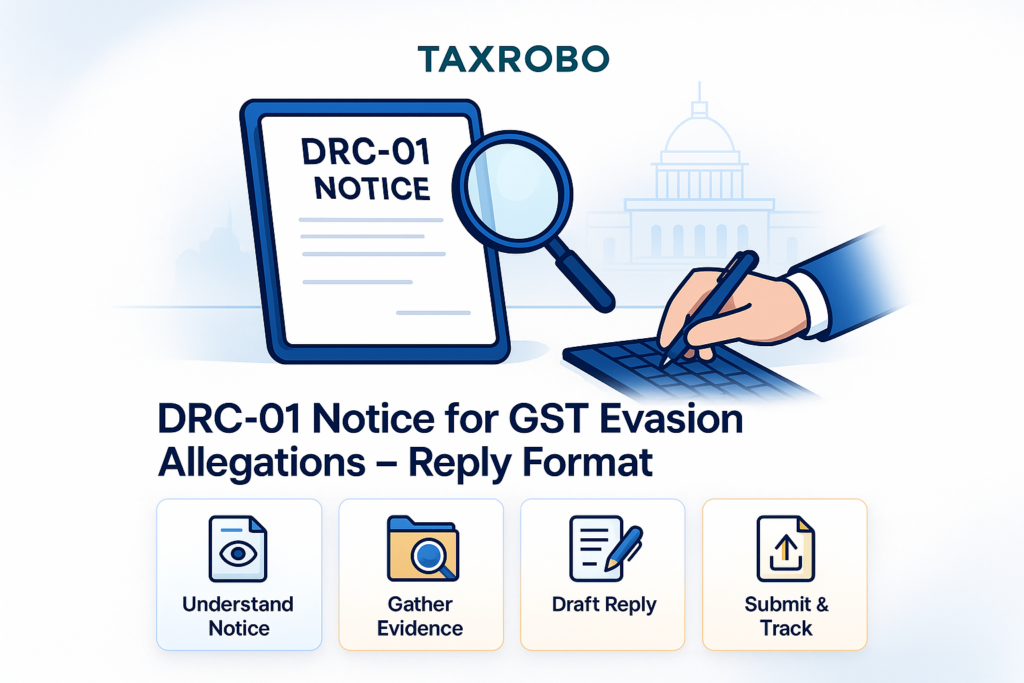
Step 1: Acknowledge and Analyze the Notice Carefully
The first and most important rule is to never ignore a GST notice. Immediately upon receipt, check the deadline mentioned for the reply, which is typically 30 days. Ignoring it will not make the problem go away; instead, it will lead the officer to confirm the demand against you. Read the notice multiple times to fully understand each allegation. Note down the specific discrepancies pointed out, the financial amounts involved, and the sections of the GST Act that have been cited by the officer. This detailed analysis forms the foundation of your entire response.
Step 2: Gather All Relevant Documents and Evidence
Your reply is only as strong as the evidence supporting it. Before you start drafting, you must gather all documents that can substantiate your claims and counter the allegations. Create a comprehensive file with the following documents:
- Copies of all relevant GST returns: GSTR-1, GSTR-3B, GSTR-9/9C.
- Financial documents: Tax invoices, credit notes, debit notes, and purchase bills.
- Proof of movement: E-way bills, lorry receipts, and delivery challans.
- Transactional proof: Bank statements highlighting the payments made or received for the transactions in question.
- Reconciliation statements: Detailed reconciliations, such as GSTR-2B vs. ITC claimed in GSTR-3B, or sales as per books vs. sales in GSTR-1.
- Correspondence: Any emails or letters exchanged with suppliers or customers that clarify the nature of the disputed transactions.
The Importance of Accurate Record-Keeping to Prevent GST Demand Notices cannot be overstated, as this documentation is the foundation of a strong rebuttal.
Step 3: Prepare a Point-by-Point Rebuttal
A vague or general denial will not be effective. The best approach is to address each allegation from the DRC-01 notice separately and systematically. For every point raised by the tax officer, you should draft a clear response. Start by stating the allegation as mentioned in the notice, then present your factual position clearly and concisely. Crucially, you must refer to the specific evidence you have gathered (e.g., “As per invoice no. XYZ dated…, a copy of which is attached as Annexure-A”). This methodical rebuttal will form the core of your written submission and is a key part of the allegations of GST evasion reply format.
Step 4: File Your Reply Online via Form DRC-06
The official respond to GST notice format India requires the reply to be filed electronically on the GST portal using Form GST DRC-06. The detailed written reply you prepared in the previous step, along with all supporting documents, should be scanned and uploaded as a PDF attachment. The online process is straightforward:
- Log in to the GST Portal.
- Navigate to Services > User Services > View Additional Notices/Orders.
- Find the relevant notice and click on the ‘Reply’ option.
- You will be directed to Form DRC-06, where you can fill in the necessary details and upload your attachments.
Knowing how to reply to DRC-01 notice online is as important as drafting the reply itself.
The Official DRC-01 Notice Reply Format (Using Form DRC-06)
While the final submission happens via the online Form DRC-06, the attached detailed reply document must be drafted with professional precision. A well-structured document is easier for the officer to understand and significantly enhances the credibility of your case. Your written reply should follow a logical and formal structure. The DRC-01 Notice reply format India is not just about the content, but also about the presentation. It should be a self-contained document that clearly presents your case without ambiguity, making it simple for the tax authority to review and, hopefully, accept your position.
Essential Components of Your Written Reply
A professional reply should include the following sections:
- Header: Your company’s letterhead with full details: Name, GSTIN, and Registered Address.
- Date & Addressee: The date of the reply and the details of the issuing authority.
- Subject Line: A clear and direct subject, such as: “Reply to Show Cause Notice (SCN) – Reference No: [Enter Notice Number] dated [Enter Notice Date]”.
- Reference: Explicitly state the notice number and date you are responding to.
- Introduction/Background: Begin with a brief paragraph acknowledging the receipt of the SCN. You can also provide a short summary of your business activities to give context.
- Point-by-Point Rebuttal: This is the most critical section. Create a separate paragraph or sub-section for each allegation mentioned in the DRC-01.
- Heading: Use a clear heading like “Rebuttal to Allegation 1: Mismatch in GSTR-1 and GSTR-3B”.
- Content: State the allegation, present your factual counter-argument, and explicitly refer to the supporting documents attached (e.g., “Please refer to Annexure-1 for the reconciliation statement”).
- Legal Submissions: If applicable, support your factual arguments with legal backing. Briefly cite relevant sections of the CGST/SGST Act, rules, circulars, or even case laws that strengthen your position.
- Prayer/Conclusion: Conclude your reply with a formal request. Summarize your position and respectfully ask the officer to consider your submissions and drop the proceedings. For example: “In light of the facts, documentary evidence, and legal submissions presented above, we humbly request your good office to drop the proceedings initiated vide the aforementioned Show Cause Notice.”
- Verification & Attachments: End with a verification statement (“I verify that the contents of this reply are true to the best of my knowledge and belief”), your signature (or that of the authorized signatory), and a clear list of all annexures/attachments.
Sample Reply Structure (Visual Template)
[Your Company Letterhead]
Date: [Date of Reply]
To,
[Designation of the Issuing Officer]
[Address of the GST Office]GSTIN: [Your GSTIN]
Subject: Reply to Show Cause Notice Reference No. [Notice Number] dated [Notice Date]Respected Sir/Madam,
1. Introduction: We acknowledge the receipt of the Show Cause Notice (SCN) with the reference number and date mentioned above. We are a registered taxpayer engaged in the business of [Briefly describe your business]. We are submitting our detailed reply as follows.
2. Facts of the Case (as per our understanding):
- [Briefly summarize the core issues raised in the notice].
3. Point-wise Reply to Allegations:
- Regarding Allegation 1: [State the allegation from the notice, e.g., Mismatch of Rs. X between GSTR-1 and GSTR-3B]
- Our submission: [Provide your detailed explanation. For instance, “The alleged mismatch is due to a clerical error in reporting an invoice in the wrong tax period, which was rectified in the subsequent month’s GSTR-1. We have attached a reconciliation statement as Annexure-A to demonstrate this.”].
- Regarding Allegation 2: [State the next allegation, e.g., Wrongful claim of ITC of Rs. Y]
- Our submission: [Provide your detailed explanation with evidence. For example, “The ITC of Rs. Y was claimed against a valid tax invoice (No. [Invoice No.]) from our supplier ([Supplier Name & GSTIN]). The goods were duly received, and payment was made. A copy of the tax invoice, e-way bill, and bank statement are attached as Annexure-B, Annexure-C, and Annexure-D respectively.”].
4. Legal Submissions: [Cite any relevant legal provisions, circulars, or case laws that support your arguments, if applicable].
5. Prayer: In view of the above submissions and the supporting documents provided, we humbly pray that the proceedings initiated against us vide the said SCN be dropped in the interest of justice. We are willing to provide any further clarification or appear for a personal hearing if required.
Verification:
I, [Your Name], [Your Designation], do hereby solemnly affirm and declare that the information given hereinabove is true and correct to the best of my knowledge and belief.Thanking you,
For [Your Company Name],
[Signature]
[Name of Authorized Signatory]
[Designation]List of Attachments:
- Annexure-A: [Description of Document]
- Annexure-B: [Description of Document]
- Annexure-C: [Description of Document]
Do’s and Don’ts: GST Notice Reply Guidelines
Navigating a GST notice requires a careful and strategic approach. Adhering to some basic principles can make a significant difference in the outcome.
Do’s:
- Do reply within the stipulated time: The deadline mentioned in the notice is non-negotiable. Timeliness shows your seriousness and compliance-oriented approach.
- Do be factual, precise, and polite: Stick to the facts of the case. Present your arguments logically and back them up with evidence. Maintain a professional and respectful tone throughout the reply.
- Do attach all necessary supporting documents: Your reply is incomplete without evidence. Ensure every claim you make is supported by a corresponding document, properly labeled and referenced in the reply.
- Do seek professional help if the matter is complex: If the notice involves complex legal interpretations or a significant tax demand, it is always wise to consult a tax professional like a Chartered Accountant or a GST lawyer.
Don’ts:
- Don’t ignore the notice: Ignoring the SCN is the worst possible action. It will result in an ex-parte order, where the officer confirms the full demand against you without considering your side of the story.
- Don’t provide vague or emotional responses: Avoid generic statements like “the allegation is denied.” Explain why it is denied with facts and figures. Emotional language has no place in a legal reply.
- Don’t submit false information or forged documents: This is a criminal offense and can lead to severe penalties and prosecution, turning a tax dispute into a much more serious legal battle.
- Don’t miss the deadline: If you need more time to prepare a comprehensive reply, you can file a request for an extension, but do not simply let the deadline pass without any communication.
4. Conclusion
A DRC-01 notice is a serious matter, but it is not a final demand. It is an opportunity for you to present your case to the tax authorities. The key to a successful outcome lies in a methodical and professional approach. By understanding the allegations in the notice, gathering all your supporting evidence, structuring your response using a proper format like Form DRC-06, and filing it on time, you can effectively address the department’s concerns. Remember, a clear, well-documented, and timely response can prevent significant financial penalties and protect your business from unnecessary legal trouble. Navigating GST notices can be complex. If you need expert assistance in preparing and filing your DRC-01 Notice reply format, contact the GST specialists at TaxRobo GST Service today for a consultation.
5. FAQ Section
Frequently Asked Questions about DRC-01 Notices
Q1: What is the time limit to reply to a DRC-01 notice?
A: The standard time limit to submit your reply is 30 days from the date the notice is served. However, you should always check the specific deadline mentioned in your notice, as it can sometimes vary.
Q2: What happens if I don’t reply to a DRC-01 notice?
A: If you fail to respond within the given timeframe, the GST officer is empowered to pass an order based on the information and records available to them. This will likely result in the confirmation of the entire proposed demand for tax, interest, and penalty against you, and the department can then initiate recovery proceedings.
Q3: Can I pay the amount mentioned in the DRC-01 notice to close the matter?
A: Yes. You can voluntarily pay the tax and interest demanded using Form DRC-03. If this payment is made before the Show Cause Notice is officially issued, the penalties can be significantly reduced or even waived entirely, depending on whether the case falls under Section 73 (non-fraud) or Section 74 (fraud). However, it is always advisable to first verify the correctness of the demand before making any payment.
Q4: Do I need a lawyer or a Chartered Accountant to draft the DRC-01 Notice reply format?
A: While it is not legally mandatory to hire a professional for all cases, it is highly recommended, especially if the tax amount is substantial or the legal issues are complex. A professional understands the nuances of GST law, knows the required documentation, and can frame legal arguments effectively. Their expertise can significantly improve your chances of receiving a favourable outcome.
Q5: Is the reply filed online or offline?
A: The formal reply to a DRC-01 notice must be filed online through the official GST portal. The submission is made using Form DRC-06. Your detailed written reply, along with all scanned copies of supporting documents, must be attached as a PDF file within this form.