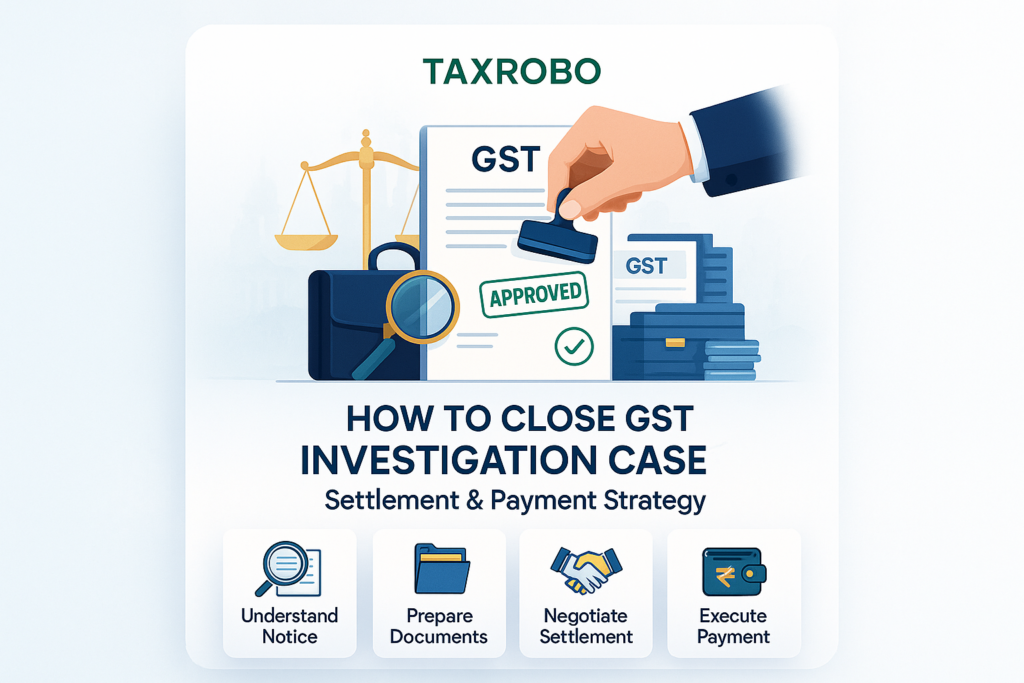

How to Close GST Investigation Case – Settlement & Payment Strategy
Receiving a notice from the GST department can be a stressful experience for any business owner, triggering concerns about penalties, legal proceedings, and business disruption. But it doesn’t have to be a crisis. A GST investigation is essentially a detailed scrutiny by tax authorities due to suspected non-compliance, tax evasion, or mismatches in filed returns. This guide provides a clear roadmap for Indian businesses and individuals on how to navigate this challenge, offering a step-by-step approach for a successful GST investigation case resolution. A proactive and informed approach, armed with the right settlement strategy for GST investigation, can significantly minimize financial penalties, protect your business’s hard-earned reputation, and ensure a swift and efficient closure of the case. Understanding the process is the first step toward taking control of the situation.
Understanding the GST Investigation Notice: Your First Steps
The moment an official envelope from the GST department arrives, your response in the next few hours and days will set the tone for the entire investigation. It’s not a time for panic but for methodical action. The notice is an inquiry, a request for information or clarification, and your goal is to address the department’s concerns accurately and completely. The first step is to understand why you have been flagged and what the notice is specifically asking for. This initial phase involves decoding the official communication, understanding the potential triggers, and formulating an immediate action plan to address the issue head-on without delay.
Common Triggers for a GST Investigation
The GST Network (GSTN) uses sophisticated data analytics and AI-powered tools to identify discrepancies and potential tax evasion. Understanding the common red flags can help you maintain compliance and, if a notice is received, quickly identify the potential problem area.
- GSTR-1 vs. GSTR-3B Mismatches: This is a primary trigger. It occurs when the total value of outward supplies (sales) you declared in your GSTR-1 does not match the sales figures on which you have paid tax in your GSTR-3B for the same period.
- GSTR-2A/2B vs. GSTR-3B Mismatches: This happens when the Input Tax Credit (ITC) you have claimed in your GSTR-3B is significantly higher than the eligible ITC appearing in your auto-populated GSTR-2A or GSTR-2B. It suggests you are claiming credit for invoices your suppliers have not declared.
- Unusually High ITC Claims: The department’s systems monitor the ratio of ITC claimed to the total tax paid. If your ITC claims are consistently high compared to your industry’s average or your own historical data without a valid business reason, it can trigger an investigation.
- Non-filing or Delayed Filing of GST Returns: Consistent failure to file returns on time is a major compliance lapse. It indicates potential financial distress or a deliberate attempt to stay off the radar, both of which can lead to deeper scrutiny.
- Specific Intelligence: The department often acts on specific information or tips received from various sources, including whistleblowers, other government agencies, or data analysis from e-way bills and other records, pointing towards potential tax evasion.
How to Decode the Official Notice
An official notice is a formal legal document, and every word matters. Take the time to read it carefully and understand its components to formulate an appropriate response.
- Check Authenticity: The very first step is to verify the notice’s legitimacy. Every communication from the CBIC must have a computer-generated Document Identification Number (DIN). You can verify this DIN on the official CBIC portal to ensure the notice is genuine and not a fraudulent attempt.
- Identify the Issuing Authority: Note which department has sent the notice. Is it the Directorate General of GST Intelligence (DGGI), the State GST department, or a local tax office like a Range or Division? This helps in understanding the seriousness and jurisdiction of the investigation.
- Understand the Legal Section: The notice will quote specific sections of the Central Goods and Services Tax (CGST) Act, 2017. Identifying the section is crucial. For instance, a notice under Section 67 pertains to Inspection, Search, and Seizure, while Section 70 is a Summons to give evidence or produce documents. A notice under Section 73 or 74 relates to the determination of tax not paid or short paid.
- Pinpoint the Allegation: The notice will clearly state the financial year(s) or tax period(s) under investigation. It will also specify the exact discrepancies or allegations, such as “Excess ITC claimed” or “Mismatch in turnover reported.” This is the core issue you need to address.
Your Immediate Action Plan
Once you understand the notice, a structured response is critical. Rushing or ignoring the notice can escalate the problem significantly.
- Do Not Panic: Remember, a notice is an inquiry, not a final judgment. Maintain your composure and approach the situation logically.
- Acknowledge the Notice: Never ignore the notice. Prepare and send a formal letter acknowledging its receipt. This communication should be professional and state that you are reviewing the matter and will respond in detail within the stipulated time frame.
- Gather All Relevant Documents: Immediately begin collating all necessary paperwork for the period in question. This includes sales invoices, purchase invoices, ledgers, bank statements, filed GST returns (GSTR-1, GSTR-3B), and any reconciliation statements.
- Consult an Expert: This is arguably the most important step for
resolving GST investigation for companies in India. The nuances of GST law are complex. Contacting a qualified tax consultant or a firm like TaxRobo immediately ensures you have expert guidance to interpret the notice correctly, prepare a legally sound reply, and represent your case effectively.
Developing Your Settlement Strategy for GST Investigation
After the initial response, the next phase is to build a robust strategy for how to settle GST investigation in India. This involves moving from a reactive stance to a proactive one. Your goal is to ascertain the facts, quantify any liabilities, and present your case to the department in a clear, transparent, and cooperative manner. A well-planned settlement strategy can be the difference between a quick resolution with minimal penalties and a prolonged dispute that drains your time and resources. This process begins with a deep dive into your own financial records to find the truth before you present it to the authorities.
Conduct an Internal Reconciliation
Before drafting a detailed reply to the tax department, you must conduct your own thorough internal audit or reconciliation. Responding without verifying your own records can lead to incorrect submissions, which can damage your credibility and complicate the case. The objective is to find the root cause of the discrepancy yourself. This self-assessment involves a meticulous comparison of your filed returns with your actual books of accounts. You need to reconcile your GSTR-1 with your sales register, your GSTR-3B with your tax ledgers, and critically, your claimed ITC with the details available in GSTR-2A/2B. By identifying the exact source and quantum of the error—be it a clerical mistake, a misinterpretation of a provision, or a supplier’s error—you gain control over the narrative. This empowers you to approach the department with facts and a clear explanation, which is the foundation of a successful settlement strategy.
Voluntary Payment using Form DRC-03
One of the most powerful tools in your arsenal for a swift GST investigation case resolution is Form GST DRC-03. This form is used to make a voluntary payment of any outstanding tax, along with applicable interest and penalty, for any reason whatsoever. Its strategic advantage is immense, particularly when used proactively. If your internal reconciliation reveals a genuine tax shortfall, you can use DRC-03 to pay the tax and interest amount *before* a Show Cause Notice (SCN) is issued by the department. Under Section 73 of the CGST Act (which deals with non-fraudulent cases), making a voluntary payment at this stage can lead to a significant reduction or even a complete waiver of penalties. This action demonstrates good faith and a commitment to compliance, which is viewed very favorably by tax authorities and often leads to an early closure of the proceedings. You can access and file this form on the official GST Portal.
Communicating and Cooperating with the Department
Your conduct and communication throughout the investigation play a pivotal role in the final outcome. It is essential to adopt a cooperative and transparent approach when interacting with tax officials. If your internal review uncovers genuine errors, it is best to be forthcoming about them. Trying to conceal facts or providing misleading information will only lead to deeper scrutiny and harsher penalties. Ensure that all documents and information requested by the department are provided promptly and in a well-organized manner. A cooperative stance helps build trust and can positively influence the officer’s discretion when determining the final penalty amount. Remember, the officials are doing their job, and a professional, respectful, and cooperative attitude will facilitate a smoother and more favorable resolution process.
Effective Payment Strategies for GST Case Resolution
Once the tax liability has been determined, either through your own reconciliation or by the department’s findings, the final step is to clear the dues. Having effective payment strategies for GST case resolution is crucial, especially for businesses that might face liquidity challenges. The GST framework provides a few options, and choosing the right one depends on your financial situation and the urgency of closing the case. Whether you opt for a one-time payment or seek instalments, understanding the rules governing these payments is essential for final compliance.
Lump-Sum Payment
A lump-sum payment is the most straightforward and preferred method for settling your dues. This approach is ideal if the total liability (tax, interest, and penalty) is manageable and your business has sufficient liquidity to cover the amount without disrupting its operations. The primary benefit of a lump-sum payment is that it leads to the fastest possible closing GST investigation case India. It immediately concludes the proceedings, ends the associated mental stress, and frees up your time and resources to focus on your core business activities. This method is often viewed most favorably by the department as it demonstrates your ability and willingness to comply promptly. The payment can be made through the GST portal using your electronic cash ledger or credit ledger as per the rules.
Requesting Payment in Instalments (Section 80, CGST Act)
For businesses facing genuine financial hardship or cash flow challenges, the CGST Act provides a provision for paying the tax dues in instalments. Under Section 80, a taxpayer can file an application with the jurisdictional Commissioner requesting permission to pay the amount in monthly instalments. However, it is crucial to understand that this is not a right; it is a facility granted at the discretion of the Commissioner based on the merits of your case.
There are specific conditions attached to this provision:
- This facility is not available for the payment of self-assessed tax.
- The maximum number of monthly instalments allowed is twenty-four (24).
- Applicable interest will continue to be levied on the outstanding amount until the entire liability is cleared.
Making a formal request for instalments can be a key part of your payment strategies for GST case resolution if a lump-sum payment is not feasible.
Using Your Input Tax Credit (ITC)
It is vital to understand the rules regarding the utilization of the balance in your Electronic Credit Ledger (ITC) for settling investigation dues. The law makes a clear distinction between the tax component and the interest and penalty components.
| Payable Component | Can be paid with ITC? | Must be paid with Cash? |
|---|---|---|
| Tax Liability | ✅ Yes | |
| Interest | ❌ No | ✅ Yes |
| Penalty | ❌ No | ✅ Yes |
As shown in the table, you can use your available ITC to pay the outstanding GST (tax) liability. However, any amount payable towards interest and penalties must be paid in cash through your Electronic Cash Ledger. Misunderstanding this rule can lead to non-compliance even after you intend to settle, so ensure your payment is bifurcated correctly.
GST Investigation Case Tips for Business Owners to Avoid Future Issues
Successfully closing a GST investigation is a relief, but the experience should also serve as a valuable lesson in financial discipline. The best way to handle an investigation is to prevent one from happening in the first place. By implementing robust internal processes and staying proactive about compliance, you can significantly reduce the risk of future scrutiny. Here are some of the most effective GST investigation case tips for business owners to ensure long-term compliance and peace of mind.
Maintain Immaculate Bookkeeping
The foundation of good GST compliance is error-free and diligent bookkeeping. Ensure that every single sale and purchase transaction is recorded accurately and in a timely manner. Implement a practice of conducting monthly reconciliations of your books with your bank statements and GST returns. This simple habit can help you catch clerical errors, mismatches, or omissions early on, before they snowball into larger discrepancies that could attract the department’s attention.
Use Reliable Accounting Software
In today’s digital age, manual bookkeeping is inefficient and prone to errors. Invest in a reliable accounting or ERP software that is GST-compliant. Modern software can automate many processes, including invoice generation, tax calculation, and return preparation. More importantly, good software provides features for auto-reconciliation of your purchase records with GSTR-2A/2B and your sales data with GSTR-1, providing you with a clear dashboard of any mismatches that need immediate attention.
Seek Professional GST Consultation
Just as you consult a doctor for a health check-up, your business’s financial health needs periodic professional review. Engage a qualified tax consultant or firm like TaxRobo to conduct periodic GST audits or reviews of your accounts. A professional can bring an external perspective, identify potential risks or non-compliance areas that you might have missed, and advise on corrective actions. This proactive audit is one of the best GST investigation case tips for business, as it helps fix issues before they become subjects of a departmental notice.
Stay Updated on GST Amendments
GST law is dynamic and subject to frequent changes, amendments, and clarifications through notifications and circulars. Pleading ignorance of a new rule or a change in a procedure is not a valid defense in the eyes of the law. Make it a practice to stay updated with these changes. You can do this by subscribing to reputable tax journals, following reliable financial news portals, or retaining a professional tax consultant who keeps you informed about any amendments that affect your business.
Conclusion
Facing a GST investigation can undoubtedly be a daunting ordeal for any business owner. However, with a structured and calm approach, it can be managed effectively. The entire process hinges on a few key principles: carefully understanding the notice, conducting a thorough and honest internal review to ascertain the facts, formulating a clear settlement strategy that may involve voluntary payments, and maintaining cooperative and transparent communication with the tax authorities. An effective GST investigation case resolution is not just about paying the dues; it’s about protecting your business from the risk of excessive penalties, reputational damage, and lengthy, draining litigation. By taking proactive steps and seeking expert guidance, you can navigate the process efficiently and emerge with your business integrity intact.
Are you facing a GST notice? Don’t navigate the complexities alone. The experts at TaxRobo are here to help you with every step, from documentation to representation. Contact us today for a consultation and achieve a swift and favorable resolution.
Frequently Asked Questions (FAQ)
Q1. What happens if I ignore a GST summons or notice?
Ignoring a GST summons or notice is a serious mistake that can lead to severe consequences. The department may proceed with an ex-parte order, which is a decision made in your absence based on the information available to them. This can result in the attachment of your business’s bank accounts and property to recover the dues. Furthermore, non-compliance can attract higher penalties for obstruction or failure to supply information under Section 122 of the CGST Act.
Q2. Can I settle a GST case after a Show Cause Notice (SCN) has been issued?
Yes, settlement is still possible even after an SCN has been issued. However, the penalty structure changes. The benefits of making a voluntary payment before an SCN are higher. For non-fraudulent cases (under Section 73), if you pay the tax and interest within 30 days of the SCN, the penalty may be waived. For fraud cases (under Section 74), paying within 30 days of the SCN can reduce the penalty to 25% of the tax amount.
Q3. How long does a typical GST investigation take to close in India?
The duration of a GST investigation varies greatly. It depends on several factors, including the complexity of the transactions involved, the quantum of the alleged tax evasion, the number of financial years under scrutiny, and most importantly, your level of cooperation. Simple cases involving clear mismatches can be resolved in a few weeks. More complex cases, especially those involving multiple states or detailed forensic audits, can take several months or even years to conclude.
Q4. Can I be arrested during a GST investigation?
Arrest provisions under GST are reserved for serious and high-value offenses. As per Section 69 of the CGST Act, the power to arrest is typically exercised only in cases where a person has committed specific offenses (like collecting tax but not depositing it, or fraudulent ITC claims) and the tax amount involved is significant (generally over ₹2 crores). Arrest is not a common outcome for routine investigations or procedural mismatches and is used only when there is sufficient evidence of deliberate, large-scale fraud.