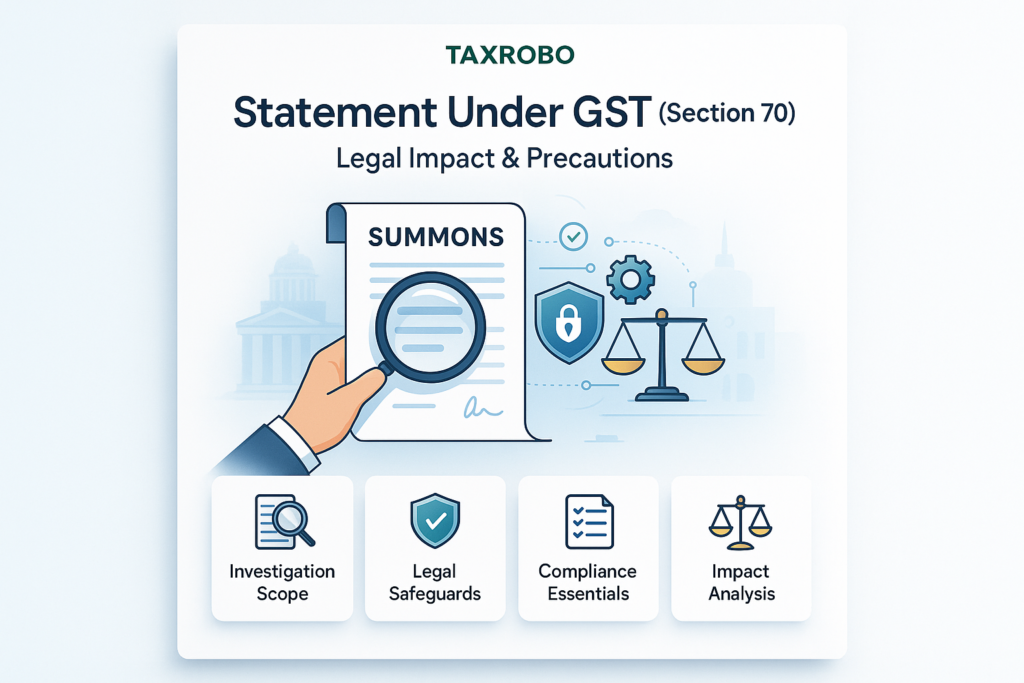

Statement Under GST (Section 70) – Legal Impact & Precautions
Imagine receiving an official-looking envelope from the GST department summoning you to provide evidence. What do you do? Panic is a common reaction, but preparation is the right one. This summons is not just a casual request for information; it is a formal legal process. Receiving a summons to give a statement under GST is a formal inquiry under Section 70 of the CGST Act, 2017, a tool used by tax authorities to gather information and evidence directly from individuals. This is not a routine notice that can be set aside. The statement you provide carries significant legal weight and can have major implications for your business and even for you personally. Understanding the process, your rights, and the necessary precautions is absolutely crucial for every business owner in India, from a small startup to a well-established enterprise.
What is Section 70 of the CGST Act? A Simple Breakdown
At its core, Section 70 of the Central Goods and Services Tax (CGST) Act, 2017, grants tax authorities “The Power to summon persons to give evidence and produce documents.” Think of it as a legal tool that allows the GST department to call upon any person to appear before a designated officer and furnish information or records relevant to an inquiry. It’s important to understand that receiving a summons does not automatically mean you have committed a wrongdoing. The department might be conducting an investigation into another taxpayer (like a supplier or a customer) and believes you possess information that could be vital to the case. However, regardless of the reason, the summons must be treated with the utmost seriousness because the proceedings are considered judicial in nature. Therefore, understanding GST section 70 is the first and most critical step for businesses in cities like Kolkata and across the country to navigate these formal inquiries without unnecessary legal complications. For more context, it’s helpful to understand the Difference Between GST Audit, Inspection, Search & Seizure Explained.
Who Can Issue a Summons Under GST?
A summons under Section 70 is not something that can be issued by just any officer from the tax department. The law specifies that only a “proper officer” who has been duly authorized under the GST Act has the power to issue such a summons. This is a key safeguard to ensure that this significant power is not misused. When you receive a summons, it should clearly state the designation and authority of the issuing officer. One of the first checks you should perform is to verify that the summons includes a valid Document Identification Number (DIN), which confirms its authenticity and tracks it within the department’s official records.
Who Can Be Summoned? (It’s Not Just the Business Owner)
A common misconception is that only the proprietor, partners, or directors of a business can be summoned. However, the scope of Section 70 is much broader. The law states that the proper officer can summon “any person” whose attendance they consider necessary for the inquiry. This means the net can be cast wide to include anyone who might have relevant information.
This includes, but is not limited to:
- The primary stakeholders of the business, such as the proprietor, partners, or directors.
- Key employees, including the Chief Financial Officer (CFO), accountants, managers, or any other staff member involved in financial record-keeping or operational processes.
- Third parties who are not directly employed by the business but have a connection to the transactions under scrutiny. This could be suppliers, customers, transporters, warehouse keepers, or even business consultants.
This broad scope is why even salaried individuals, who may be key managerial personnel in a company, need to be aware of the implications of providing a statement under GST.
The Serious Legal Impact of Your Statement Under GST
The gravity of providing a statement under GST cannot be overstated. It is far from an informal conversation or a simple clarification call. The proceedings conducted under Section 70 are legally equivalent to judicial proceedings, and every word you speak is recorded and can be used as formal evidence. The legal impact of a statement under GST in Delhi is the same as in any other part of India, and the consequences of non-compliance or providing false information can be severe, impacting both your business’s financial health and your personal legal standing. A statement given without proper preparation or legal guidance can inadvertently create liabilities, admissions of guilt, or contradictions that can be very difficult to retract later.
Is Your Statement Legally Binding? Understanding its Evidentiary Value
Yes, your statement is absolutely legally binding. Section 70(2) of the CGST Act clarifies that any inquiry conducted under this section is deemed to be a “judicial proceeding” within the meaning of section 193 and section 228 of the Indian Penal Code (IPC), 1860.
What does this mean for you in simple terms?
- Admissible as Evidence: The statement you provide is recorded, signed, and becomes a part of the official record. It is fully admissible as evidence in any subsequent legal action, including proceedings before appellate authorities, tribunals, or courts of law.
- It Can Be Used Against You: The primary purpose of the summons is to gather evidence. The information you provide can be used by the department to build a case against your business or even against you personally if any discrepancies or non-compliance are revealed.
- Binding Admission: Any factual admission made during the statement can be held against you. For example, admitting to a specific business practice that contravenes GST law would be very difficult to deny later.
Penalties for Non-Compliance and False Statements
The law provides strict penalties to ensure that summonses are taken seriously. These penalties fall into two main categories:
- Non-Compliance: If a person who is summoned fails to appear before the officer on the designated date and time without a reasonable cause, or fails to produce the required documents, they are liable for a penalty. Under Section 122(3)(d) of the CGST Act, this penalty can extend up to ₹25,000. Ignoring a summons is never an option and immediately puts you on the wrong side of the law.
- Providing False Statements: Given that the proceedings are considered “judicial,” intentionally providing false information has very serious consequences. This action is treated as perjury and is punishable under Section 193 of the Indian Penal Code, which can lead to imprisonment for a term that may extend to seven years, along with a fine.
For those who wish to delve into the specific legal text, you can refer to the official act on the CBIC’s website. You can find the updated laws under the GST section on the Central Board of Indirect Taxes and Customs (CBIC) Website. A broader guide on Understanding the Penalties for GST Non-Compliance: A Detailed Overview may also be helpful.
Essential Precautions for Giving a GST Statement
Being summoned can be stressful, but a systematic and calm approach can make a significant difference in the outcome. Proactive preparation and awareness are your strongest tools to protect your interests. Following these precautions for a GST statement is a standard practice for compliant businesses in financial hubs like Mumbai and should be adopted by every taxpayer across India.
Step 1: Upon Receiving the Summons
What you do in the first few hours after receiving the summons is critical.
- Do Not Ignore It: This is the most crucial rule. Ignoring a summons is a direct violation of the law and invites penalties. Acknowledge the receipt and mark the date of appearance in your calendar immediately.
- Verify Authenticity: In an age of potential scams, verification is key. Check for a Document Identification Number (DIN) on the summons. As per a circular from the CBIC, all communications from the GST department must mandatorily quote a DIN. You can verify the DIN on the CBIC-GST portal to ensure the notice is genuine.
- Read Carefully: Read the entire summons document multiple times. Pay close attention to who has been summoned (is it you personally, or you in a specific capacity like a director?), what specific documents are being requested, the purpose of the inquiry (if mentioned), and the date, time, and location of the appearance.
Step 2: Preparation is Key
Once you have understood the summons, the preparation phase begins. Rushing into the proceeding unprepared is a recipe for disaster.
- Gather Documents: Meticulously collect and organize all the documents requested in the summons. This could include invoices, purchase orders, e-way bills, ledgers, bank statements, GST returns (GSTR-1, GSTR-3B), and any other relevant records. Make copies for your own reference.
- Review Your Facts: Do not rely on your memory alone. Thoroughly review the facts, figures, and transactions related to the period mentioned in the inquiry. Reconstruct the sequence of events and understand the context of the transactions under scrutiny.
- Seek Professional Help: This is not the time for DIY solutions. It is highly advisable to consult with a seasoned tax professional or a lawyer immediately. An expert can help you understand the finer GST legal considerations relevant to your case, whether you’re in Chennai or elsewhere. They can review the documents, anticipate potential questions, prepare you for the inquiry, and ensure your responses are factually accurate and legally sound.
Step 3: During the Statement Recording
Your conduct during the actual recording of the statement is just as important as your preparation.
- Be Truthful and Factual: Always tell the truth. However, stick strictly to the facts and answer only what is asked. Do not volunteer extra information or speculate. If you are unsure about an answer, it is perfectly acceptable to say, “I do not recall at this moment, but I can check my records and provide this information.” This is far better than guessing and providing incorrect data.
- Stay Calm and Composed: The environment can be intimidating, but it is essential to remain calm and professional. Avoid being argumentative or confrontational with the officer. A cooperative yet cautious demeanor is the best approach.
- Read Before You Sign: After the officer records your statement, they will ask you to read and sign it. Read every single word carefully. Ensure that the written statement is an exact and accurate reflection of what you said. If there are any ambiguities, misinterpretations, or errors, insist on having them corrected before you sign.
- Request a Copy: You have a right to a copy of your recorded statement. Always request a copy for your records before you leave. This document is crucial for any future proceedings.
How TaxRobo Can Help You Navigate GST Summons
Facing a GST summons alone can be a daunting experience, filled with legal complexities and potential pitfalls. This is where professional guidance becomes invaluable. At TaxRobo, we understand the intricacies of GST law and the seriousness of a Section 70 inquiry. Our team of experienced CAs and tax lawyers is dedicated to helping you navigate this process with confidence and clarity.
Our services are designed to provide comprehensive support:
- Expert Review: We will thoroughly review the summons to understand its scope and implications for your business.
- Document Preparation: Our team will assist you in gathering, organizing, and vetting all the necessary documents to ensure they are complete and accurate.
- Strategic Consultation: We provide expert legal consultation to help you understand the legal impact of GST section 70, whether your business is in Bangalore or any other part of the country. We will prepare you for the questions you might face and advise on the best way to present the facts.
- Rights Protection: Most importantly, we ensure that your legal rights are protected at every stage of the process, from the initial reply to the final statement recording.
Conclusion
A summons for a statement under GST is a formal and serious legal matter that demands your immediate and careful attention. It is a critical juncture where the information you provide can shape the future of any tax litigation your business might face. Remember the key takeaways to navigate this challenge effectively:
- A summons under Section 70 of the CGST Act is a judicial proceeding, not an informal inquiry.
- Your statement is admissible as evidence in a court of law and carries significant legal consequences.
- Preparation, truthfulness, and professional guidance are your best defenses against potential legal and financial repercussions.
Don’t face the complexities of GST law alone. If you’ve received a summons or want to ensure your business is compliant and prepared for any eventuality, contact the experts at TaxRobo today for a consultation.
Frequently Asked Questions (FAQs)
Q1: Can I send my accountant instead of going myself if the summons is in my name?
Answer: No. A summons is issued to a specific person, and it is a legal directive for that person to appear. You must attend personally. Sending someone else in your place, even your accountant or lawyer, will likely be treated as non-compliance unless the summoning officer has given explicit prior permission for such a representation, which is rare.
Q2: Is a statement given under Section 70 confidential?
Answer: The information provided is used for the purpose of the GST inquiry. While it is not made public, it is not confidential in the same way a conversation with your lawyer is. It can be used in legal proceedings against you and may be shared with other government or law enforcement agencies as permitted under the law.
Q3: What happens if I make a genuine mistake in my statement?
Answer: If you realize after the fact that you have made a genuine, unintentional error, you should immediately seek legal advice. It may be possible to rectify the error by submitting a supplementary statement or a formal clarification to the concerned officer. However, preventing errors is always the better strategy, which underscores the importance of thorough preparation before the statement is given.
Q4: Do I need to deposit any tax or penalty during the summons proceeding itself?
Answer: You are not legally required to make any “spot” payments of tax or penalty during the statement recording. Any demand for tax must follow the due process of law, which includes the issuance of a formal show-cause notice and an opportunity for you to be heard. This is covered in our How to Respond to a GST Show Cause Notice: A Step-by-Step Guide. Be extremely wary of any officer who exerts pressure on you to pay any amount on the spot. Such actions are not in accordance with the law.