
Franchise vs Own Brand: 12 Ideas Compared on Cost, Risk and Compliance Load
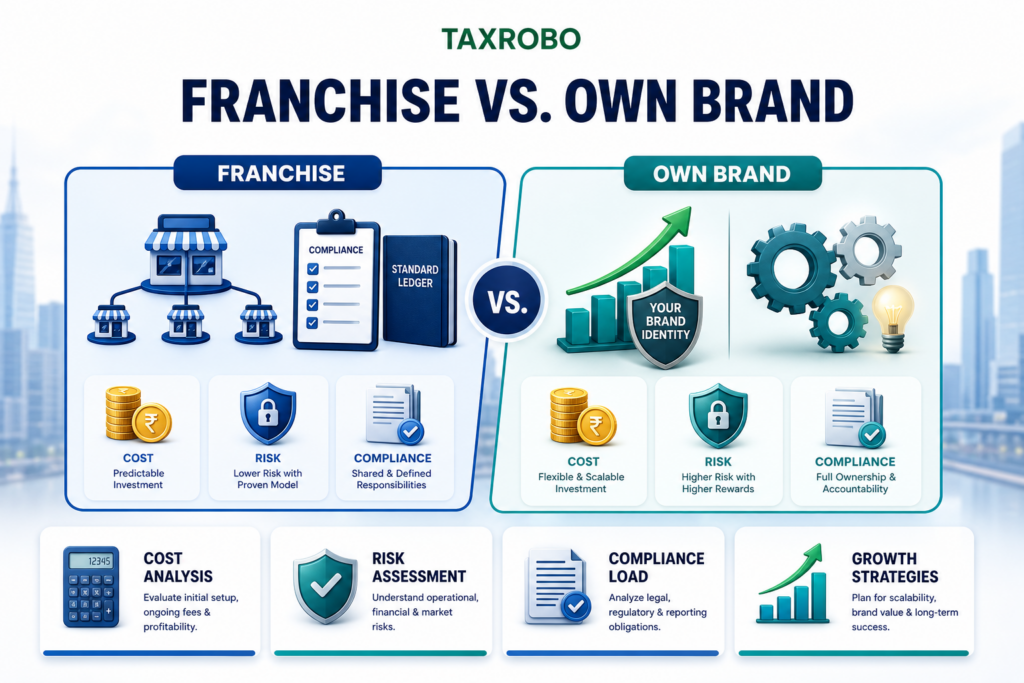
For any aspiring entrepreneur in India, the first major crossroad is often the choice between building a dream from the ground up or buying into a proven system. This decision frames the entire business journey. The debate of franchise vs own brand is one of the most critical choices a new business owner will make, as it fundamentally impacts everything from the initial investment and daily operations to long-term growth potential and personal satisfaction. It’s a choice between a well-trodden path with guide rails and an unmarked trail with limitless possibilities. This post will provide a comprehensive own brand vs franchise comparison India, breaking down 12 crucial factors across three key areas: Cost, Risk, and Compliance. Our goal is to empower you with the clarity needed to make an informed decision that aligns perfectly with your financial resources, risk appetite, and entrepreneurial vision.
Cost Analysis: A Detailed Financial Breakdown
One of the first considerations for any new venture is the financial outlay. The cost structures of a franchise and an own brand are vastly different, both at the outset and over the long term. Here, we’ll dive into a detailed cost analysis franchise vs own brand to help you understand where your money will go.
1. Initial Setup Cost & Capital Investment
- Franchise: When you buy a franchise, your initial costs are largely predetermined and transparent. The primary expenses include a significant, one-time franchise fee, which grants you the right to use the brand’s name, systems, and trademarks. Following this, you’ll incur setup costs for the store or office fit-out, which must adhere to strict brand guidelines, and the initial purchase of inventory from approved suppliers. While these costs can be substantial, they are highly predictable. A good
franchise investment guide Indiawill always provide a detailed breakdown of these expected expenses, reducing the risk of unforeseen financial shocks during the setup phase. - Own Brand: Creating your own brand can appear cheaper at first glance, but the costs are far less predictable. Your initial capital will be directed towards market research, product or service development (R&D), brand creation (including logo design, website development, and creating brand guidelines), and the crucial initial marketing push to build awareness from scratch. While you can control these expenses to an extent, they can escalate quickly. For example, a complex product might require extensive prototyping, or a competitive market may demand a larger-than-expected advertising budget, making it harder to stick to an initial financial plan.
2. Ongoing Operational Costs
- Franchise: The financial commitment to a franchisor doesn’t end with the initial fee. Franchisees are typically required to pay ongoing royalty fees, calculated as a percentage of their monthly or quarterly revenue. This is the cost of continued brand association and support. Additionally, you will likely contribute to a national marketing fund, which the franchisor uses for large-scale advertising campaigns. There may also be mandatory software, technology, or training fees. These recurring costs eat into your profit margins but also provide you with continuous support and brand visibility.
- Own Brand: The most significant financial advantage of an own brand is that you keep 100% of your profits—there are no royalty fees to pay. This gives you complete control over your earnings and how you reinvest them into the business. However, the flip side is that you bear the full weight of all operational costs. You are solely responsible for funding all marketing and advertising, upgrading technology, conducting staff training, and investing in research to improve your products or services. These expenses are essential for growth but lack the shared-cost benefit of a franchise system.
3. Supply Chain & Inventory Management
- Franchise: A major perk of the franchise model is gaining immediate access to the franchisor’s established and optimized supply chain. This often translates into bulk pricing discounts on raw materials or inventory that you couldn’t secure as a small, independent operator. This consistency ensures product quality across all locations. The main drawback is a lack of flexibility; you are restricted to using only the franchisor’s approved suppliers. This limits your ability to negotiate prices or source alternatives if you find a better or more cost-effective option.
- Own Brand: As the owner of your brand, you have complete freedom to build your supply chain. You can choose your vendors based on quality, price, location, or ethical standards. This autonomy allows you to negotiate deals, find unique suppliers, and maintain tight control over your product quality. However, building a reliable and cost-effective supply chain from the ground up is one of the most significant
own brand business challenges India. It requires extensive research, negotiation skills, and a robust vetting process to avoid issues with quality, consistency, and delivery timelines.
4. Access to Business Loans & Funding
- Franchise: When approaching banks and lenders for a business loan, franchise owners often have an advantage. Financial institutions tend to view franchises more favorably because they operate on a proven business model with a documented track record of success. The franchisor provides established financial projections and performance data, which significantly reduces the perceived risk for the lender. This can make the loan application process smoother and increase your chances of securing the necessary funding.
- Own Brand: For an entrepreneur starting their own brand, securing funding is a more challenging endeavor. Lenders will scrutinize your business plan, your personal industry experience, and your market analysis much more intensely. Since there is no existing track record, the loan is considered higher risk. Your ability to secure funding will depend heavily on your ability to present a compelling and well-researched case for your brand’s potential profitability and long-term viability.
Risk vs. Control: Weighing Autonomy and Security
Beyond the numbers, the choice between a franchise and an own brand is a fundamental trade-off between the security of a proven model and the creative freedom of building something uniquely yours. This section provides a risk comparison franchise vs own brand India to help you evaluate which path aligns with your personality and long-term goals.
5. Brand Recognition & Market Entry
- Franchise: The most significant
franchise advantage in Indiais the power of an established brand. You benefit from day one with instant brand recognition, customer trust, and the results of years of marketing efforts funded by the franchisor. This drastically shortens the time it takes to attract customers and generate revenue. Your market entry is accelerated because the product or service has already been validated, and a customer base already exists. You are not selling an unknown concept; you are opening a new, convenient location for an already-loved brand. - Own Brand: When you launch your own brand, you start with a blank slate. Building brand awareness, establishing credibility, and earning customer trust from zero is a monumental task. It requires a significant and sustained investment in marketing, public relations, and customer service. The path to profitability is often much longer as you must first educate the market about who you are and what you offer. This journey requires patience, resilience, and a robust, well-executed marketing strategy to cut through the noise.
6. Business Model & Operational Support
- Franchise: Franchises are often described as a “business-in-a-box” for a reason. You receive a comprehensive operational playbook that covers everything from inventory management and accounting to customer service protocols and marketing tactics. The franchisor provides extensive initial training for you and your staff, along with ongoing support to help you navigate challenges. This structured system dramatically reduces the learning curve, making it an excellent option for first-time business owners or those entering a new industry.
- Own Brand: As the creator of your own brand, you are also the architect of all its systems and processes. You are responsible for developing, testing, refining, and documenting every aspect of the business operation. This process inevitably involves a great deal of trial and error. While this allows you to create a system perfectly tailored to your vision, it also means you bear the full responsibility for every mistake and must learn from them without the safety net of a support network.
7. Autonomy, Creativity & Innovation
- Franchise: The price of a proven system is a significant loss of autonomy. Franchisees must strictly adhere to the franchisor’s brand guidelines, operating procedures, menu or service offerings, and even the store’s decor. There is very little room for personal creativity or innovation. Your role is to execute a pre-defined model flawlessly, not to reinvent it. If you are an entrepreneur who thrives on experimentation and creative expression, this restrictive environment can feel stifling.
- Own Brand: This is where an own brand truly shines. You have complete freedom and 100% creative control. You can innovate on your products, pivot your entire business model in response to market changes, experiment with unconventional marketing campaigns, and build a unique company culture that reflects your personal values. This autonomy is often the primary motivator for entrepreneurs who choose to build their own brand, as it allows them to bring their unique vision to life without constraints.
8. Exit Strategy
- Franchise: When it comes time to sell your business, the process for a franchise is structured but restrictive. While a branded franchise can be an attractive asset for buyers, any potential sale is subject to the franchisor’s approval. The franchisor has the right to vet and approve the new owner to ensure they meet the brand’s financial and operational standards. This can limit your pool of potential buyers and complicate the sale process.
- Own Brand: As the sole owner, you have complete control over your exit strategy. You decide when to sell, how to sell, and to whom you sell your business. The value of your business is directly tied to the brand reputation, customer loyalty, and profitability that you have built over the years. A successful, well-regarded independent brand can fetch a high valuation, giving you full control over the final negotiations and terms of the sale.
Compliance & Legal Load: Navigating the Paperwork
Regardless of the path you choose, navigating India’s legal and regulatory landscape is a non-negotiable part of doing business. However, the specific requirements and complexities differ. Understanding the compliance load in franchise business India versus that of an own brand is crucial for a smooth start.
9. Company Registration
- Franchise & Own Brand: This is the foundational step where both paths converge. Every business in India must be registered under a legal structure. Whether you are a franchisee or an independent owner, you will need to choose and register your business entity. Common structures include:
- Sole Proprietorship: Simple to set up, but offers no liability protection.
- Limited Liability Partnership (LLP): Offers a balance of flexibility and limited liability.
- Private Limited Company: Offers limited liability and is seen as more credible, but has higher compliance requirements.
Actionable Tip: Choosing the Right Legal Structure for Your Business impacts your liability, taxation, and ability to raise funds. Get expert advice before you decide. Start the process with TaxRobo’s Company Registration Service.
10. Core Legal Agreements
- Franchise: The single most important legal document for a franchisee is the Franchise Agreement. This is a lengthy, complex, and legally binding contract drafted by the franchisor. It dictates every aspect of your relationship, including territory rights, the term of the agreement, all fees and payment schedules, training and support obligations, and strict termination clauses. It is absolutely critical to have this document thoroughly reviewed by a legal expert before signing.
- Own Brand: For an independent business, you will be creating your own set of foundational legal documents. Depending on your structure, this could include a Partnership Deed to define roles and profit-sharing between partners, or a Shareholders’ Agreement for a private limited company. Additionally, you will need to draft standard business contracts, such as vendor agreements, employment contracts, and customer terms of service, to protect your business legally.
11. Taxation and GST Compliance
- Franchise: Franchisees must manage standard GST compliance just like any other business, including collecting and remitting CGST and SGST/IGST on their sales. However, there is an added layer of complexity. TDS (Tax Deducted at Source) is applicable on the royalty payments and other fees you make to the franchisor under Section 194C or 194J of the Income Tax Act, a concept you can explore further in our guide, Decoding TDS: Tax Deducted at Source Explained. This means you must deduct tax before paying the franchisor and deposit it with the government. The franchisor may also dictate a specific format for your sales invoices to ensure brand consistency.
- Own Brand: For an own brand, GST compliance is more straightforward. The primary responsibilities include obtaining a GST registration, filing monthly or quarterly returns (GSTR-1 and GSTR-3B) on time, and properly managing your Input Tax Credit (ITC). While still a significant responsibility, you don’t have the added complexity of managing TDS on royalty payments or adhering to invoicing formats set by another entity.
Actionable Tip: Staying on top of GST is crucial for any business. For official information, visit the GST Portal. For hassle-free compliance, explore TaxRobo’s professional GST Filing Service.
12. Intellectual Property (IP) Protection
- Franchise: As a franchisee, you are a licensee, not the owner, of the intellectual property. You get the right to use the franchisor’s well-established and legally protected trademark, brand name, and proprietary business processes (trade secrets). The heavy lifting of registering and defending the IP has already been done by the franchisor, providing you with a ready-made, protected brand identity.
- Own Brand: For an independent entrepreneur, protecting your brand is one of the most critical investments you will make. This is your responsibility and is essential for building long-term value. Key steps include:
- Trademark Registration: To Secure Your Brand’s Future Trademark Your Brand – Registration, Benefits & The Cost of Neglect, filing a trademark for your brand name, logo, and tagline is essential. It gives you the exclusive legal right to use them and prevents competitors from creating confusingly similar brands.
- Copyright Registration: This protects your original creative works, such as your website content, marketing materials, software code, or product packaging design.
Actionable Tip: Think of IP protection as a crucial investment in your brand’s future, not just a cost. It secures your unique identity in the marketplace. Let TaxRobo help you safeguard your brand with our Trademark Registration Service.
Conclusion: Making the Final Call in the Franchise vs Own Brand Debate
The choice between a franchise and an own brand is a decision between two distinct entrepreneurial paths. There is no universally “correct” answer. A franchise offers a lower-risk, faster path to market with a built-in support system, proven business model, and instant brand recognition. However, this security comes at the cost of creative freedom, operational autonomy, and ongoing royalty fees. On the other hand, starting your own brand provides complete control, unlimited potential for innovation, and the full share of profits. This path, however, carries significantly higher risk, a longer road to profitability, and the immense responsibility of building every single aspect of the business from the ground up.
Ultimately, the right choice in the franchise business model comparison India depends entirely on you. Carefully assess your personal risk appetite, your available capital, your level of industry experience, and your ultimate long-term goals. Are you looking to execute a proven system efficiently, or are you driven by a unique vision that you want to bring to the world?
Whether you’re ready to review a complex franchise agreement or register your very own brand, navigating the legal and financial compliance is key to a successful launch. The experts at TaxRobo are here to help. Contact us today for a consultation on company registration, GST filing, and IP protection to start your business journey on the right foot.
Frequently Asked Questions (FAQs)
1. Is a franchise always more expensive than starting your own brand in India?
Not necessarily. While a franchise has a high upfront franchise fee, an own brand can incur significant hidden costs in brand building, marketing, and R&D that can quickly add up. The cost analysis franchise vs own brand depends heavily on the specific industry and the scale of the brand. A low-cost service franchise might be significantly cheaper to start than a manufacturing-intensive product-based own brand.
2. What are the main legal documents I need for a franchise business in India?
The most important document is the Franchise Agreement, which governs your relationship with the franchisor. Besides that, you will need your own business registration documents (e.g., Certificate of Incorporation for a company or LLP Agreement), a GST registration certificate, a Shop and Establishment License for your premises, and any other industry-specific licenses required to operate legally.
3. How much control will I have in a franchise business?
Your control is primarily operational. You will be responsible for managing the day-to-day activities, including staffing, local marketing initiatives, and ensuring excellent customer service. However, all major strategic decisions related to branding, product or service offerings, pricing, and national marketing campaigns are dictated by the franchisor to maintain brand consistency across all locations.
4. If I start my own brand, how can I protect it from being copied?
The most effective way to protect your brand is through Intellectual Property (IP) registration. You should file for a trademark for your brand name and logo as soon as you finalize them. This gives you legal ownership and the exclusive right to use that brand identity in connection with your goods or services. It also provides you with the legal standing to stop others from using a similar name or logo that could confuse customers. TaxRobo can guide you through the entire trademark registration process to ensure your unique brand is protected.