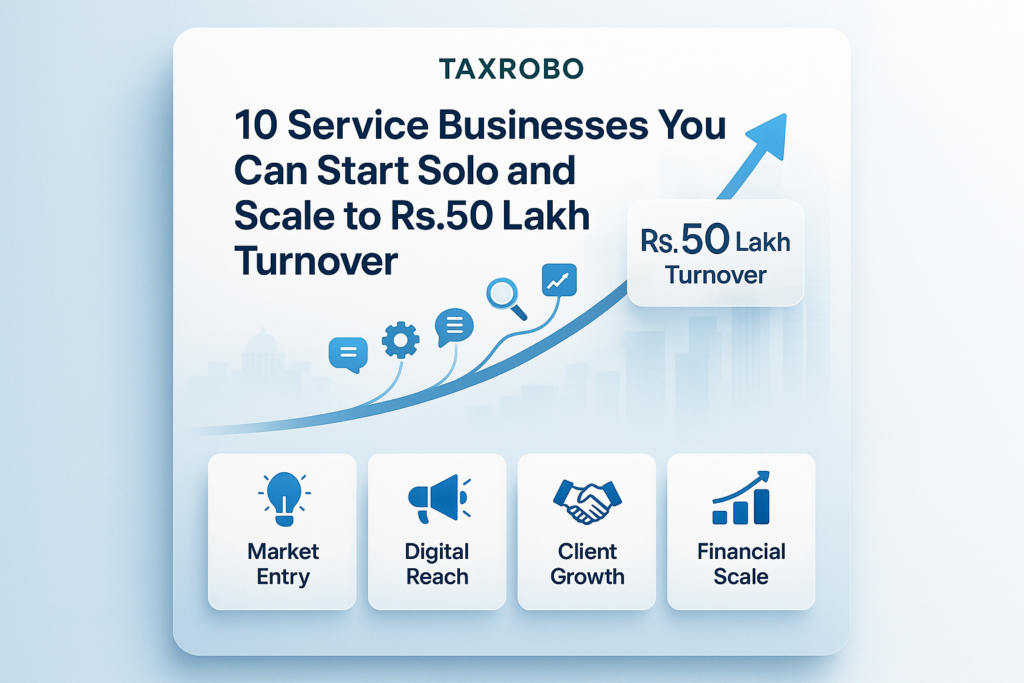

10 Service Businesses You Can Start Solo and Scale to Rs.50 Lakh Turnover
Meta Description: Looking for the best service businesses to start in India? Discover 10 profitable solo service business ideas you can launch with low investment and a clear roadmap to scale to a Rs. 50 lakh turnover. Learn about legal and GST compliance.
The Indian service sector is booming, contributing over 50% to the nation’s GDP and creating a fertile ground for ambitious entrepreneurs. For many, the dream of financial independence feels closer than ever, yet the question remains: where to begin? If you’re looking for practical service businesses to start with minimal investment and high-profit potential, you’ve come to the right place. This guide isn’t just a list of ideas; it’s a comprehensive roadmap detailing 10 profitable solo service business ideas in India that you can launch on your own and strategically scale to a turnover of Rs. 50 lakh and beyond. We’ll explore not only what to do but also how to manage the crucial legal and financial aspects of your entrepreneurial journey.
Why Solo Service Businesses are a Golden Opportunity for Indian Entrepreneurs
Starting a business can seem daunting, often associated with high costs and significant risks. However, the rise of the digital economy has opened a golden door for aspiring individuals. The beauty of a solo service-based business lies in its simplicity and efficiency, making it one of the most attractive forms of entrepreneurship in the service sector in India. You are not selling a physical product; you are selling your expertise, your skill, and your time. This model presents several powerful advantages for service businesses for Indian entrepreneurs.
- Low Initial Investment: Forget the need for expensive inventory, large warehouses, or a fancy office. Your primary startup costs are often just a good laptop, reliable internet, and any specialized software for your field. You can start from your home, keeping overheads incredibly low.
- High Profit Margins: Since your main “product” is your intellectual capital, the cost of goods sold is virtually zero. This means a significant portion of your revenue translates directly into profit, allowing for faster financial growth.
- Flexibility & Control: As a solopreneur, you are the boss. You have the ultimate freedom to set your working hours, choose the clients you want to work with, and operate from anywhere in the world. This work-life integration is a major draw for modern professionals.
- Scalability: Starting solo doesn’t mean staying solo. Service businesses have a clear and proven path to growth. As demand for your expertise increases, you can scale by hiring freelancers, building a small team, or creating digital products, transforming your one-person operation into a thriving agency.
Top 10 Service Businesses to Start and Scale in India
Here is a curated list of high-demand, scalable service businesses to start that you can launch today. Each idea comes with a practical roadmap to help you achieve your financial goals and a snapshot of the essential legal and tax compliance you need to know.
1. Digital Marketing & SEO Consultancy
Why it’s a great solo venture: In today’s digital-first world, every business, from the local kirana store to a multinational corporation, needs a strong online presence to survive and thrive. This has created a relentless demand for skilled digital marketers. As a solo expert, you can deliver measurable results and immense value, making it a highly lucrative and respected profession.
Skills & Tools: A deep understanding of Search Engine Optimization (SEO), Pay-Per-Click (PPC) advertising like Google Ads, Social Media Marketing, and Email Marketing is crucial. You’ll need to be proficient with tools like SEMrush or Ahrefs for SEO analysis, Google Analytics for tracking performance, and Meta Business Suite for social media management.
Path to Rs. 50 Lakh:
- Phase 1 (0 – ₹10 Lakh): Begin by taking on freelance projects from platforms like Upwork and Freelancer or by networking with local businesses. Focus on building a strong portfolio and gathering testimonials.
- Phase 2 (₹10 – ₹25 Lakh): Shift from project-based work to monthly retainer packages. Securing 4-5 clients at a retainer of ₹40,000 – ₹50,000 per month provides stable, predictable income.
- Phase 3 (₹25 – ₹50 Lakh+): Scale your operations by hiring junior marketers or specialized freelancers to handle the day-to-day execution. This frees you up to focus on high-level strategy, client acquisition, and business development.
Financial & Legal Snapshot:
- Registration: You can start as a Sole Proprietor. As your income grows and you approach the ₹20-25 lakh turnover mark, consider registering a One Person Company (OPC) to gain limited liability protection and a separate legal identity. Check out TaxRobo’s Company Registration Service for expert help.
- GST: GST registration becomes mandatory once your annual turnover exceeds ₹20 lakhs. However, if you serve clients outside your state (inter-state supply), you must register for GST from day one. Let us simplify the process with TaxRobo’s GST Registration Service.
- ITR: As a professional, you can file your returns using ITR-3. A smarter option is to leverage Presumptive Taxation under Section 44ADA, which simplifies compliance significantly. Our experts can guide you through TaxRobo’s Income Tax Filing Service.
2. Content Creation & Copywriting Services
Why it’s a great solo venture: “Content is king” is more than just a saying; it’s a business reality. Companies constantly need high-quality website copy, engaging blog posts, persuasive social media updates, and compelling video scripts to attract and retain customers. A skilled writer can build a thriving business with just a laptop and a creative mind.
Skills & Tools: Exceptional writing, editing, and storytelling skills are non-negotiable. A strong grasp of grammar and a flair for different writing styles are essential. Familiarity with tools like Grammarly, Google Docs, and a basic understanding of SEO principles will set you apart.
Path to Rs. 50 Lakh:
- Phase 1 (0 – ₹10 Lakh): Build a strong portfolio by writing for blogs, guest posting, or offering your services at an introductory rate. Price your work per-word or per-project initially.
- Phase 2 (₹10 – ₹25 Lakh): Develop a niche, such as B2B SaaS, finance, or healthcare technology. Specialists command higher fees. Start offering high-value content strategy and monthly content packages.
- Phase 3 (₹25 – ₹50 Lakh+): Transition from a writer to a content strategist. Build a small, reliable team of niche writers to handle the bulk of the writing, allowing you to manage more clients and focus on strategy.
Financial & Legal Snapshot: The legal structure is similar to a digital marketing consultancy. The Presumptive Taxation scheme under Section 44ADA is particularly beneficial for writers and content creators, allowing you to declare 50% of your gross receipts as your income and pay tax on that amount, reducing your compliance burden.
3. Web & App Development
Why it’s a great solo venture: A website or mobile app is the digital storefront for modern businesses. This has created an evergreen demand for talented developers. As a solo developer, you have the flexibility to work with clients from around the globe, right from your home office.
Skills & Tools: Proficiency in programming languages and frameworks is key. For web development, this could be JavaScript (with frameworks like React or Vue), Python (with Django or Flask), or CMS platforms like WordPress and Shopify. For app development, knowledge of Swift/Kotlin or frameworks like Flutter is essential. Tools like VS Code, GitHub, and Figma are part of the daily toolkit.
Path to Rs. 50 Lakh:
- Phase 1 (0 – ₹15 Lakh): Start by building simpler websites for local businesses or startups. This helps build your portfolio and refine your client management skills.
- Phase 2 (₹15 – ₹35 Lakh): Take on more complex projects like e-commerce sites, custom web applications, or mobile apps, which command significantly higher fees.
- Phase 3 (₹35 – ₹50 Lakh+): Introduce Annual Maintenance Contracts (AMCs) for a recurring revenue stream. Scale by collaborating with UI/UX designers and other developers on a project-by-project basis to take on larger, more profitable projects.
Financial & Legal Snapshot: When providing services to clients in other states or countries, GST registration is mandatory from the first transaction. It’s also crucial to have a detailed Service Level Agreement (SLA) with each client, outlining the scope of work, payment terms, and deliverables to avoid disputes.
4. Graphic Design & Branding Agency
Why it’s a great solo venture: A strong visual identity can make or break a brand. Businesses understand this and are willing to invest in professional design. A talented designer can run a highly profitable solo business with just a powerful computer and design software.
Skills & Tools: Mastery of the Adobe Creative Suite (Photoshop, Illustrator, InDesign) and/or modern UI/UX tools like Figma is essential. Beyond technical skills, a strong understanding of color theory, typography, and branding strategy is what separates a good designer from a great one.
Path to Rs. 50 Lakh:
- Phase 1 (0 – ₹10 Lakh): Begin with one-off projects like logo design, social media graphics, or brochures. Use platforms like Behance and Dribbble to showcase your work.
- Phase 2 (₹10 – ₹30 Lakh): Move up the value chain by offering complete branding packages. These include the logo, brand guidelines, color palettes, typography, and marketing collateral, and are priced at a premium.
- Phase 3 (₹30 – ₹50 Lakh+): Offer monthly design retainers for businesses with ongoing creative needs. Scale by outsourcing specific tasks like illustration or by hiring a junior designer to support you.
Financial & Legal Snapshot: When you create logos and brand names for clients, it’s a good practice to advise them on legal protection. This creates an opportunity to offer value-added services. You can guide them on the importance of registering a trademark for their new brand identity through services like TaxRobo’s Trademark Registration Service.
5. Virtual CFO & Accounting Services
Why it’s a great solo venture: This is a perfect venture for finance professionals like CAs, CFAs, or MBAs. Startups and SMEs desperately need expert financial guidance but often cannot afford the salary of a full-time Chief Financial Officer (CFO). A Virtual CFO bridges this gap, offering high-level strategic advice on a flexible, part-time basis.
Skills & Tools: A professional qualification is a huge advantage. You need expertise in accounting software (Tally, Zoho Books, QuickBooks), financial modeling in Excel, and a deep understanding of Indian tax laws and corporate compliance.
Path to Rs. 50 Lakh:
- Phase 1 (0 – ₹15 Lakh): Start by offering essential services like bookkeeping, GST filing, and basic compliance on a retainer basis to small businesses.
- Phase 2 (₹15 – ₹40 Lakh): Introduce high-value Virtual CFO services. This includes financial forecasting, budget management, MIS reporting, fundraising support, and strategic advice, billed at a much higher monthly retainer.
- Phase 3 (₹40 – ₹50 Lakh+): As your client base grows, hire junior accountants to manage the day-to-day bookkeeping and compliance tasks. This allows you to focus solely on providing strategic CFO-level advice to a larger number of clients.
Financial & Legal Snapshot: As a specified professional service, this business model is an ideal candidate for the Presumptive Taxation scheme under Section 44ADA. Given the professional responsibility involved, it is crucial to have a robust engagement letter or service agreement that clearly defines the scope of your services and liabilities. Need help managing client books? Explore TaxRobo’s Accounting & Bookkeeping Service.
6. HR & Recruitment Consultancy
Why it’s a great solo venture: Finding and retaining the right talent is a major challenge for companies of all sizes. A solo recruiter with a strong network and industry knowledge can operate with extremely low overheads (a phone, laptop, and LinkedIn account) and earn significant commissions.
Skills & Tools: Excellent communication, networking, and negotiation skills are paramount. You need to be adept at using professional networking platforms like LinkedIn Premium or Recruiter, job portals like Naukri, and potentially a basic Applicant Tracking System (ATS) to manage your candidate pipeline.
Path to Rs. 50 Lakh:
- Phase 1 (0 – ₹20 Lakh): Start with contingency-based recruitment, where you earn a commission (typically 8-15% of the candidate’s annual salary) only after a successful placement.
- Phase 2 (₹20 – ₹40 Lakh): Target senior-level or highly specialized roles and move to a retained search model. Here, you receive a portion of your fee upfront, providing more stable cash flow.
- Phase 3 (₹40 – ₹50 Lakh+): Expand your service offerings. You can add HR policy drafting, payroll processing, or employee onboarding services for your clients, creating multiple streams of recurring revenue.
Financial & Legal Snapshot: The service fee charged to companies for recruitment services is subject to GST, typically at 18%. It is vital to have clear, written contracts with your client companies that outline the fee structure, payment terms, and replacement policies.
7. Online Fitness & Wellness Coaching
Why it’s a great solo venture: The health and wellness industry in India is experiencing explosive growth. Technology has made it possible for certified fitness trainers, yoga instructors, and nutritionists to coach clients from anywhere in the world, breaking down geographical barriers.
Skills & Tools: A credible certification in your area of expertise (fitness, yoga, nutrition) is essential for building trust. The required tools are simple: a good smartphone for recording and streaming, scheduling software like Calendly, and a platform for live sessions like Zoom or Google Meet.
Path to Rs. 50 Lakh:
- Phase 1 (0 – ₹10 Lakh): Begin by offering 1-on-1 personalized online training sessions. This helps you build a client base and refine your coaching methods.
- Phase 2 (₹10 – ₹25 Lakh): To leverage your time better, introduce small group online classes. You can train multiple clients in the same hour, significantly increasing your earning potential.
- Phase 3 (₹25 – ₹50 Lakh+): Develop scalable, passive income streams. Create pre-recorded online courses, specialized diet plans, or a paid subscription-based wellness community that provides ongoing value with less direct time investment from you.
Financial & Legal Snapshot: If you earn income from international clients, you must be mindful of FEMA (Foreign Exchange Management Act) guidelines for receiving payments. GST becomes applicable once your total turnover crosses the ₹20 lakh threshold.
8. Social Media Management
Why it’s a great solo venture: While a subset of digital marketing, social media management has become a specialized field in its own right. Many business owners recognize its importance but lack the time, skill, or consistency to manage their social media presence effectively, creating a perfect opportunity for a dedicated solo manager. This is one of the most popular solo service business ideas in India.
Skills & Tools: You need a deep, practical understanding of how major social media platforms like Instagram, LinkedIn, Facebook, and Twitter work. This includes content creation, community engagement, and performance analytics. Proficiency with tools like Canva for design and Buffer or Hootsuite for scheduling is a must.
Path to Rs. 50 Lakh:
- Phase 1 (0 – ₹12 Lakh): Start by managing one or two key platforms for a few small businesses. Offer a simple monthly retainer package that covers content posting and basic engagement.
- Phase 2 (₹12 – ₹30 Lakh): Expand your services to include a comprehensive social media strategy, content creation (including simple videos), and paid advertising campaign management, which allows you to charge a higher retainer.
- Phase 3 (₹30 – ₹50 Lakh+): As you take on more clients, hire a freelance content creator or graphic designer to assist with execution. This lets you scale your client capacity while you focus on strategy and growth.
Financial & Legal Snapshot: The financial and legal requirements are identical to those for a Digital Marketing consultancy. GST registration is mandatory for inter-state services or after crossing the ₹20 lakh turnover limit. Section 44ADA for presumptive taxation is an excellent choice for income tax filing.
9. Video Editing Services
Why it’s a great solo venture: Video is the most consumed form of content online. From Instagram Reels and YouTube videos to corporate training modules and advertisements, the demand for skilled video editors is skyrocketing. A talented editor can build a successful business with a powerful computer and editing software.
Skills & Tools: Proficiency in professional video editing software like Adobe Premiere Pro, Final Cut Pro, or DaVinci Resolve is fundamental. A good understanding of storytelling, pacing, color grading, and sound design will elevate your work and allow you to charge premium rates.
Path to Rs. 50 Lakh:
- Phase 1 (0 – ₹15 Lakh): Start by offering editing services for short-form content like Reels and YouTube Shorts for individual content creators. This helps build a fast and impressive portfolio.
- Phase 2 (₹15 – ₹35 Lakh): Target corporate clients for higher-value projects such as advertisements, customer testimonials, and internal training videos. These projects have bigger budgets and longer timelines.
- Phase 3 (₹35 – ₹50 Lakh+): Offer monthly video editing retainer packages for YouTubers or businesses that produce a high volume of video content. This creates a stable and predictable revenue stream.
Financial & Legal Snapshot: When working with creative clients, it is essential to have crystal-clear invoicing and payment terms. Specify the number of revisions included in your fee to avoid scope creep. Standard GST and Income Tax rules apply.
10. E-commerce & Marketplace Consultant
Why it’s a great solo venture: Thousands of sellers and brands are trying to sell their products on platforms like Amazon, Flipkart, and Myntra, but most struggle to get visibility. An expert consultant who understands the nuances of these marketplaces can provide immense value and command high fees.
Skills & Tools: You need a deep understanding of marketplace algorithms, product listing optimization (SEO for e-commerce), inventory management, and platform-specific PPC advertising (e.g., Amazon Ads, Flipkart Ads).
Path to Rs. 50 Lakh:
- Phase 1 (0 – ₹15 Lakh): Offer foundational services like new seller account setup, brand registry, and product listing optimization on a per-project basis.
- Phase 2 (₹15 – ₹40 Lakh): Transition to a full account management model. Here, you handle everything from advertising to customer service for a brand and charge a fixed monthly retainer or a percentage of sales, which aligns your success with your client’s.
- Phase 3 (₹40 – ₹50 Lakh+): Scale by specializing in a high-growth category (like electronics or beauty) or by hiring and training junior account managers to handle a portfolio of clients under your supervision.
Financial & Legal Snapshot: This is a crucial area for compliance. As a consultant, you can guide your clients on the fact that GST is mandatory from day one for anyone selling goods on an e-commerce platform, as per the rules on the official GST Portal. Your own consulting service fee is subject to GST as per standard rules.
The Legal & Financial Blueprint to Scale Your Service Business in India
Having a great business idea is only half the battle. To successfully scale your service business in India, you need a solid legal and financial foundation. Ignoring compliance can lead to penalties and roadblocks down the line. Here’s your blueprint for success.
Choosing the Right Business Structure
Your choice of business structure affects your liability, compliance, and ability to raise funds.
- Sole Proprietorship: The simplest and quickest to start. Your business is not separate from you, meaning you have unlimited liability. It’s great for testing an idea but can be risky as you grow.
- One Person Company (OPC): The perfect structure for solo founders. An OPC is a separate legal entity, which means your personal assets are protected from business debts (limited liability). It adds credibility and makes it easier to get loans.
- Limited Liability Partnership (LLP) / Private Limited Company: These are better suited for when you plan to bring on co-founders or seek investment from external sources.
Confused about which structure is right for you? Don’t guess. Let TaxRobo help you choose and register the right structure for your business.
Mastering GST Compliance
GST can seem complex, but understanding the basics is essential.
- The Threshold: Remember, GST registration is mandatory for service providers once your annual turnover exceeds ₹20 lakhs (or ₹10 lakhs for special category states).
- Mandatory Registration Cases: You must register for GST irrespective of turnover if you provide services to clients in another state (inter-state supply) or operate as an e-commerce aggregator.
- Key Concepts: Proper GST compliance allows you to claim Input Tax Credit (ITC) on your business expenses (like software subscriptions or office rent), which reduces your final tax payout. Regular filing of returns like GSTR-1 and GSTR-3B is non-negotiable to avoid penalties.
Smart Income Tax Planning
Effective tax planning can save you a significant amount of money that you can reinvest into your business.
- Presumptive Taxation (Section 44ADA): This is a game-changer for specified professionals (including many on our list). You can declare 50% of your total gross receipts as your profit and pay income tax on that amount. This drastically reduces the need for extensive bookkeeping.
- Deducting Expenses: If you don’t opt for the presumptive scheme, it’s crucial to meticulously track all your business-related expenses. Costs like software licenses, internet bills, co-working space fees, and marketing expenses can be deducted from your revenue to lower your taxable profit.
- Advance Tax: As your income grows, you’ll be required to pay income tax in quarterly installments. If your estimated tax liability for the year is more than ₹10,000, you must pay advance tax to avoid interest penalties.
Conclusion: Your Journey from Solopreneur to Business Leader Starts Now
Starting a solo service business in India has never been more accessible or filled with opportunity. The key is to choose a niche you are skilled in, commit to delivering exceptional value to your first few clients, and have a clear, strategic plan for growth. The journey from a solopreneur to a business leader with a Rs. 50 lakh turnover is not a distant dream; it’s a tangible goal that can be achieved with dedication and smart planning. These top service businesses to start provide a realistic and proven path to get you there.
Your expertise is your greatest asset. Don’t let the complexities of legal paperwork and tax compliance become a barrier to your success. Take that first crucial step today.
Ready to take the leap? Don’t let legal and tax compliance hold you back. Schedule a free consultation with a TaxRobo expert today and let us handle your company registration, GST, and accounting, so you can focus on growing your business.
Frequently Asked Questions (FAQ)
Q1: Do I need GST registration from day one for my service business?
A: Not necessarily. GST registration is mandatory only if your annual turnover exceeds ₹20 lakhs, or if you provide services to clients in other states (inter-state supply). For expert guidance on your specific case, consult a tax professional.
Q2: What is the best business structure for a solo entrepreneur in India?
A: A Sole Proprietorship is the easiest to start. However, an OPC (One Person Company) is highly recommended as it gives you a separate legal identity and limited liability, which is crucial as your business grows.
Q3: How can I manage my taxes as a freelancer?
A: The simplest way is to opt for the Presumptive Taxation Scheme under Section 44ADA of the Income Tax Act. This allows you to declare 50% of your gross receipts as profit and pay tax on that amount, simplifying bookkeeping. You can learn more from our experts specializing in ITR Filing for Freelancers.
Q4: Can I run my business using my personal bank account?
A: While you can start with a personal account as a proprietor, it is highly recommended to open a separate business current account. It makes tracking income/expenses easier, appears more professional, and is mandatory for company structures like OPC or Pvt Ltd.
Q5: How can TaxRobo help me start my service business?
A: TaxRobo is your one-stop solution. We can help you with everything from choosing and registering the right business structure (Proprietorship, OPC, LLP), getting your GST number, managing your accounting and bookkeeping, to filing your annual income tax returns.