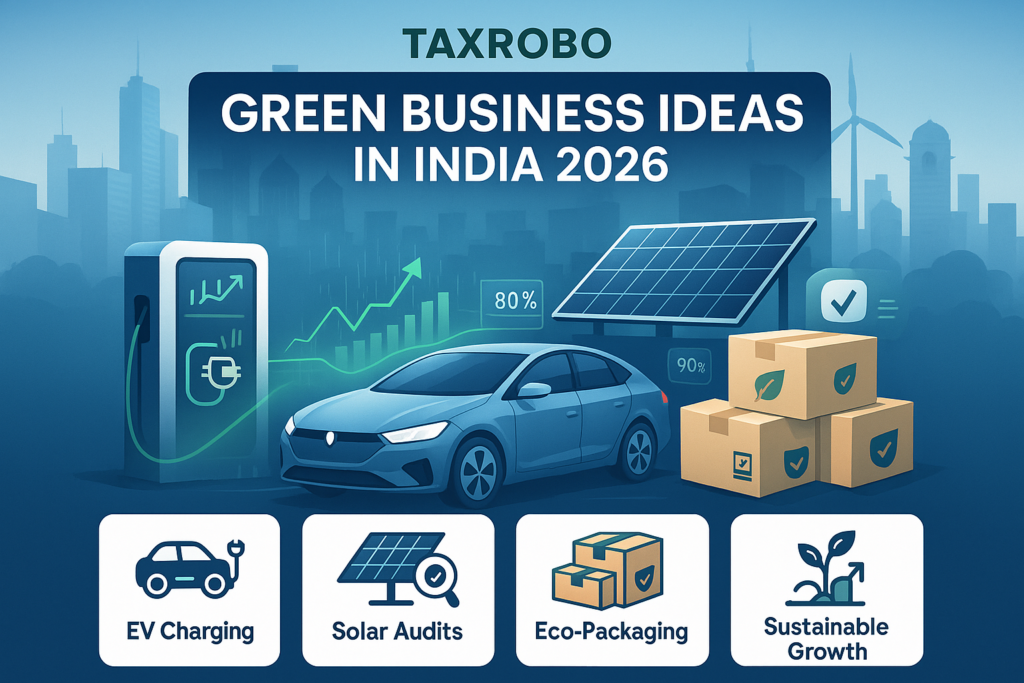

Green Business Ideas in India 2026: EV Charging, Solar Audits and Eco-Packaging
As India charges towards its ambitious goal of achieving Net Zero emissions by 2070, the green economy is no longer a niche market but a booming frontier of opportunity. The government is pushing for sustainability, and consumers are actively seeking eco-friendly products and services. This convergence makes exploring green business ideas India one of the smartest moves for aspiring entrepreneurs today. It’s a chance to build a profitable venture that also contributes positively to the planet. While many sectors are evolving, this guide cuts through the noise to focus on the top three high-potential, low-competition eco-business opportunities 2026: EV charging, solar energy solutions, and sustainable packaging. We will dive deep into each idea, exploring viable business models and the crucial legal and financial steps you need to take, showcasing how to align your business with current sustainable business trends India.
Why is 2026 the Right Time for Green Entrepreneurship in India?
The year 2026 stands at a pivotal moment for India’s green transition. A combination of strong policy support, rising consumer awareness, and technological maturity has created a perfect storm for green entrepreneurship in India. This isn’t just about feeling good; it’s about sound business logic. Early movers in this space are poised to capture significant market share in industries that are projected to grow exponentially over the next decade. The ecosystem is ripe with incentives, demand is surging, and the cost of entry is lower than ever before, making it an ideal time to invest your capital and energy into a sustainable venture that promises both financial returns and a lasting positive impact on the environment.
Strong Government Support and Policies
The Indian government has laid a solid foundation for green businesses through a series of robust policies and incentives. The FAME-II (Faster Adoption and Manufacturing of Electric Vehicles) scheme, for instance, provides subsidies to make EVs more affordable, directly fueling the demand for charging infrastructure. Similarly, the Production Linked Incentive (PLI) scheme for high-efficiency solar PV modules is designed to boost domestic manufacturing and reduce reliance on imports, creating numerous opportunities in the solar supply chain. Furthermore, the nationwide ban on single-use plastics has forced businesses across sectors to seek sustainable alternatives, opening a massive market for eco-friendly packaging solutions. Aspiring entrepreneurs should regularly check official portals like the Ministry of New and Renewable Energy (MNRE) and the Ministry of Power to stay updated on the latest policies and subsidy programs.
Growing Consumer Demand for Sustainability
Today’s Indian consumer is more informed and environmentally conscious than ever before. Market reports consistently show a significant shift in buying behaviour, with a growing preference for brands that demonstrate a genuine commitment to sustainability. A recent survey indicated that over 70% of urban Indian consumers are willing to pay a premium for eco-friendly products. This “green premium” is a powerful market force, driving demand for everything from electric vehicles to products with sustainable packaging. This conscious consumerism means that a green business is not just a regulatory compliance measure but a strong unique selling proposition (USP) that can build brand loyalty, attract a dedicated customer base, and ultimately drive higher profitability in a competitive market.
Technological Advancements and Falling Costs
One of the biggest drivers of renewable energy business opportunities India is the dramatic reduction in technology costs. Over the past decade, the price of solar panels has plummeted by over 80%, making rooftop solar installations financially viable for millions of homes and businesses. Similarly, advancements in lithium-ion battery technology have lowered the cost of electric vehicles and energy storage systems. In the packaging sector, innovations in material science have led to the development of cost-effective and scalable biodegradable materials made from cornstarch, seaweed, and even mushroom roots. These technological advancements have lowered the barrier to entry, reducing the initial capital investment required and making green business models more accessible and profitable for small business owners and startups.
Business Idea 1: Electric Vehicle (EV) Charging Solutions India
The electric vehicle revolution is rapidly gaining momentum in India, but it’s hitting a significant roadblock: a massive deficit in charging infrastructure. As EV sales surge, the demand for accessible and reliable charging points is skyrocketing, creating one of the most promising electric vehicle charging solutions India. This gap between vehicle sales and available chargers presents a golden opportunity for entrepreneurs to build a scalable and future-proof business. From public charging plazas on highways to dedicated fleet solutions for logistics companies, the possibilities are vast and varied. Entering this market now means establishing a foothold in an essential service industry that will underpin the future of transportation in the country for decades to come.
Market Opportunity: The EV Revolution is Here
India’s EV market is growing at an exponential rate, with sales more than doubling year-on-year. While the government is targeting 30% EV penetration by 2030, the current public charging infrastructure is critically inadequate. According to government data, the ratio of EVs to public chargers is alarmingly high, leading to “range anxiety” among potential EV buyers. This infrastructure gap is the central market opportunity. Businesses, housing societies, and public spaces are all in desperate need of charging solutions. An entrepreneur can cater to this demand by setting up charging stations in high-traffic commercial areas, residential complexes, and along major transport corridors, creating a network that supports the growing EV ecosystem.
Viable Business Models to Consider
The EV charging sector offers multiple entry points depending on your investment capacity and business strategy.
- Public Charging Stations (PCS): This is the most visible model, involving setting up charging stations in publicly accessible locations like shopping malls, fuel stations, restaurants, and highway rest stops. Revenue is generated on a pay-per-use basis. This model requires a higher initial investment but offers significant long-term returns.
- Fleet Charging Solutions: A lucrative B2B opportunity involves partnering with companies that operate large EV fleets, such as e-commerce delivery firms, taxi aggregators, and logistics providers. You can offer a complete package including hardware installation, software management, and maintenance services at their depots, securing a stable, recurring revenue stream.
- Residential & Commercial Installation Services: This is a lower-investment, service-oriented model. You can become an authorized installer for various EV charger brands, providing end-to-end installation and maintenance services for individual homeowners (in apartments and standalone houses) and offices looking to provide charging facilities for their employees.
Getting Started: Key Legal & Financial Steps
Launching an EV charging business requires careful planning and compliance with specific regulations. The first step is to choose the right business structure.
| Business Structure | Pros | Cons |
|---|---|---|
| Private Limited Company | Limited liability, easy to raise funds, separate legal entity | Higher compliance costs, more paperwork |
| Limited Liability Partnership (LLP) | Limited liability, lower compliance than Pvt Ltd Co. | Can be harder to raise external investment |
For a scalable venture, a Private Limited Company is often the preferred choice. You can get started with TaxRobo’s Company Registration Service to handle the entire process smoothly.
Next, you must understand the key regulations. The Ministry of Power has issued clear guidelines stating that setting up a public charging station is a de-licensed activity, meaning you don’t need a separate license to operate one. However, you must comply with technical standards and electricity tariff regulations set by the state electricity regulatory commissions.
Finally, understanding the tax implications is crucial. While the sale of electricity itself is exempt from GST, the service of charging an electric vehicle is taxable. The current GST rate for this service is 18%. This means you must obtain GST registration, charge GST on your invoices, and you will be eligible to claim an Input Tax Credit (ITC) on the capital goods (chargers, transformers) and services used to set up your station.
Business Idea 2: Solar Energy Audits and Rooftop Installation
With abundant sunshine year-round, India has set some of the world’s most ambitious solar energy targets. The government is aggressively promoting solar power to reduce carbon emissions and decrease reliance on fossil fuels. This national push creates a wealth of solar energy business ideas India, particularly in the decentralized rooftop solar segment. While large-scale solar farms require massive investment, the rooftop solar market for homes and businesses is relatively untapped and accessible to small and medium-sized entrepreneurs. This sector allows you to offer tangible value to customers by significantly reducing their electricity bills while contributing to a cleaner environment, making it a financially and ethically rewarding business.
The Untapped Potential of Solar Energy Business Ideas in India
India aims to install 500 GW of renewable energy capacity by 2030, with a significant portion expected to come from solar power. The rooftop solar segment, in particular, holds immense potential. Millions of residential rooftops and vast commercial and industrial building spaces are yet to be utilized for power generation. For homeowners, a rooftop solar system is a long-term investment that slashes monthly electricity expenses. For businesses, it not only reduces operational costs but also serves as a green credential, enhancing their brand image. This dual benefit of economic savings and environmental responsibility is a powerful driver of demand, creating a sustainable market for solar entrepreneurs.
Viable Business Models to Consider
The solar industry offers diverse business models catering to different skill sets and investment levels.
- Residential Solar Installation: This is an end-to-end model where you provide a complete package for homeowners. This includes site assessment, system design, procurement of panels and inverters, installation, and facilitating net-metering and subsidy applications through the National Portal for Rooftop Solar.
- Commercial Energy Audits & Installation: This B2B model focuses on commercial and industrial (C&I) clients. You start by conducting a detailed energy audit of their facility to identify consumption patterns and savings potential. Based on the audit, you design and install a customized solar power plant that helps them reduce their significant energy expenditures.
- Solar Panel Maintenance & Cleaning Services: Every solar installation requires regular maintenance for optimal performance. Dust, bird droppings, and wear and tear can reduce a panel’s efficiency by up to 25%. This creates a recurring revenue opportunity through annual maintenance contracts (AMCs) for cleaning, inspection, and servicing of existing solar installations in your area.
Getting Started: Key Legal & Financial Steps
To build credibility and succeed in the solar business, certain legal and technical prerequisites are essential. While not always mandatory for small installers, obtaining certifications from recognized bodies like the National Institute of Solar Energy (NISE) can significantly boost your credibility and technical expertise.
For your business entity, registering as an MSME through the official Udyam Registration portal is highly recommended. This provides access to government schemes, priority sector lending from banks, and other benefits.
Navigating the GST structure for solar components is a critical aspect of financial management. The tax rates are not uniform across the entire system, which can be complex.
- Solar Panels & specific components: Attract a 12% GST rate.
- Inverters, Batteries, and Installation Services: Attract a higher 18% GST rate.
This mixed-rate structure requires meticulous accounting to ensure you are correctly calculating your final project cost and managing your Input Tax Credit (ITC). Mismanagement can lead to compliance issues and financial losses. Seeking expert guidance from services like TaxRobo’s GST Services is advisable to ensure your business stays compliant from day one.
Business Idea 3: Eco-Friendly and Sustainable Packaging
The nationwide ban on single-use plastics and the explosive growth of e-commerce have created an urgent and massive demand for sustainable packaging options India. Businesses in the food and beverage (F&B), Fast-Moving Consumer Goods (FMCG), and retail sectors are scrambling to find viable, eco-friendly alternatives to plastic. This regulatory push combined with a strong consumer preference for green brands makes eco-friendly packaging one of the most relevant and scalable eco-friendly business concepts India today. From manufacturing biodegradable containers to consulting firms on their green transition, this industry offers a wide spectrum of opportunities for new entrepreneurs to make a significant environmental impact while building a profitable business.
The Shift Towards Sustainable Packaging Options in India
The demand for green packaging is no longer a choice but a necessity. Large e-commerce players like Amazon and Flipkart are making public commitments to eliminate single-use plastic from their supply chains, creating a ripple effect across their thousands of sellers. Similarly, food delivery platforms, restaurants, cafes, and FMCG companies are actively sourcing materials that are compostable, biodegradable, or made from recycled content. This market-wide transition has opened up a significant gap for suppliers and manufacturers of materials like bagasse (sugarcane pulp), cornstarch, bamboo, recycled paper, and even innovative materials like mycelium (mushroom root).
Viable Business Models to Consider
The sustainable packaging industry is diverse, allowing entrepreneurs to enter at various points in the value chain.
- Manufacturing Biodegradable Packaging: This involves setting up a unit to produce eco-friendly packaging items. You could focus on a specific niche, such as producing biodegradable cutlery from cornstarch, food containers from bagasse, or packaging fillers from recycled paper. This model is capital-intensive but offers high margins and scalability.
- Distribution & Supply: If manufacturing seems too daunting, you can start as a distributor. This involves sourcing a variety of eco-friendly packaging products from multiple manufacturers and supplying them to local businesses like restaurants, cafes, bakeries, and small retailers. This model requires lower initial investment and focuses on building a strong local sales and logistics network.
- Packaging Design & Consulting: Many brands want to switch to sustainable packaging but lack the expertise to do so without compromising product safety and branding. You can offer a consulting service that helps these businesses design new packaging, source the right materials, and re-engineer their supply chain for a smooth transition away from plastic.
Getting Started: Key Legal & Financial Steps
The legal structure for your packaging business will depend on your scale. A Sole Proprietorship is simpler for a small distribution business, while a Private Limited Company is better suited for a manufacturing unit that plans to scale and seek investment.
If you choose to manufacture, you will need specific licenses. A Factory License is mandatory, and you will need to obtain clearances from your State Pollution Control Board (SPCB) to ensure your manufacturing process complies with environmental norms. These regulations vary by state, so it’s crucial to check the local requirements.
Understanding the GST implications is vital for profitability. The GST rates can differ for raw materials versus finished goods. For example, the GST on bamboo as a raw material might be different from the GST on finished bamboo-based containers. Managing this requires careful accounting to track input costs and output taxes accurately, ensuring you claim the correct ITC and maintain healthy margins. Proper bookkeeping and GST filing are non-negotiable for success in this supply-chain-intensive business.
How TaxRobo Can Help You Launch Your Green Business
Embarking on your entrepreneurial journey is exciting, but navigating the maze of legal and financial compliance can be overwhelming. At TaxRobo, we specialize in helping small business owners and startups lay a solid foundation, so you can focus on what you do best: building your green business. We provide end-to-end support, ensuring your venture is structured correctly, compliant, and protected from the very beginning.
Choosing the Right Business Structure
The choice between a Sole Proprietorship, LLP, or Private Limited Company has long-term implications for your liability, ability to raise funds, and compliance burden. A proprietorship is easy to start but offers no liability protection. An LLP offers a balance, while a Private Limited Company is ideal for startups planning to scale and seek venture capital. Our experts at TaxRobo can analyze your business model and future goals to help you choose the structure that best fits your green venture. For a detailed breakdown, see our guide on Comparing Business Structures: Private Limited, LLP, OPC & More.
Seamless Company and GST Registration
Once you’ve chosen a structure, a series of registrations become mandatory. This includes obtaining a PAN, TAN, registering your company with the Ministry of Corporate Affairs, getting GST registration, and signing up on the Udyam portal for MSME benefits. Handling these multiple applications can be time-consuming and prone to errors. TaxRobo acts as your one-stop solution, managing all these registrations seamlessly and ensuring you are 100% compliant and ready for business. You can learn more in our Ultimate Guide to GST Registration for Small Businesses.
Protecting Your Green Brand with Trademark Registration
In a growing market, your brand is your most valuable asset. A unique brand name, logo, or tagline for your EV charging network or eco-packaging product sets you apart from the competition. Protecting it through trademark registration is essential to prevent others from using it and to build long-term brand equity. TaxRobo’s experts can handle the entire trademark search and application process for you. Learn more at TaxRobo Intellectual Property Service.
Ongoing Compliance: Accounting & Tax Filing
Running a business successfully requires more than just a great idea; it requires disciplined financial management. From day-to-day bookkeeping to monthly GST returns and annual income tax filing, staying on top of your compliance is crucial to avoid heavy penalties and legal issues. Learning how to Set Up An Accounting System for My Small Business is a fundamental first step. Our team of chartered accountants provides comprehensive accounting and tax filing services, giving you peace of mind and the financial clarity you need to grow your business. Explore our services at TaxRobo’s Accounting Services.
Conclusion
The transition to a green economy is creating a wave of opportunities for innovators and entrepreneurs across India. The three green business ideas India we’ve explored—EV charging solutions, solar energy services, and sustainable packaging—are not just fleeting trends but foundational pillars of our country’s sustainable future. With strong government backing, surging consumer demand, and increasingly affordable technology, there has never been a better time to embrace green entrepreneurship in India. The journey from a sustainable vision to a successful business requires passion, planning, and a solid legal and financial framework.
Ready to turn your sustainable vision into a successful business? The journey starts with a solid legal and financial foundation. Contact TaxRobo today for a free consultation on company registration, GST compliance, and all the support you need to launch your green venture.
FAQs About Green Business Ideas in India
Q1: What is the approximate initial investment for setting up an EV charging station in India?
A: The investment varies significantly based on the type of charger and location. A basic AC slow charger setup can cost between ₹2-5 lakhs. A high-speed DC fast-charging station, which is more suitable for highways and commercial hubs, can require an investment of ₹15-30 lakhs or more, depending on the cost of the charger, electrical infrastructure upgrades, and site rental.
Q2: Are there any government subsidies for solar energy business ideas in India?
A: Yes, the government provides significant support for solar energy. For residential rooftop solar installations, homeowners can avail of Central Financial Assistance (CFA) or subsidies through the National Portal for Rooftop Solar. For businesses installing solar for their own consumption, benefits are available in the form of accelerated depreciation, which allows them to claim a higher rate of depreciation on their solar assets, leading to tax savings. Various state-level policies also offer additional incentives.
Q3: How do I legally register my eco-friendly business in India?
A: The legal registration process starts with choosing a business structure (e.g., Sole Proprietorship, LLP, Private Limited Company). After deciding, you need to obtain essential registrations: a Permanent Account Number (PAN) and Tax Deduction and Collection Account Number (TAN) for the business, GST Registration if your turnover exceeds the threshold, and an Udyam Registration to be recognized as an MSME and avail its benefits. TaxRobo can guide you through this entire process seamlessly.
Q4: What are the main challenges for new green businesses in India?
A: While the opportunities are vast, new green businesses face several challenges. These often include a high initial capital requirement for sectors like manufacturing and infrastructure, navigating complex and evolving government regulations and standards, facing competition from larger, established players, and building a reliable and cost-effective supply chain, especially for sustainable raw materials.
Q5: Is GST applicable on all eco-friendly products?
A: No, GST rates are not uniform and depend on the specific product or service. For instance, in the solar sector, panels are taxed at 12%, while inverters and installation services are taxed at 18%. In packaging, unprocessed agricultural raw materials might be exempt from GST, but finished goods like biodegradable cutlery or containers are taxed at rates ranging from 5% to 18%. It is crucial to get expert advice on the specific HSN codes and GST rates applicable to your products to ensure correct tax compliance.