
Quick-Commerce Is Leaving Metros: 8 Dark-Store Business Ideas for Coimbatore, Madurai and Trichy
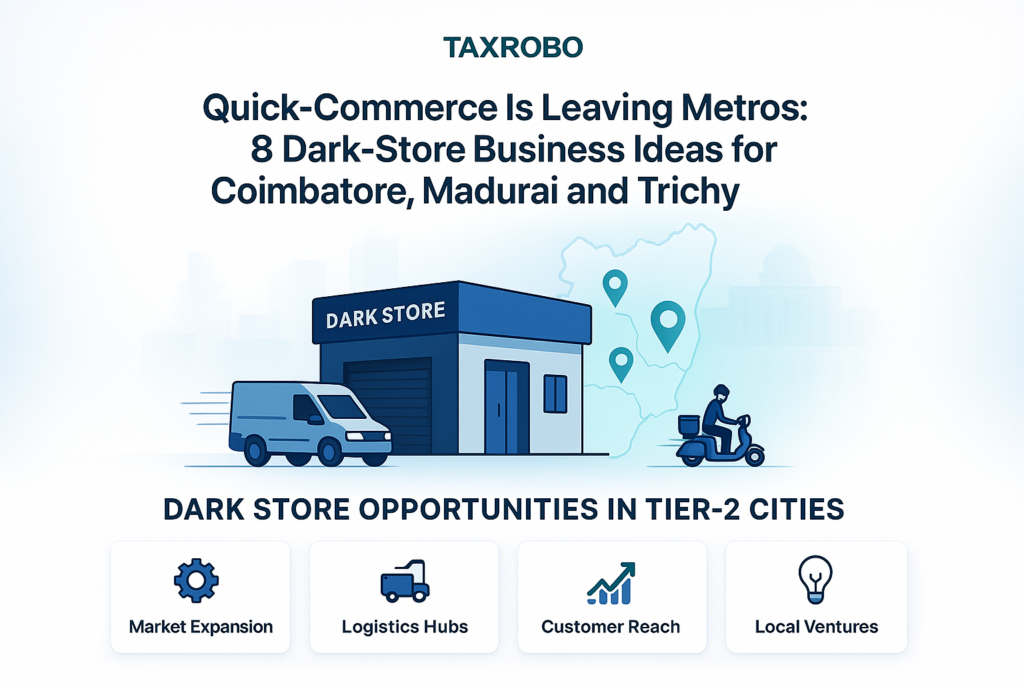
The landscape of Indian e-commerce is experiencing a seismic shift. The fierce 10-minute delivery battle, once confined to the bustling streets of Bengaluru and Chennai, is now moving to high-potential Tier-2 cities. This migration presents a golden opportunity for local entrepreneurs to innovate and capture a rapidly growing market. For aspiring business owners in thriving hubs like Coimbatore, Madurai, and Trichy, this is the perfect time to explore profitable dark-store business ideas. A “dark store” is essentially a mini-warehouse or fulfillment center dedicated exclusively to online orders—there are no walk-in customers, just a streamlined operation designed for speed. This article will break down 8 lucrative dark-store concepts perfectly suited for the unique demands of these Tamil Nadu cities and walk you through the essential legal steps to turn your idea into a successful venture.
The Untapped Potential: Why Quick-Commerce is Thriving Beyond Metros
The narrative of quick-commerce is no longer a metro-exclusive story. Big players are realizing that the next wave of growth lies in the aspirational, digitally-savvy populations of Tier-2 and Tier-3 cities. This strategic pivot is driven by sound business logic and changing consumer behaviour, creating a fertile ground for new businesses to flourish.
The Great Metro Exit: What’s Driving the Change?
The hyper-competitive metro markets are becoming increasingly difficult to operate in. Sky-high real estate costs, intense marketing wars, and complex last-mile logistics have pushed operational expenses through the roof, squeezing profit margins for even the most established players. This has led to the development of metro exit strategies Coimbatore and other similar cities are now benefiting from. Companies are moving their focus to areas with lower operational costs and a largely untapped customer base.
Simultaneously, cities like Madurai and Trichy are witnessing a surge in disposable income, widespread 4G/5G internet penetration, and a growing cultural shift towards convenience. Consumers here are no longer just browsing; they are actively seeking and paying for services that save them time and effort. This convergence of factors is a key driver behind the latest quick-commerce trends Trichy and its sister cities are experiencing, making them the new frontier for rapid delivery services.
Decoding the Dark Store: The Engine of Quick-Commerce
At the heart of this quick-commerce revolution is the dark store. Unlike a traditional retail shop, a dark store is not open to the public. It is a strategically located, compact warehouse optimized for one thing: speed. The operational flow is simple yet highly efficient, representing one of the most effective quick-commerce business models Madurai entrepreneurs can adopt.
- Order Placement: A customer places an order through a mobile app or website.
- Order Picking: The order instantly appears on the system inside the dark store. A dedicated staff member, often called a “picker,” quickly locates and assembles the items from shelves laid out for maximum efficiency.
- Dispatch & Delivery: The packed order is handed over to a delivery partner who is already waiting or nearby, ensuring it reaches the customer’s doorstep in minutes.
This model offers significant advantages over traditional retail:
- Lower Real Estate Costs: You can operate from a low-cost commercial space or warehouse instead of a premium retail location.
- Optimized Inventory: Inventory is managed purely based on sales data, reducing waste and ensuring popular items are always in stock.
- Faster Fulfillment: The entire layout and process are designed for speed, from shelf placement to packing stations.
8 Profitable Dark-Store Business Ideas for Coimbatore, Madurai, and Trichy
Here are some hyperlocal dark-store business ideas you can launch to capitalize on this trend and become a key player in your city’s e-commerce ecosystem.
1. Hyperlocal Grocery & Farm-Fresh Produce
Concept: This is the cornerstone of quick-commerce. A dark store focused on delivering daily essentials like milk, bread, eggs, staples, and, most importantly, fresh fruits and vegetables sourced directly from local farms.
Why it works: Groceries are a high-frequency, non-negotiable purchase for every household. Offering a “farm-to-table” promise adds a powerful unique selling proposition (USP). For dark-store business ideas Coimbatore, leveraging the city’s proximity to rich agricultural belts to source fresh produce can be a game-changer, guaranteeing quality and freshness that national players can’t match.
Key Consideration: This model demands an impeccable cold-chain for perishables and building strong, reliable relationships with local farmers and suppliers is critical for consistent quality.
2. Specialty & Gourmet Foods
Concept: Cater to the discerning palate by offering products not easily found in local supermarkets. Think organic produce, vegan and gluten-free products, artisanal cheeses, imported chocolates, exotic spices, and authentic local delicacies.
Why it works: As incomes rise, so does the demand for premium and niche food products. This model targets a growing segment of health-conscious and aspirational consumers willing to pay a premium for quality. For business ideas for dark-stores Madurai, you could curate a special selection of iconic local sweets and savouries like Jigarthanda mix or Manapparai Murukku, offering quick delivery across the city.
Key Consideration: Success hinges on targeted digital marketing to reach the right audience and excellent product curation to build a reputation for quality and uniqueness.
3. Pet Care Essentials
Concept: A dedicated dark store for all things pets. This includes a wide range of pet food for dogs, cats, birds, and other animals, along with treats, toys, grooming supplies, bedding, and basic over-the-counter wellness products.
Why it works: Pet ownership is booming across India, and pet parents are a passionate, high-spending demographic. They often treat their pets as family and prioritize their well-being, making this a recession-proof niche. The convenience of getting a 5kg bag of dog food delivered in 20 minutes is a powerful draw.
Key Consideration: Building a community is key. Use social media to share pet care tips, run contests, and feature customer pets to build a loyal following that goes beyond just transactions.
4. Baby & Mother Care Products
Concept: A highly focused dark store catering to the urgent needs of new parents. The inventory would include diapers, baby wipes, formula, baby food, feeding bottles, skincare products, and wellness items for new mothers.
Why it works: For parents with a newborn, running out of diapers or formula at an odd hour is a genuine emergency. These are essential, time-sensitive purchases. Offering a reliable, lightning-fast delivery service provides immense value and peace of mind to young families.
Key Consideration: Trust is non-negotiable. Product authenticity and safety are paramount. You must source all your products exclusively from authorized distributors and reputable brands to build credibility with parents.
5. Electronics Accessories & WFH Essentials
Concept: Focus on the immediate tech needs of students and professionals. This dark store would stock phone chargers, USB cables, power banks, headphones, mice, keyboards, pen drives, and other small work-from-home (WFH) gadgets.
Why it works: A broken charger or a malfunctioning mouse can bring work or studies to a halt. This store solves an urgent problem. For dark-store concepts Trichy, with its large and vibrant student population from institutions like NIT and IIM, an on-demand gadget store would find a ready and willing market.
Key Consideration: The tech world moves fast. You need to stay updated with the latest models (like Type-C chargers vs. older pins) and manage your inventory effectively to avoid being stuck with obsolete stock.
6. Pharma & OTC Wellness Products
Concept: A dark store dedicated to delivering over-the-counter (OTC) medicines, vitamins, supplements, first-aid supplies, personal hygiene products, and wellness devices like glucose meters or blood pressure monitors. This model is one of the most innovative dark-store solutions Madurai can benefit from, especially for its elderly population.
Why it works: This offers unparalleled convenience for those who are sick, elderly, or simply unable to leave home. It transforms a trip to the pharmacy into a simple tap on a screen.
Key Consideration: This is critically important. Operating a pharmacy business, even for OTC products, is heavily regulated. You MUST have a valid Drug License from the State Drug Control authority and employ a registered pharmacist to oversee operations. Compliance is absolute and non-negotiable.
7. Home Cleaning & Kitchen Supplies
Concept: A straightforward business focusing on everyday household necessities. The inventory would include detergents, dishwashing liquids, floor cleaners, disinfectants, cleaning tools like mops and brushes, garbage bags, and basic kitchen supplies like foil and food storage containers.
Why it works: Every single household requires these products on a recurring basis, ensuring consistent and predictable demand. It’s a stable and easily scalable business model with a vast addressable market.
Key Consideration: To create a loyal customer base and secure recurring revenue, consider offering monthly subscription bundles. For example, a “Monthly Cleaning Kit” with all essential supplies delivered on the 1st of every month.
8. Celebration & Party Supplies
Concept: An on-demand store for last-minute celebrations. Offer a curated selection of balloons, candles, party poppers, disposable plates and cutlery, cake-making supplies, small return gifts, and themed decorations.
Why it works: Life is full of spontaneous celebrations. This business capitalizes on the urgency of last-minute planning for birthdays, anniversaries, promotions, and festivals. It saves the customer a frantic trip to multiple stores.
Key Consideration: Build strategic partnerships with local businesses. Collaborate with local bakeries, cake shops, and event planners for cross-promotion. You can offer their products on your platform for a commission, creating a one-stop-shop for celebrations.
From Idea to Reality: Your Legal & Financial Checklist
The success of any business, including these dark-store business ideas, depends on a strong legal foundation. All successful dark-store examples Coimbatore has seen started with proper compliance and a clear understanding of the regulatory landscape. These are the Starting a Startup in India: Legal and Tax Essentials every new founder must know.
Step 1: Choose Your Business Structure
The first decision you’ll make is how to structure your business legally. Choosing the Right Legal Structure for Your Business is crucial as each option has its own implications for liability, compliance, and scalability.
- Sole Proprietorship: The simplest structure to start, linked directly to your PAN. It has minimal compliance requirements but comes with unlimited liability, meaning your personal assets are at risk if the business incurs debt.
- One Person Company (OPC): An excellent middle ground for a solo founder. It gives you the status of a private limited company with a separate legal identity and limited liability, protecting your personal assets.
- Private Limited Company (Pvt. Ltd.): This is the most preferred structure for startups that plan to scale, raise funds from investors, or build significant credibility. It offers limited liability, a separate legal identity, and makes it easier to transfer ownership.
Need help deciding? The experts at TaxRobo can analyze your business goals and help you choose the perfect legal structure.
Step 2: Secure Mandatory Registrations
Once your structure is decided, you need to obtain several licenses and registrations to operate legally.
- Company/Business Registration: This involves formally registering your business name and structure. For a Pvt. Ltd. or OPC, this is done with the Ministry of Corporate Affairs (MCA).
- GST Registration: Goods and Services Tax (GST) registration is mandatory if your annual turnover from selling goods is projected to exceed ₹40 Lakhs. Our Ultimate Guide to GST Registration for Small Businesses explains why it’s highly advisable to register voluntarily from day one. It allows you to claim Input Tax Credit (ITC) on your business purchases (like rent, packaging, etc.) and is often a prerequisite for partnering with other registered businesses. For more details, you can visit the official GST Portal.
- FSSAI License: If your dark store deals with any food items—be it groceries, gourmet foods, or baby formula—an FSSAI license from the Food Safety and Standards Authority of India is non-negotiable. The type of license (Basic Registration, State License, or Central License) depends on the scale of your operation.
- Shop and Establishment Act License: This is a state-specific license required for any commercial establishment. It regulates working hours, holidays, and other conditions of work for your employees.
Step 3: Manage Your Finances & Taxes
Solid financial management is the backbone of a sustainable business.
- Accounting & Bookkeeping: From the very first day, maintain meticulous records of all your income and expenses. Use accounting software or professional services to keep your books clean. This is vital for tracking profitability, making informed business decisions, and filing accurate tax returns.
- GST Filings: As a GST-registered business, you will be required to file monthly or quarterly returns like GSTR-1 (details of sales) and GSTR-3B (a summary return for paying taxes). Timely filing is crucial to avoid late fees and penalties.
- Income Tax: Your business will need to file an annual Income Tax Return (ITR). The specific form and due dates depend on your business structure. Proper bookkeeping throughout the year makes this process smooth and hassle-free.
Conclusion
The quick-commerce revolution is no longer a distant metro phenomenon; it’s happening right now in Coimbatore, Madurai, and Trichy. The market is ripe with opportunity for sharp entrepreneurs who can identify a local need and build an efficient, customer-centric delivery service. We’ve explored eight diverse and practical dark-store business ideas, from essential groceries to niche party supplies, that you can launch with a solid strategy. Remember, a brilliant idea is only the first step. Navigating the maze of legal registrations and tax compliance is what transforms that idea into a legitimate, scalable business.
Ready to launch your own dark-store venture but feeling overwhelmed by the legal paperwork? The experts at TaxRobo are here to help. From Company Registration and GST Filing to complete Accounting and Compliance, we ensure your business journey begins smoothly. Contact us today for a free consultation!
Frequently Asked Questions (FAQs)
1. What is the minimum investment needed to start a small dark store?
Investment varies significantly by niche. A lean model like electronics accessories or party supplies might be started with an initial investment of ₹2-3 lakhs. However, a grocery dark store requiring cold storage, extensive inventory, and robust delivery software could require ₹8-10 lakhs or more to cover rent deposits, inventory, technology, and initial marketing expenses.
2. Do I need a GST number for my dark-store business from day one?
While GST registration is legally mandatory in India only after your annual turnover from selling goods exceeds ₹40 lakhs, it is highly advisable to register voluntarily from the start. A GST number allows you to claim Input Tax Credit on your business expenses (reducing your tax liability), is necessary for selling on major online marketplaces, and enhances your credibility with suppliers and partners.
3. Can I run a dark store from a residential property to save costs?
This is generally not advisable and often illegal. Most municipal corporations have strict zoning laws that prohibit commercial operations, especially those involving storage and regular movement of goods, from residential areas. It is always better to rent a small, compliant commercial space or godown in a location that provides good connectivity to your target delivery zones.
4. Which of these dark-store business ideas is most profitable?
Profitability depends heavily on your operational efficiency, supplier margins, inventory management, and local customer demand. Generally, high-frequency categories like groceries and daily essentials (which build customer habit) or high-margin niches like gourmet foods, pet supplies, and baby care (which command premium prices) tend to be very profitable when managed well.
5. How can TaxRobo help me with legal and financial compliance?
TaxRobo provides comprehensive, end-to-end services designed for new businesses. We act as your compliance partner, helping you choose the right business structure, handling your complete TaxRobo Company Registration Service, applying for your GST and other necessary licenses, managing your monthly bookkeeping and TaxRobo Accounts Service, and ensuring all your TaxRobo GST Service and income tax filings are done accurately and on time. This lets you focus on what you do best—growing your business.