
REG-17 GST Cancellation Notice for Non-Functioning Business – Reply Format
Receiving a notice from the tax department can be stressful, especially when it threatens to cancel your GST registration. A Show Cause Notice in Form GST REG-17 is particularly common for small business owners or salaried individuals who registered a business that is no longer operational. The key to resolving this is a timely and correctly drafted GST cancellation notice reply. This comprehensive guide will walk you through why you received this notice, how to respond effectively, and the exact GST cancellation notice reply format to use. Understanding these steps is crucial for maintaining GST compliance for inactive businesses and avoiding further legal complications that could impact your financial standing and future business endeavors. A well-prepared response not only addresses the immediate issue but also demonstrates your commitment to regulatory compliance, setting a positive precedent with the tax authorities.
Understanding the REG-17 GST Cancellation Notice
What is a Show Cause Notice in Form GST REG-17?
Form GST REG-17 is a Show Cause Notice (SCN) issued by a GST officer asking you to explain why your GST registration should not be cancelled. It is not a final cancellation order but an opportunity for you to present your case and rectify any compliance-related shortcomings. The notice essentially initiates a dialogue between you and the tax department, giving you a fair chance to be heard before any adverse action is taken against your registration. Understanding The Significance of ‘Show Cause Notices’ in GST: Legal Framework and Compliance is key to handling them correctly.
Common reasons for receiving a REG-17 notice include:
- Failure to file GST returns for six consecutive months (or for three consecutive tax periods for composite dealers). This is the most frequent reason for notices issued to inactive businesses.
- The business has ceased operations, has been discontinued, or has been transferred fully for any reason.
- GST registration was obtained by means of fraud, wilful misstatement, or suppression of facts.
- Violation of anti-profiteering provisions, meaning the benefit of input tax credit or a reduction in tax rate was not passed on to the consumer.
This notice is a critical part of the GST cancellation process India and must be addressed within the stipulated time, which is usually seven working days from the date of service of the notice. Ignoring this notice can lead to the ex-parte cancellation of your GSTIN, creating significant hurdles for any future business activities.
Why Do Non-Functioning Businesses Receive This Notice?
A common misconception among new entrepreneurs and small business owners is that if a business has no sales, purchases, or operations, it doesn’t need to comply with GST laws. This assumption is incorrect and often leads to non-compliance penalties. Under the GST regime, every registered person is legally required to file GST returns for every tax period, even if there is no business activity to report. In such cases, you are obligated to file a ‘Nil’ GST return to inform the department of your status for that period. Our guide on How to File GST Returns Online: A Step-by-Step Guide of the GST Filing Process & Procedure provides a detailed walkthrough.
When you fail to file these returns for a continuous period of six months, the GST system’s automated compliance-tracking mechanism flags your GSTIN for severe non-compliance. The department then initiates a suo motu (on its own motion) cancellation process to remove non-compliant taxpayers from its records, starting with the issuance of the REG-17 notice. This is the primary trigger for a non-functioning business GST cancellation proceeding. The notice serves as an official prompt for you to either bring your compliance up to date or formally close the registration if the business is genuinely defunct.
A Step-by-Step Guide to Your GST Cancellation Notice Reply
Responding correctly and systematically is key to resolving the notice favorably and retaining your GST registration if needed. A panicked or incomplete response can do more harm than good. Follow these steps meticulously for an effective GST cancellation notice reply that addresses the officer’s concerns directly and professionally.
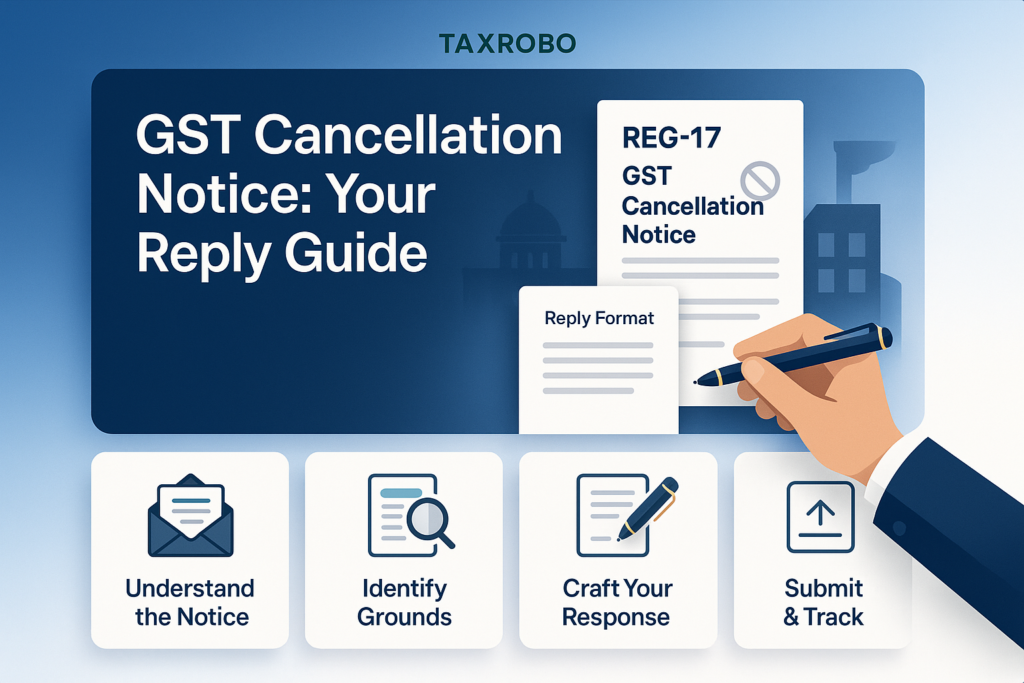
Step 1: Analyze the Notice Carefully
The moment you receive the REG-17 notice, the first step is to avoid panic. Read the document thoroughly to understand the specific reason cited by the officer for the proposed cancellation. The notice will clearly state the grounds, such as “non-filing of returns for 6 consecutive months.” It is crucial to note down the Show Cause Notice (SCN) reference number, the date of issuance, and, most importantly, the deadline for submitting your reply. This information is vital for referencing in your response and ensuring timely submission. A clear understanding of the exact charge against you is the foundational step in responding to GST cancellation notice India and formulating a logical and persuasive argument.
Step 2: Clear All Pending Dues and File Returns
Before you even begin to draft your reply, you must take immediate and decisive corrective action. This is the most important step in the entire process, as your words will carry no weight with the tax officer if they are not backed by action. The department is primarily concerned with compliance, and demonstrating it is your best defense.
- File All Pending Returns: Log in to the GST Portal and file all pending GSTR-1 and GSTR-3B returns. If your business had no transactions, you must file ‘Nil’ returns for each of the missed periods. This action rectifies the core issue that triggered the notice.
- Pay All Dues: The non-filing of returns will have automatically resulted in the accumulation of late fees and interest. You must pay these dues in full. The GST portal will automatically calculate the liability, and you can pay it using the electronic cash ledger.
Your reply will be considered weak and may be rejected if you have not first rectified the fundamental non-compliance. The officer needs to see that you have fulfilled your statutory obligations before they can consider dropping the cancellation proceedings.
- External Link: Access the official portal to complete these actions here: GST Portal
Step 3: Draft Your Reply in Form GST REG-18
The official and mandated response to a REG-17 notice must be submitted online through the GST portal in Form GST REG-18. This form is specifically designed for replying to a Show Cause Notice for cancellation. Your reply should be clear, concise, professional, and respectful in tone. It must directly address the reason mentioned in the notice, state the genuine reasons for your previous non-compliance, and, most importantly, confirm that all necessary corrective actions have now been completed. This formal reply serves as your official statement on the matter and is the primary document the officer will review to make a decision.
The Official Format for Your GST Cancellation Notice Reply (Form GST REG-18)
Using the correct GST cancellation notice reply format is crucial for ensuring your response is taken seriously and processed efficiently. A well-structured reply demonstrates professionalism and makes it easier for the tax officer to understand your position and the corrective measures you have undertaken. Your reply in Form GST REG-18 should be organized logically and address all the points raised in the notice to leave no room for ambiguity.
Key Components of the Reply Format
Your online submission in Form GST REG-18 should be comprehensive and contain the following essential elements:
- Reference to the Notice: Always begin by clearly mentioning the Show Cause Notice (SCN) number and date from the REG-17 notice. This immediately connects your reply to the specific case file.
- Reason for Non-Compliance: Provide a genuine and honest reason for the delay in filing returns. For a non-functioning business, you can state that the business was non-operational, and you were unaware of or had overlooked the legal requirement to file ‘Nil’ returns. Avoid making excuses and take responsibility for the oversight.
- Details of Corrective Action: This is the core of your defense. Explicitly state that all pending returns have been filed from the first defaulting period to the current date and that all dues, including late fees and interest, have been paid. It is highly recommended to mention the ARN (Application Reference Number) for the last filed return as concrete proof of your compliance.
- Request to Drop Proceedings: Conclude your reply with a formal and polite request for the officer to drop the cancellation proceedings initiated against your GSTIN. You should also provide an assurance of timely compliance in the future.
- Supporting Documents: The portal allows you to attach supporting documents. You should upload proof of your corrective actions, such as copies of the tax payment challans (Form PMT-06) and acknowledgments of the filed returns (GSTR-3B).
Sample Format for Replying GST Cancellation Notice
Here is a template you can adapt for your reply in the text box on the GST portal when filing Form GST REG-18:
—
To,
The Proper Officer,
[Jurisdiction/Address as mentioned in the notice]
Reference No: [SCN Number from REG-17]
Date of Notice: [Date of REG-17 Notice]
GSTIN: [Your GSTIN]
Legal Name: [Your Business Name]
Subject: Reply to Show Cause Notice for Cancellation of GST Registration (Form GST REG-17)
Respected Sir/Madam,
This is with reference to the Show Cause Notice received on [Date of Notice], proposing the cancellation of our GST registration for the reason of [Mention reason from the notice, e.g., “non-filing of returns for 6 consecutive months”].
We sincerely acknowledge the delay in filing our GST returns. The default was completely unintentional and occurred because our business has been non-operational since [Mention Date/Month, Year] due to [mention a brief reason like “market conditions” or “exploring new ventures”]. Due to an oversight on our part, we failed to file the mandatory ‘Nil’ returns on time as required under GST law.
We wish to inform you that we have taken immediate corrective action to rectify this non-compliance upon receiving the notice. All pending GST returns from [Start Period] to [End Period] have now been successfully filed, and all associated late fees and interest have been paid in full. The ARN for our last filed return is [Mention last GSTR-3B ARN]. Copies of the filed returns and payment challans are attached for your kind perusal.
We deeply regret the inconvenience caused and request you to kindly accept our explanation and the corrective actions taken. We humbly request that you drop the proceedings initiated for the cancellation of our GST registration. We assure you of our complete and timely compliance with all GST regulations in the future.
Thank you for your understanding.
Sincerely,
[Your Name/Authorized Signatory]
[Designation]
[Business Name]
—
How to Submit the Reply on the GST Portal
- Log in to the GST Portal using your credentials.
- Navigate to Services > User Services > View Notices and Orders.
- Find the relevant notice by its Reference ID and click on it to view the details.
- In the notice details page, click on the ‘REPLY’ button.
- You will be directed to Form GST REG-18. Fill in your detailed reply in the text box provided, following the format above.
- Click on ‘Choose File’ to upload your supporting documents (e.g., PDF of payment challans).
- Submit the reply using a Digital Signature Certificate (DSC) for companies/LLPs or through E-Verification (EVC) with an OTP for other taxpayers.
What Happens After You Submit the Reply?
Once you have submitted your reply in Form GST REG-18, the GST officer assigned to your case will review your explanation, the corrective actions taken, and the supporting documents provided. The outcome will depend entirely on whether the officer is satisfied that you have rectified the default and are serious about future compliance. There are two possible outcomes based on the official GST cancellation procedures for businesses:
Scenario 1: The Officer is Satisfied
If the officer finds your reply satisfactory and verifies that all pending returns have been filed and all dues have been cleared, they will accept your explanation. In this favorable outcome, the officer will issue an order in Form GST REG-20. This order officially drops the cancellation proceedings, and your GSTIN will remain active and valid. This is the ideal result, as it restores your compliance status without any disruption to your registration. You will receive a notification via email and SMS once the order is issued.
Scenario 2: The Officer is Not Satisfied
If the officer is not convinced by your reply, or if you have failed to take complete corrective action (e.g., some returns are still pending or dues are unpaid), they will reject your explanation. In this scenario, the officer will proceed with the cancellation and issue a final cancellation order in Form GST REG-19. This order will state the effective date of cancellation. If this happens, your GSTIN becomes inactive, and you can no longer conduct business under it. However, you still have a recourse: you can apply for the Revocation of Cancellation in Form GST REG-21 within 30 days of the date of the cancellation order.
Conclusion
Receiving a GST cancellation notice can be daunting, but it is a manageable issue if you act promptly and correctly. The key is to not ignore the notice. You must immediately clear all your pending compliance obligations, file all returns, pay any outstanding dues, and then submit a well-structured and polite GST cancellation notice reply in Form REG-18. By demonstrating to the tax authorities that you have rectified the issue and are committed to future compliance, you stand a very strong chance of having the cancellation proceedings dropped.
Navigating the nuances of the GST cancellation process India can be complex, especially when you are trying to manage other aspects of your business. If you find the process overwhelming or need expert assistance to ensure your reply is perfect, TaxRobo is here to help. Our team of tax experts can manage your GST compliance, respond to notices on your behalf, and ensure your business remains compliant and in good standing with the law, even when it is inactive. Contact us today for professional guidance and peace of mind.
Frequently Asked Questions (FAQs)
1. What if I miss the deadline to reply to the GST cancellation notice?
If you fail to reply within the specified time (usually 7 working days), the tax officer is empowered to proceed with the cancellation ex-parte. This means they will make a decision based on the information they have, without your response. In almost all such cases, your GSTIN will be cancelled. Once cancelled, you cannot issue GST invoices or claim input tax credit. Your only recourse would be to go through the more complicated and time-consuming process of applying for Revocation of Cancellation.
2. I want to close my business anyway. Should I still reply to the REG-17 notice?
Yes, you absolutely should. The proper procedure for closing a business is to first clear all liabilities and file all pending returns up to the date you ceased operations. In your reply to the REG-17 notice, you can state that the business is closed and that you consent to the cancellation. This ensures a clean and compliant exit. An even better approach is to follow the GST Registration Cancellation – Step-by-Step Guide & Practical Issues and file for cancellation yourself in Form GST REG-16 after clearing all dues. Simply ignoring the notice will lead to a cancellation due to non-compliance, which reflects poorly on your record.
3. Do I need a professional to draft the GST cancellation notice reply?
While you can use a standard GST cancellation notice reply format and file the reply yourself, consulting a professional like TaxRobo is highly recommended. A tax expert can ensure that your reply is legally sound, all procedural requirements are met perfectly, and your arguments are presented in the most effective way. They can also guide you in calculating the exact late fees and interest, ensuring there are no errors. Using a professional maximizes your chances of getting a favorable order from the officer.
4. Can my GST registration be cancelled even if I have no tax liability?
Absolutely. The Goods and Services Tax Act mandates that every registered person must file returns for every tax period, regardless of whether there was any business activity or tax liability. The filing of a ‘Nil’ return is a statutory obligation. It informs the government that you had no transactions during the period. Non-filing of ‘Nil’ returns for six consecutive months is treated as a serious violation and is one of the most common grounds for cancellation. This highlights that GST compliance for inactive businesses is mandatory until the registration is officially surrendered or cancelled through the proper channels.