
GST DRC-03 Payment During Investigation – When & How to Pay
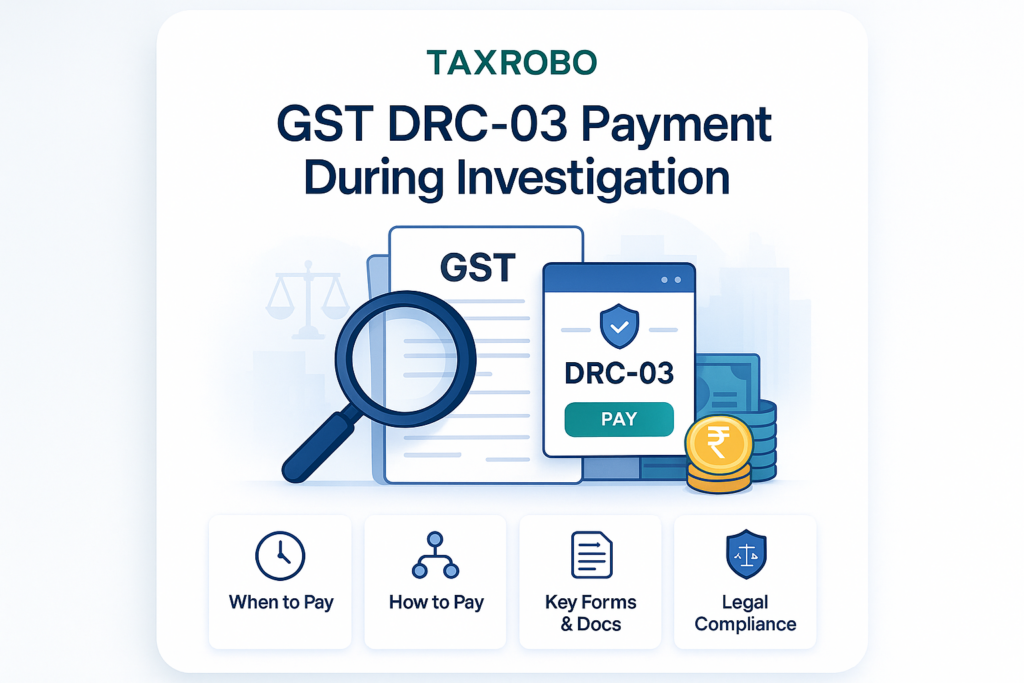
Receiving a notice from the GST department can be stressful for any business owner. But what if you find a discrepancy yourself during an audit or investigation? This is where Form DRC-03 comes in. This form is a challan used for making a voluntary payment of outstanding GST liability, and a timely GST DRC-03 payment can be a powerful tool to manage your tax obligations proactively. Understanding this process is crucial, especially when you are under scrutiny from the tax authorities, as it can significantly mitigate penalties and ensure compliance. This post will serve as your comprehensive GST DRC-03 payment guide India, breaking down everything you need to know.
What is Form GST DRC-03 and Why is it Used?
Form GST DRC-03 is not a demand notice from the tax department; instead, it is a form that you, the taxpayer, use to voluntarily pay any tax, interest, or penalty that you have identified. This proactive step demonstrates your intent to comply with the law. It allows you to settle a tax shortfall before the authorities issue a formal Show Cause Notice (SCN), which often comes with higher penalties and more complex legal proceedings. Think of it as a way to self-correct a mistake regarding your tax liability. The payment can be made for any shortfall related to an audit, an ongoing investigation, or even a self-discovered error during your internal reconciliation. The key characteristic of this form is its voluntary nature, putting you in control of the compliance process.
The Legal Basis: Section 73(5) & Section 74(5)
The power to make these voluntary payments is rooted in the Central Goods and Services Tax (CGST) Act, 2017. Two key sections govern this process, differing based on the taxpayer’s intent.
- Section 73(5): This section applies to cases where there is no fraud, willful misstatement, or suppression of facts to evade tax. If you discover an error (like an incorrect HSN code or a miscalculation) and pay the tax and applicable interest using DRC-03 before a notice is issued, the law states that no penalty shall be levied. This is a significant incentive for honest taxpayers to self-correct.
- Section 74(5): This section deals with more serious cases involving fraud, willful misstatement, or suppression of facts. Even in such scenarios, if you pay the due tax, interest, and a reduced penalty of 15% of the tax amount before a notice is issued, all further proceedings against you for that matter can be concluded.
Key Scenarios for Making a GST DRC-03 Payment
The use of Form DRC-03 is not limited to a single situation. It is a versatile tool for various compliance scenarios. Here are the most common instances where you would make a GST DRC-03 payment:
- During an audit, investigation, or inquiry: If tax officers visit your premises or summon you for an inquiry and point out a tax shortfall, you can use DRC-03 to pay the admitted liability.
- Before a Show Cause Notice (SCN) is issued: This is the most beneficial time to pay. As discussed under Sections 73(5) and 74(5), paying before a formal notice can lead to a waiver or a significant reduction in penalties.
- After an SCN is issued: You can still use DRC-03 to pay the liability after receiving a notice but before the final order is passed. However, the penalty benefits are lower at this stage.
- For miscellaneous liability: If your internal audit or reconciliation process reveals any unpaid tax, you can use DRC-03 to clear this liability and ensure your books are clean.
The Critical Question: When to Pay GST DRC-03 India During an Investigation?
The timing of your payment is arguably the most critical factor during an investigation, as it directly impacts the financial penalty you might face. Knowing when to pay GST DRC-03 India can save your business a considerable amount of money and legal trouble. The decision hinges on whether a Show Cause Notice (SCN) has been issued by the tax authorities. The GST framework provides strong incentives for early and voluntary compliance, making it crucial to act swiftly once a liability has been identified and confirmed. Delays can lead to a cascading effect of higher penalties and more rigorous scrutiny from the department.
Payment Before a Show Cause Notice (SCN)
This is the golden window of opportunity for any taxpayer. If you or the tax officer identifies a tax shortfall during an investigation and you agree with the liability, making the payment via DRC-03 before an SCN is issued is the most advantageous course of action. The primary benefit is the potential for significantly reduced or even completely waived penalties. In non-fraudulent cases (Section 73), paying the tax and interest concludes the matter without any penalty. In cases involving fraud (Section 74), the penalty is capped at a much lower rate (15%) compared to the higher penalties (up to 100%) that can be imposed after the proceedings advance.
Payment After an SCN is Issued
While not as beneficial as a pre-SCN payment, you still have the option to use Form DRC-03 after receiving a Show Cause Notice. If you pay the tax and interest within 30 days of the SCN being issued, the penalty amount is often reduced. For instance, in fraud cases under Section 74, the penalty might be reduced to 25% of the tax amount if paid within this 30-day window. While you miss out on the maximum benefit, this is still a better alternative than letting the case proceed to a final order, which could attract even steeper penalties. The key is to assess the situation quickly and act decisively.
A Common Concern: Is Payment an Admission of Guilt?
This is a valid and frequent concern among business owners. Paying a tax liability, especially during an investigation, can feel like an admission of wrongdoing. However, the GST portal provides a specific option to address this. When filing Form DRC-03, you can choose to make the payment “under protest.” Selecting this option signifies that you are depositing the amount to comply with the legal process but you do not agree with the department’s assessment of the liability. This action preserves your right to contest the matter and file an appeal at a later stage. If you are disputing the tax liability calculated by the officer, it is highly advisable to consult a tax professional before making a payment, even under protest, to understand the full legal implications.
A Step-by-Step Guide: How to Make GST DRC-03 Payment Online
The process of filing and making a payment through Form DRC-03 is entirely online via the GST portal. It is designed to be straightforward, but it requires careful attention to detail to ensure accuracy. Following a clear procedure can prevent errors and ensure your payment is correctly recorded against your liability. This section will walk you through how to make GST DRC-03 payment from start to finish.
Prerequisites for Filing
Before you begin the process, make sure you have the following information and access ready:
- Valid GSTIN: You must have your active Goods and Services Tax Identification Number.
- Login Credentials: You will need your username and password for the official GST portal.
- Liability Details: Have a clear breakdown of the amount you need to pay. This includes the specific amounts for tax (broken down by CGST, SGST/UTGST, IGST), interest, and any applicable penalty.
- Sufficient Ledger Balance: Ensure you have an adequate balance in your Electronic Cash Ledger or Electronic Credit Ledger to cover the payment.
The Online GST DRC-03 Payment Process India
Follow these steps carefully on the official GST portal to complete your payment:
- Login: First, access the official GST Portal at https://www.gst.gov.in/ and log in with your credentials.
- Navigate: On your dashboard, navigate to the following path: Services > User Services > My Applications.
- Select Application Type: On the “My Applications” page, select “Intimation of Voluntary Payment – DRC-03” from the “Application Type” dropdown menu and then click on “New Application”.
- Cause of Payment: The system will ask you to specify the reason for the payment. From the dropdown menu under “Cause of payment”, select “Investigation”. You will also need to enter the relevant financial year for which the liability pertains.
- Enter Liability Details: This is the most crucial step. You must carefully fill in the tax period and the specific amounts for IGST, CGST, SGST/UTGST, Cess, Interest, and Penalty in the provided table. Double-check these figures for accuracy before proceeding.
- Make the Payment: The portal will prompt you to proceed with the payment. Here, you will see the balances in your Electronic Cash Ledger and Electronic Credit Ledger. You can use a combination of both to settle the liability.
- Crucial Note: It is extremely important to remember that the Input Tax Credit (ITC) available in your Electronic Credit Ledger can only be used to pay the “tax” component of the liability. Any amount due towards interest, penalty, or fees must be paid using the balance from your Electronic Cash Ledger. If your cash ledger has insufficient funds, you will need to create a challan (Form PMT-06) and add money to it first.
- File and Submit: After you have set off the liability using your ledgers, you can preview the form to verify all details. Once satisfied, you must file the form using either a Digital Signature Certificate (DSC) for companies and LLPs or an Electronic Verification Code (EVC) for other taxpayers.
- Get ARN: Upon successful submission, an Application Reference Number (ARN) will be generated. You should save this number for your records and for future correspondence with the tax department.
Post-Payment Formalities: What Happens Next?
Making the payment is a significant step, but it is not the final one. There are subsequent procedures that both you and the tax officer must follow to bring the matter to a formal conclusion. Understanding these post-payment steps will help you manage your expectations and ensure that the proceedings are properly closed. The goal is to receive official confirmation that your liability has been settled to the satisfaction of the department.
Officer’s Acknowledgment in Form DRC-04
After you file Form DRC-03, the proper tax officer will review your application and the payment details. Once the officer has verified that the payment is correct and corresponds to the identified liability, they are required to issue an acknowledgment. This official acknowledgment comes in the form of Form GST DRC-04. This document serves as proof that the department has received and accepted your voluntary payment. It is a critical piece of documentation for your records, as it formally confirms the receipt of the amount you have paid.
Does Payment Guarantee Closure of Proceedings?
This is a key question that business owners often have. While making a voluntary payment is a huge step towards closing an investigation, it does not offer an automatic guarantee. The tax officer will thoroughly verify if the amount you have paid covers the entire liability, including all applicable interest, for the period under investigation. If the officer finds that the paid amount is correct and there are no other outstanding dues for the matter, they will not issue a Show Cause Notice and will conclude the proceedings by issuing an order. However, if there is a shortfall—meaning you have paid less than the actual liability calculated by the officer—the department may continue the proceedings for the remaining amount. Therefore, ensuring a full and correct GST DRC-03 payment is essential to achieving a final closure.
Conclusion
Navigating a GST investigation requires a proactive and informed approach. Form DRC-03 serves as an invaluable tool for businesses to voluntarily settle their tax liabilities, demonstrating good faith and a commitment to compliance. To recap the key takeaways, remember that Form DRC-03 is for voluntary payments, not a response to a demand. Paying early, especially before a Show Cause Notice is issued, can save you from substantial penalties. While the online process is user-friendly, it demands meticulous attention to detail, particularly when allocating payments from the cash and credit ledgers.
Making a well-timed and accurate GST DRC-03 payment can make a significant difference in the outcome of an investigation, turning a potentially stressful situation into a manageable compliance activity. By understanding the when, why, and how of this process, you can protect your business from unnecessary financial strain and legal complications.
Are you facing a GST inquiry and unsure about the next steps? Don’t leave it to chance. Contact the experts at TaxRobo GST Service today for professional guidance on your GST DRC-03 payment and ensure full compliance with confidence.
Frequently Asked Questions (FAQs)
Q1: Can I use my Input Tax Credit (ITC) to make the entire GST DRC-03 payment?
A: No. You can only use the balance in your Electronic Credit Ledger (ITC) to pay the tax liability component (e.g., CGST, SGST, IGST). Any amount payable towards interest, penalty, or late fees must be paid from your Electronic Cash Ledger.
Q2: Is it mandatory to pay via DRC-03 if a tax officer points out a liability during an investigation?
A: The payment is “voluntary.” This means you are not forced to pay on the spot. However, if the liability is confirmed and undisputed, paying it voluntarily through DRC-03 before a notice is issued is a highly recommended step. It helps in significantly reducing or even waiving the penalty as per the provisions of the GST Act.
Q3: What does it mean to pay ‘under protest’ in DRC-03?
A: Paying ‘under protest’ is an option you can select in the form. It signifies that you are making the payment to comply with the ongoing process but you do not agree with the department’s calculation or interpretation of the liability. This action reserves your right to dispute and appeal the matter before a higher authority at a later date.
Q4: What happens if I don’t file DRC-03 after identifying a shortfall?
A: If a tax shortfall is identified and you choose not to pay it voluntarily using Form DRC-03, the tax officer will proceed with issuing a formal Show Cause Notice (SCN). This will be followed by a demand order confirming the tax, interest, and a much higher penalty. Proactively using DRC-03 is always a more favorable and cost-effective approach to compliance.