
Fake ITC Cases in GST – Latest Rules, Penalties & Defence Strategy
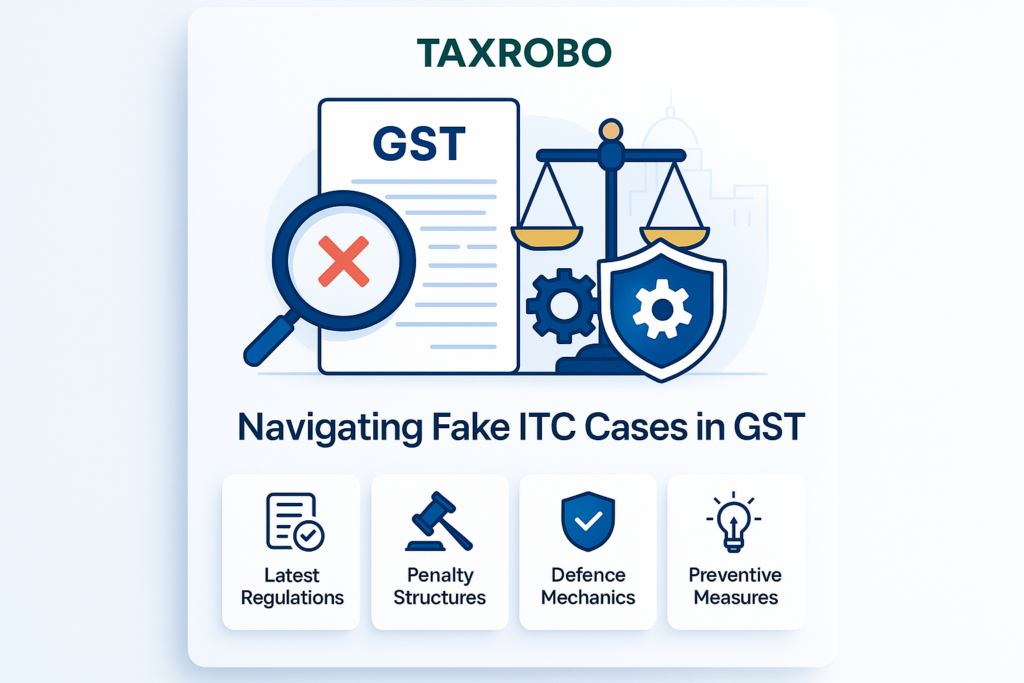
The Indian government has intensified its crackdown on GST fraud, with thousands of crores in fake Input Tax Credit (ITC) detected. For an honest small business owner, getting caught in this net can be a nightmare. The rise in fake ITC cases has put every business under scrutiny, making compliance more critical than ever. Input Tax Credit, in simple terms, is the credit businesses receive for the GST they pay on their inputs (like raw materials, services, etc.), which they can then use to reduce their final tax liability to the government. This system is the backbone of GST, designed to prevent the cascading effect of taxes. However, this very system is being exploited through fraudulent schemes where businesses claim ITC on invoices without any actual supply of goods or services. This article will serve as your comprehensive guide to understanding fake ITC cases, the latest rules on fake ITC in India, the severe penalties involved, and most importantly, a robust defence strategy against ITC fraud.
What Exactly Constitutes Fake ITC Cases in India?
To build a defence, you first need to understand what the authorities consider a fraudulent claim. Fake ITC cases are not always straightforward; they can arise from complex schemes or even unintentional oversights. Understanding these common fraudulent patterns is the first step towards ensuring robust GST fake ITC compliance in India. Typically, fraudulent claims fall into these common categories.
Invoices Without Actual Supply of Goods or Services
This is the most prevalent and blatant form of ITC fraud. In this scenario, one business issues a GST-compliant tax invoice to another business, but no goods or services are ever actually delivered or rendered. The receiving entity, armed with this fake invoice, proceeds to claim Input Tax Credit from the government, effectively stealing from the exchequer. The supplier in this arrangement often only exists on paper and vanishes after issuing a series of such invoices. For the recipient, this might seem like an easy way to reduce tax outflow, but it’s a direct path to severe legal repercussions, as the foundational requirement for claiming ITC—the actual receipt of goods or services—is absent.
Invoices from Non-Existent or Fake Firms
This method involves the creation of shell companies or “paper firms” that exist only to perpetrate fraud. These entities are registered under GST using forged documents or by exploiting the identities of unsuspecting individuals. Their sole business activity is to generate fake invoices and pass on fraudulent ITC to other businesses for a commission. These firms have no real office, no employees, and conduct no legitimate business. The GST department uses advanced data analytics to identify such entities by looking for red flags like multiple registrations at a single address, disproportionately high ITC claims compared to declared turnover, and a lack of corresponding e-way bills. Before engaging with any new supplier, it is crucial to verify their authenticity and GST registration status on the official GST portal. For new businesses, understanding the Ultimate Guide to GST Registration for Small Businesses is a foundational step in ensuring compliance from the start.
Circular Trading Fraud
Circular trading is a more sophisticated form of fraud involving a network of businesses. In this scheme, a group of companies collaborates to issue invoices to one another in a circular manner without any corresponding movement of goods or services. For example, Company A issues an invoice to Company B, B to C, C to D, and finally, D back to A. This chain of transactions artificially inflates the turnover for all participating companies, making them appear legitimate and high-volume businesses. At each stage of this fake supply chain, the companies wrongfully claim Input Tax Credit. This not only results in a loss of revenue for the government but can also be used for money laundering or to secure higher credit limits from banks based on inflated turnover figures.
Claiming ITC on Ineligible Goods/Services
Not all GST paid on inputs is eligible for ITC. Section 17(5) of the CGST Act, often called the “blocked credits” section, specifies a list of goods and services on which ITC cannot be claimed. Claiming credit on these items, knowingly or unknowingly, can lead to a notice from the tax department. Common examples include:
- Goods or services used for personal consumption.
- Motor vehicles for transportation of persons with a seating capacity of 13 or less (including the driver), except when used for specific purposes like further supply, passenger transport, or training.
- Food, beverages, outdoor catering, beauty treatments, and health services, unless used for making an outward taxable supply of the same category.
- Works contract services when supplied for the construction of an immovable property (other than plant and machinery).
Latest Rules and Legal Provisions for Fake ITC in India
Staying updated with GST law is crucial for GST fake ITC compliance in India. The government, in its continuous effort to plug leakages and combat fraud, has introduced several stringent measures and reinforced existing legal provisions to curb this menace. These rules place a significant onus on the taxpayer to ensure the legitimacy of every transaction.
Core Conditions under Section 16 of the CGST Act
This section is the foundation of ITC eligibility. Before even considering claiming ITC, a business must satisfy all four of the following conditions. Failure to meet even one condition can render the entire claim invalid and attract scrutiny from tax authorities.
- Possession of a Valid Tax Invoice: You must have a proper tax invoice, debit note, or other prescribed tax-paying document issued by your supplier.
- Receipt of Goods or Services: You must have actually received the goods or services. This is a critical point in fake ITC cases, as paper transactions without actual delivery are illegal.
- Tax Paid by Supplier: The tax charged on your purchase invoice must have been actually paid to the government by your supplier, either in cash or through their own eligible ITC.
- Filing of Return: You must have filed your own GST return (Form GSTR-3B) for the relevant tax period.
Rule 86A: Power to Block ITC
Introduced as a powerful anti-evasion tool, Rule 86A gives tax officers of the rank of Assistant Commissioner and above the authority to block a taxpayer’s electronic credit ledger. This drastic measure can be taken if the officer has “reasons to believe” that the ITC has been fraudulently availed or is ineligible. This could be due to invoices from non-existent suppliers or situations where goods or services were never received. Once blocked, the taxpayer cannot use the balance ITC to pay their output tax liability, severely impacting their cash flow until the investigation is complete.
Rule 86B: Restriction on Using ITC for Discharge of Liability
This rule targets large-scale businesses to ensure they contribute a minimum amount of their tax liability in cash. Rule 86B restricts the use of ITC for discharging output tax liability to 99% for registered persons whose monthly taxable turnover (excluding exempt and zero-rated supplies) exceeds ₹50 lakhs. This means they must pay at least 1% of their tax liability in cash. However, this rule does not apply if the proprietor, partner, or director has paid more than ₹1 lakh as income tax in the preceding two financial years or if the business has received a refund of more than ₹1 lakh on account of zero-rated supplies.
Actionable Tip: Always reconcile your GSTR-2B with your purchase register before filing your GSTR-3B. GSTR-2B is a static statement that clearly shows the eligible ITC available to you for a particular month, helping you avoid claiming credit based on a supplier’s non-filed or improperly filed returns.
Severe Penalties & Consequences of Fake ITC Claims in GST
The consequences of fake ITC claims in GST extend far beyond simple tax recovery. They are designed to be a strong deterrent and can lead to severe financial distress, business disruption, and even imprisonment. Understanding fake ITC penalties in India is the first step toward appreciating the gravity of non-compliance and the importance of maintaining a clean record.
Heavy Monetary Penalties
Under Section 122 of the CGST Act, if a taxpayer fraudulently claims ITC, they are liable to pay a penalty equivalent to 100% of the tax amount involved or ₹10,000, whichever is higher. This means that in addition to repaying the entire wrongfully claimed ITC amount, you will have to pay an equal amount as a penalty, effectively doubling your liability. This penalty applies not only to the person claiming the fake ITC but also to those who aid or abet in the fraud, such as the issuer of the fake invoice.
Interest on Wrongfully Claimed ITC
The financial burden doesn’t stop at the penalty. As per Section 50 of the CGST Act, interest is levied on the wrongfully availed and utilized ITC. The interest is calculated from the date the ITC was wrongfully utilized until the date the amount is paid back to the government. The rate of interest can be as high as 24% per annum, which can accumulate into a substantial sum, especially if the fraud is detected after a long period. This provision ensures that the government is compensated for the delay in receiving its due revenue.
Prosecution and Arrest Provisions (Section 69 & 132)
For significant fraud, the consequences become criminal. Section 132 classifies wrongfully availing ITC as a cognizable and non-bailable offense if the amount exceeds ₹5 crores. This gives tax authorities, under Section 69, the power to arrest the individuals involved. The monetary thresholds for imprisonment are tiered:
- Fraud above ₹5 crore: Imprisonment for a term which may extend to 5 years and a fine. This is a non-bailable offence.
- Fraud between ₹2 crore and ₹5 crore: Imprisonment for a term which may extend to 3 years and a fine.
- Fraud between ₹1 crore and ₹2 crore: Imprisonment for a term which may extend to 1 year and a fine.
These stringent measures are detailed under Section 74 of the CGST Act: Dealing with GST Demand Notices Involving Fraud, which specifically covers cases involving willful misstatement or suppression of facts.
Provisional Attachment of Assets
During fake ITC investigations in India, tax authorities can invoke Section 83 of the CGST Act. This section empowers the Commissioner to order the provisional attachment of any property belonging to the taxable person, including their bank accounts. This is done to protect the interests of government revenue, ensuring that funds are available for recovery once the demand is confirmed. An attachment of a bank account can paralyze a business’s operations, making it impossible to pay salaries, suppliers, or other operational expenses.
How to Handle Fake ITC in GST: A Practical Defence Strategy
Receiving a notice from the GST department can be an incredibly stressful experience. However, panic is counterproductive. A systematic, calm, and evidence-based approach can help you build a strong case and prove the genuineness of your transactions. Here’s a practical defence strategy against ITC fraud that every business owner should know and implement proactively.
Step 1: Proactive Due Diligence on Suppliers
The first line of defence is prevention. You must treat every new supplier relationship with a healthy dose of skepticism and conduct thorough due diligence before engaging in any transaction. This minimizes the risk of inadvertently dealing with a fraudulent entity.
- Verify GSTIN: Always verify the GST Identification Number (GSTIN) of every new supplier on the official GST Portal. This simple check confirms if the registration is active and belongs to the entity you are dealing with.
- Check Compliance History: The portal also allows you to see a taxpayer’s return filing status. Avoid suppliers who are consistently non-compliant with their GSTR-1 and GSTR-3B filings, as their failure to pay tax will directly impact your ability to claim ITC.
- Physical Verification: For high-value transactions or new, unproven suppliers, consider conducting a physical verification of their registered business premises. This helps confirm that they are not just a “paper firm.”
- Written Agreements: Always have a formal, written agreement or contract in place that clearly outlines the goods or services to be supplied, payment terms, and GST compliance responsibilities.
Step 2: Meticulous Record-Keeping
When an investigation begins, your documentation becomes your most valuable asset. The burden of proof to establish the genuineness of a transaction lies squarely on the taxpayer claiming the ITC. Meticulous and organized record-keeping is non-negotiable. In fact, understanding The Importance of Accurate Record-Keeping to Prevent GST Demand Notices is a cornerstone of any effective defense strategy.
- Valid Tax Invoices: Ensure every invoice complies with the requirements of Rule 46 of the CGST Rules, containing all mandatory details like GSTIN of both parties, HSN code, place of supply, etc.
- E-way Bills: For the movement of goods exceeding ₹50,000 in value, a valid E-way bill is mandatory. This is a crucial piece of evidence proving that goods were actually transported.
- Proof of Delivery: Maintain delivery challans, lorry receipts, or signed proof of delivery (POD) documents. For services, keep service completion certificates or correspondence proving the service was rendered.
- Proof of Payment: All payments to suppliers should be made through banking channels. Maintain bank statements that clearly show the payment made against a specific invoice. Avoid large cash transactions.
- Goods Receipt Notes (GRN): Implement a system of creating Goods Receipt Notes in your warehouse or store for every consignment received. This internal document serves as strong evidence of the actual receipt of goods.
Step 3: Responding to a GST Department Notice
If you receive a summons or notice, how you respond in the initial stages is critical.
- Do Not Ignore It: The worst thing you can do is ignore a notice. This will only lead to adverse orders being passed against you.
- Consult a Professional: Immediately seek the advice of a seasoned GST professional or a reputable firm like TaxRobo. They can interpret the notice correctly, understand the allegations, and guide you on the appropriate legal course of action.
- Prepare a Factual Reply: Work with your consultant to prepare a detailed, point-by-point reply to the notice. Back up every claim with the supporting documentary evidence you have meticulously maintained.
Step 4: Proving the Genuineness of the Transaction
The ultimate goal of your defence is to prove that a genuine business transaction occurred. It’s not enough to just have an invoice and a bank payment entry. You must build a complete narrative. Use the documents listed in Step 2 to demonstrate the entire lifecycle of the transaction: the purchase order was raised, the supplier generated an e-way bill, the goods were transported, they were received at your premises (evidenced by a GRN), and finally, payment was made against the invoice through the bank. This chain of evidence makes it difficult for authorities to allege that the transaction was merely a paper entry.
Are you facing a notice for a fake ITC case? The stakes are too high to navigate alone. The expert team at TaxRobo specializes in GST litigation and compliance. Contact us today for a consultation and build a robust defence strategy.
Conclusion: Staying Compliant in the Fight Against Fake ITC Cases
The crackdown on fake ITC cases is not a temporary drive; it is a permanent feature of the GST regime, powered by advanced data analytics and inter-departmental information sharing. The message from the government is loud and clear: non-compliance will have severe consequences. For honest business owners, the key takeaway is the paramount importance of supplier verification, meticulous documentation, and a proactive approach to compliance. The penalties for being involved in fake ITC schemes, even unintentionally, are harsh enough to cripple a thriving business.
In this stringent regulatory environment, proactive compliance is not just a legal obligation; it’s a critical business survival strategy. It involves more than just filing returns on time; it requires a robust internal system for vetting suppliers and maintaining an impeccable audit trail for every single transaction. By implementing these best practices, you can safeguard your business from the enormous risks associated with fake ITC cases and focus on what you do best – growing your business with peace of mind.
Frequently Asked Questions (FAQs)
1. Can I be penalized if my supplier didn’t pay GST to the government, even if my transaction was genuine?
Answer: Yes. As per Section 16(2)(c) of the CGST Act, one of the fundamental conditions for claiming ITC is that the tax charged on the supply has been actually paid to the government by the supplier. If your supplier collects GST from you but fails to deposit it, the tax authorities can reverse the ITC you have claimed. This is precisely why regular supplier compliance checks and thorough GSTR-2B reconciliation are critical to protect your business.
2. What is the first thing I should do if I receive a GST notice about a potential fake ITC case?
Answer: Do not panic or ignore the notice. The first step is to carefully read the notice to understand the specific transaction(s) being questioned. Immediately collate all related documents, including the tax invoice, e-way bill, delivery challan, proof of payment (bank statement), and any related contracts or correspondence. Most importantly, consult with a qualified tax professional immediately. They can help you understand the legal implications and draft a legally sound, fact-based response within the stipulated time.
3. How can I check if a supplier’s GSTIN is active and genuine?
Answer: You can easily verify any GSTIN on the official GST Portal for free. Visit the portal and navigate to ‘Search Taxpayer’ > ‘Search by GSTIN/UIN’. Enter the supplier’s GSTIN, and the system will show you the legal name of the business, date of registration, business constitution, and, most importantly, whether the registration is ‘Active’ or ‘Cancelled’. You can access this service directly here: https://services.gst.gov.in/services/searchtp.
4. What is the difference between GSTR-2A and GSTR-2B for ITC verification?
Answer: GSTR-2A is a dynamic, real-time statement that gets updated every time a supplier files their GSTR-1 or uses the Invoice Furnishing Facility (IFF). GSTR-2B, on the other hand, is a static, auto-drafted statement that is generated once a month, after the due date for filing GSTR-1 has passed. For claiming ITC, you should always rely on GSTR-2B. It provides a stable and clear summary of the eligible and ineligible ITC available to you for a specific tax period, preventing errors and ensuring compliance with the law.